
Home Depot is one of the most practical places to buy a patio garbage can because you can check dimensions in person, pick it up the same day, and return it within 90 days if it doesn't fit your space. If you need one specifically for a patio, search for a 'patio outdoor trash can' to find models sized and styled for decks and outdoor kitchens. For most patios, a 32- to 44-gallon resin or HDPE can with a latching lid is the sweet spot: big enough to hold a week of household waste, small enough to tuck beside a fence or grill station, and tough enough to handle sun, rain, and curious raccoons.
Patio Garbage Can Home Depot: Buyer's Guide & Sizing Tips

Miles Sutton
14 Jul 2026
Why buy your patio trash can from Home Depot
The main advantages are selection, same-day availability, and easy returns. Home Depot stocks a genuine range of outdoor-rated cans in-store and online, from Rubbermaid BRUTE workhorses to Suncast resin units designed specifically for patio aesthetics. The 90-day return window on most trash can listings (confirmed on the Suncast GH3900 product page and several BRUTE listings) means you're not stuck with something that looks wrong on your deck. You can also use curbside pickup to grab an order in about two hours without leaving your car, which is genuinely useful when you're mid-project and need the can today. For heavier or bulkier cart-style units, Home Depot's threshold and scheduled delivery options bring items closer to your door rather than dropping them at the curb.
That said, Home Depot isn't the only option. Lowe's carries many of the same models, sometimes at different price points. The Suncast 39-gallon resin can, for example, lists at $79.00 at Home Depot but has appeared at $108.25 on a Lowe's listing for a comparable model. Costco is worth checking for bulk or bundle deals, and their risk-free satisfaction guarantee is hard to beat, though in-store selection rotates seasonally. If local availability matters most to you, the 'near me' search strategies covered later will help. You can also search for a patio trash can near me to find nearby stores and same-day pickup options. For the purposes of this guide, we're focused on Home Depot because their online filtering tools, in-store stock, and predictable return policies make the buying process the most straightforward.
Quick decision checklist before you buy
Before you open the Home Depot app or walk into the store, run through these five criteria. Skipping even one usually leads to a return trip.
- Capacity: Does the gallon size match your household size and pickup schedule? (See sizing guide below.)
- Material: Resin and HDPE handle UV and moisture the best outdoors. Metal looks sharp but rusts at seams without a powder-coat or stainless finish. Wood and composite look great in built-in enclosures but need annual sealing.
- Lid and pest-proofing: Does it have a latching lid? A locking mechanism? Will bears, raccoons, or dogs be an issue on your patio?
- Mobility: Do you need wheels or a dolly to roll it to the curb? What's the path from your patio to the street — steps, gravel, pavers?
- Weatherproofing: Is it rated for year-round outdoor use? UV inhibitors, drain holes, and a non-porous interior matter for longevity.
Sizing guide: how many gallons do you actually need
The EPA puts average per-capita solid waste generation at roughly 4.9 pounds per person per day. According to the EPA's 'National Overview: Facts and Figures on Materials, Wastes and Recycling,' national municipal solid waste generation averaged about 4.9 pounds per person per day (2018), which is useful as a baseline for household waste‑generation sizing National Overview: Facts and Figures on Materials, Wastes and Recycling | US EPA. A typical household of four generates around 19-20 pounds of trash daily, or about 130-140 pounds per week. In volume terms, that works out to roughly 30-45 gallons per week for a family of four with standard mixed waste, less if you compost food scraps or recycle aggressively. Use the table below as a quick reference, then adjust up if you entertain frequently or down if you're a committed recycler.
| Household Size | Entertaining Frequency | Pickup Schedule | Recommended Capacity |
|---|---|---|---|
| 1-2 people | Rarely | Weekly | 20-32 gallons |
| 2-3 people | Occasionally | Weekly | 32-39 gallons |
| 3-5 people | Regularly | Weekly | 44-55 gallons |
| 5+ people or rental | Frequently / parties | Weekly or twice-weekly | 55-65 gallons (or dual-bin setup) |
| Any size | Heavy summer entertaining | Weekly | Add a secondary 20-32 gal for overflow |
One practical rule of thumb: choose a can that holds at least 1.5 times your estimated weekly output. That buffer handles holiday weekends, delayed pickups, and the inevitable extra bag from a barbecue. On the Home Depot site, you can filter by 'capacity (gallons)' under outdoor trash cans to narrow the search quickly without clicking through dozens of listings.
Materials and how they hold up outdoors
This is probably the most important long-term decision, and it's worth spending a few minutes on before defaulting to whatever is cheapest in-store.
HDPE and resin (the reliable default)
Most outdoor patio cans at Home Depot, including the Rubbermaid BRUTE line and the Suncast GH3900, are made from high-density polyethylene (HDPE) or a closely related resin. UV-stabilized HDPE grades (the kind used in quality outdoor products) resist photodegradation, meaning they won't yellow, crack, or become brittle the way cheap plastics do after a few summers. Rubbermaid specifically advertises UV inhibitors in BRUTE product descriptions. In cold climates, UV-stabilized HDPE also maintains decent impact resistance down to low temperatures, reducing the chance of cracking when a full can tips over in January. The downside is aesthetics: most HDPE cans look utilitarian. If that bothers you, a resin unit like the Suncast GH3900 tends to have a more refined, faux-wood or textured exterior finish that fits better on a designed patio space.
Metal (galvanized steel and stainless)
Galvanized steel cans are durable and pest-resistant, but the seams and bottom edges are rust-prone on patios where water pools or sprinklers hit them regularly. Stainless steel is better but costs more and shows fingerprints and water spots constantly. If you want metal on your patio, look specifically for powder-coated finishes or all-stainless construction, not galvanized. Metal is also heavier to maneuver and can dent if tipped onto pavers.
Wood and composite (for built-in enclosures)
Cedar, teak, and composite lumber are great for built-in trash enclosures that house a plastic liner can, but they're not ideal as the can itself. They absorb moisture, stain from leaks, and need sealing or staining every one to two years to stay looking good. If you're planning a DIY enclosure cabinet for your patio, these materials make sense structurally, with a HDPE can inside doing the actual containment work.
| Material | UV Resistance | Pest Resistance | Rust Risk | Aesthetics | Approx. Price Range at Home Depot |
|---|---|---|---|---|---|
| UV-stabilized HDPE/Resin | Excellent | Good | None | Utilitarian to attractive | $50-$120 |
| Galvanized Steel | Good | Excellent | Moderate (seams/bottom) | Classic | $30-$80 |
| Stainless Steel | Good | Excellent | Low | Premium | $80-$200+ |
| Wood/Composite (enclosure) | Moderate (needs sealing) | Fair | N/A | High-end patio look | $80-$300+ (DIY build) |
Lids, locks, and keeping pests out
A lid is not optional for a patio can. An open-top container will attract flies, yellow jackets, and neighborhood animals within a day in warm weather. Here's what to look for depending on your situation.
Hinge types and lid styles
- Flip-top or butterfly lids: Common on smaller cans, easy one-hand operation, but gaps around the hinge invite insects.
- Snap-on or press-fit lids: Secure against wind but annoying to remove repeatedly. Good for storage areas where you aren't opening the can constantly.
- Latching lids: The best balance for patio use. The Suncast GH3900's latching lid is a good example — it stays closed in wind, requires deliberate action to open, and keeps most small animals out.
- Step-pedal lids: Hands-free convenience, but the foot pedal mechanism collects grime and can fail after extended outdoor use. Better suited for covered porches than open patios.
Locking mechanisms and animal deterrents
For raccoons, a tight-latching lid is usually sufficient. Raccoons can open lids but prefer easy targets, so a lid with a separate latch step or a bungee cord discourages most of them. For bears, the standard is IGBC (Interagency Grizzly Bear Committee) certification. Toter manufactures IGBC-certified 64- and 96-gallon carts with dual-wall lids, reinforced rims, and locking systems. If you live in bear country, this isn't optional, and you should specifically search Home Depot or your local municipality's approved list for IGBC-certified carts. Standard HDPE cans, including BRUTE, are not bear-rated regardless of how tight the lid feels. For dogs, a bungee cord or simple lid lock works well.
Mobility: wheels, dollies, and getting the can to the curb
Most patio cans in the 32-44 gallon range don't come with wheels, which is fine if your patio is close to the street or you're emptying it into a larger municipal cart. But if you're using a large can (44+ gallons) and need to wheel it to the curb weekly, the can gets heavy fast: a 44-gallon can full of standard household waste can weigh 80-120 pounds, enough to strain your back on uneven paver surfaces.
Home Depot sells the Rubbermaid BRUTE Dolly separately, at around $44.97, and it fits BRUTE cans from 20 to 55 gallons. This is a genuinely useful accessory if you have a longer or uneven path to the curb. For patio placements, consider whether your can needs to clear a step, navigate between furniture, or roll across gravel, because standard dolly casters handle smooth pavers fine but struggle on loose gravel or threshold lips. If mobility is a priority, cart-style municipal cans with integrated rear wheels and a tipping handle are designed specifically for rolling, though they're larger and look more industrial on a designed patio.
Trash only, or recycling too? Single vs. dual-bin setups
If you're sorting recyclables on your patio or by your outdoor kitchen, a dual-bin setup is worth the extra footprint. The cleaner approach is two clearly labeled cans of the same model side by side, one for trash and one for recycling. The Suncast resin cans work well for this because the consistent aesthetic keeps it from looking like a utility area. Alternatively, some all-in-one dual-compartment outdoor cans are available, though Home Depot's selection of those is more limited and they tend to be shallower per compartment.
Sorting tips that actually work outdoors: keep the recycling bin closest to the door so it gets used first, and use a mesh liner or no liner at all in the recycling bin so it's easier to dump into your municipal bin. For trash, a fitted liner is non-negotiable, especially on patios where liquid from food scraps or rain overflow can pool at the base. The Suncast GH3900's pull-out liquid catch tray is a nice feature for exactly this reason.
Model types and accessories worth knowing
Freestanding cans
The most common and flexible option. The Rubbermaid BRUTE series (32, 44, and 55 gallon) and the Suncast GH3900 (39 gallon) are the two best-represented lines at Home Depot for patio use. The BRUTE is a commercial-grade workhorse: venting channels make liner removal easier, the resin is thick and durable, and sizes are consistent enough to stack or pair. The Suncast GH3900, at $79.00, adds the built-in bag roll holder and liquid catch tray, making it slightly more user-friendly for daily residential use. The BRUTE 32-gallon runs around $62. Home Depot's Rubbermaid Commercial Products listings (Rubbermaid Commercial Products - The Home Depot (BRUTE product listings)) show multiple BRUTE sizes (32-, 44-, 55-gallon), list the BRUTE 32‑gal at about $62.97, and note features like venting channels, UV inhibitors, and heavy‑duty resin construction. 97 and is the better choice if you're prioritizing durability over convenience features.
Cart-style and wheeled units
Cart-style cans with integrated wheels and a hinged lid are the closest to a municipal-issue cart. They're practical for large households or properties where you need to roll significant waste to the curb, but they're bulkier on a patio and look more utilitarian. If your patio is a designed entertaining space, consider tucking these behind a fence panel or in a dedicated side-yard nook rather than placing them in the main seating area.
Decorative cabinets and enclosures
Decorative trash enclosure cabinets, either pre-built units or DIY builds using cedar or composite lumber, are one of the cleanest solutions for a designed patio. They contain one or two standard cans inside a wooden or composite cabinet with a door and a lid cutout, keeping everything hidden and accessible. If you're planning to build or buy one, the can inside should be sized to the cabinet opening: most single-can enclosure builds are designed around a 32-39 gallon can, so measure before you build. This is an area where a DIY enclosure project ties directly into your broader patio design choices.
Liners, odor control, and add-ons
- Fitted liners: Bags that fit the specific can's dimensions prevent sagging and reduce liquid pooling. BRUTE has integrated bag cinches on most models; for Suncast cans, look for 33-gallon drawstring bags as a close fit for the GH3900.
- Odor-control liners: Bags with baking soda or activated charcoal infusion (brands like Glad ForceFlex OdorShield) make a real difference in summer heat. They're available at Home Depot alongside the cans.
- Bungee lid locks: Cheap, effective deterrent for raccoons and wind. A single bungee cord from handle to handle costs under $5 and adds meaningful pest resistance.
- Deodorizing discs or panels: Adhesive activated-charcoal panels placed inside the lid absorb odors without chemicals. Replace every 2-4 weeks during summer.
- BRUTE Dolly: Adds mobility to a standard freestanding BRUTE, about $44.97 at Home Depot.
Placement and styling on your patio
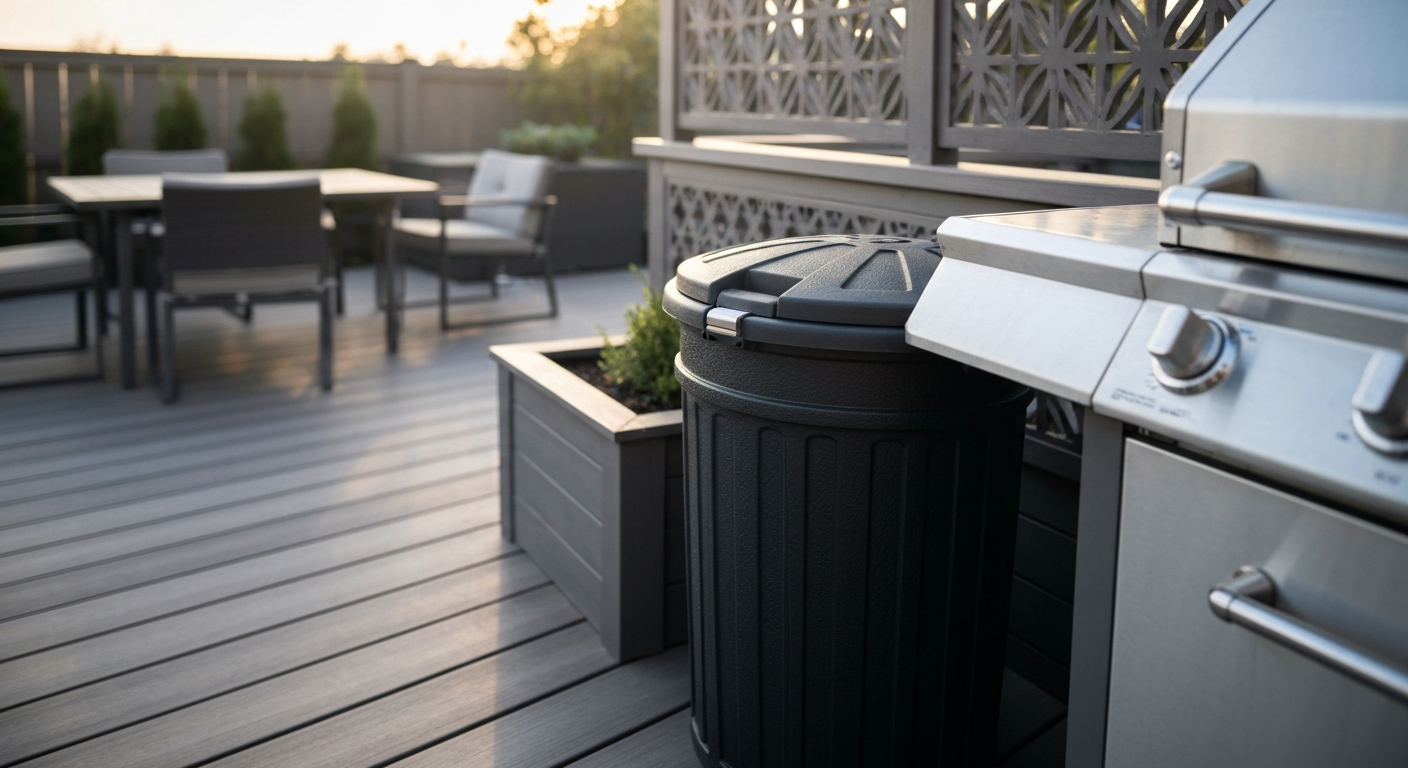
The most common mistake is placing the trash can in the first convenient spot rather than the most functional one. For a grilling or outdoor kitchen area, position the can within arm's reach of the prep zone but out of the sightline from seating. A corner placement with a small decorative screen or planter box on one side hides the can without blocking access. If you have a covered patio or pergola, a wall-mounted bin holder can free up floor space entirely. For more placement and styling inspiration, see our patio trash can ideas to find solutions that blend function with your outdoor design. For open patios, keep the can at least 3-4 feet from seating to minimize odor and insect proximity, especially in warm months.
Matching the can to your patio's style doesn't require spending a lot. A dark-colored resin can (black or dark brown) reads as a neutral and blends with most outdoor furniture finishes. If your patio uses warm wood tones, the Suncast GH3900's textured exterior in a wood-tone finish coordinates better than a bright white BRUTE. For a fully designed entertaining patio, hiding the can in an enclosure cabinet finished in the same stain as your deck is the cleanest possible solution, and it's a reasonable weekend DIY project.
Installation, anchoring, and securing the can
Most freestanding patio cans don't need formal installation, but if you live in a windy area or have an elevated deck, securing the can prevents it from tipping and scattering waste. Here are the most practical options.
- Bungee or strap anchor: Loop a bungee cord or ratchet strap from the can's handle to a fence post, railing, or ring anchor screwed into a deck post. This takes about five minutes and is reversible.
- Deck ring anchor: A simple stainless eye bolt screwed into a deck post or fence panel gives you a permanent anchor point without permanent modification to the can itself.
- Enclosure cabinet: A built-in or freestanding enclosure cabinet naturally prevents tipping because the can sits inside a framed box. This is the most stable option and is worth building if you're planning to keep the same placement long-term.
- Weighted base or sandbag: Placing a small sandbag or flat paver slab under the can's base adds enough weight to resist moderate wind without anchoring to structure.
- Side-yard wall mount: For narrow side-yard placements, a wall-mounted can holder keeps the can upright and off the ground, improving drainage and making it harder for animals to knock over.
Maintenance, odor control, and pest prevention
A patio can in summer heat without regular cleaning becomes a serious odor and pest problem within a few weeks. The fix is simple but needs to be consistent. Rinse the interior of the can with a garden hose every two to four weeks, then spray with a diluted bleach solution (about one tablespoon of bleach per gallon of water), let it sit for a few minutes, and rinse again. Let it air dry in the sun before replacing the liner; UV exposure actually helps eliminate residual bacteria. The Suncast GH3900's pull-out liquid catch tray is worth rinsing separately every week during summer.
For ongoing odor control between cleanings, a layer of baking soda at the base of the liner before you put in a new bag absorbs a surprising amount of odor. Activated charcoal panels inside the lid work even better. Keeping the lid latched, even when the can isn't full, is the single most effective pest deterrent available for free. If you're seeing ants, check that the can isn't sitting in a spot where syrup or grease drips from nearby grilling are hitting the ground around it.
HOA rules, local codes, and safety notes
Many HOAs have specific rules about trash can visibility, storage location, and materials. Before buying a large or permanently placed can, check your HOA covenants for language about 'trash receptacles,' 'outdoor storage,' or 'waste containers.' Common restrictions include requiring cans to be stored out of street view except on collection days, limiting colors to neutral or earth tones, and prohibiting permanently installed containers in front yards or visible side yards. An enclosure cabinet is often the easiest path to HOA compliance because it qualifies as a storage structure rather than an exposed trash can.
In wildlife management zones or areas with active bear activity, some municipalities actually mandate bear-resistant cans and prohibit leaving standard cans outdoors overnight. Check your local ordinance if you're in a foothills, mountain, or rural area. IGBC-certified carts (like Toter's 64- and 96-gallon bear-resistant models) are the standard for these situations, and some municipalities provide them directly or subsidize the cost.
Home Depot shopping and ordering tips
When searching on HomeDepot.com, use the 'Outdoor Trash Cans' subcategory under Storage and Organization rather than the general search bar. The filters for 'capacity (gallons),' 'material,' and 'color' are genuinely useful here and will get you to the right models faster than scrolling. For in-store trips, the app's store map shows which aisle and bay a specific model is in, which saves time in large stores.
- In-store pickup: Order online and pick up in about 2 hours using curbside pickup via the Home Depot app. You don't need to go inside the store to retrieve the order.
- Same-day delivery: Available on many items depending on your zip code; confirmed at checkout before payment.
- Scheduled or threshold delivery: For larger cart units or enclosure cabinets, threshold delivery brings the item to your door rather than the curb. White-glove service places it inside, though this is rarely needed for a trash can.
- Returns: Most outdoor trash cans at Home Depot show a 90-day return window. Bring the receipt and the item in its original packaging if possible, though Home Depot typically processes returns without original packaging as well.
- Price matching: Home Depot's price match policy covers identical items from major retailers, so if you find a lower price at Lowe's on the same model, bring it up at checkout or use the online price match request.
How Home Depot compares to Lowe's and Costco for patio cans
| Factor | Home Depot | Lowe's | Costco |
|---|---|---|---|
| Selection of outdoor cans | Wide, including BRUTE and Suncast lines | Similar range, some different SKUs | Seasonal, rotates; limited year-round |
| Typical price (Suncast 39-gal equiv.) | $79.00 (GH3900) | ~$108 on some listings | Varies; often competitive on bundles |
| Return window | 90 days on most trash cans | 90 days standard | Risk-free satisfaction guarantee (flexible) |
| Same-day pickup | Yes, curbside in ~2 hours | Yes, similar curbside system | Warehouse only, no curbside |
| Delivery options | Same-day, next-day, threshold, white-glove | Similar delivery tiers | Online orders to warehouse or home |
| Bear-resistant cans | Limited | Limited | Rarely stocked |
For most homeowners, Home Depot wins on price and immediate availability. Lowe's is worth checking if your local store has a model in stock that Home Depot doesn't carry, or if the price is meaningfully lower on a specific SKU. Costco is the better call for bulk supplies like liner bags or if they happen to be running a specific outdoor storage promotion. For a head-to-head look at what Lowe's and Costco specifically carry, those are worth exploring separately when you're comparison shopping.
Next steps: buy, build, or hire a pro
Here's how to decide which path makes sense for your situation.
- Just buy a can: If you need a practical solution quickly and don't mind a visible can, the Rubbermaid BRUTE 32-gallon ($62.97) or Suncast GH3900 39-gallon ($79.00) from Home Depot covers most residential patio needs. Add a dolly if the path to the curb is long.
- Build a DIY enclosure: If aesthetics matter and you have basic carpentry skills, a weekend enclosure project using cedar or composite boards and a HDPE liner can is the cleanest long-term solution. It integrates into your patio design and satisfies most HOA requirements.
- Hire a pro for a built-in: For a custom built-in trash cabinet as part of a larger outdoor kitchen or patio renovation, a licensed contractor or outdoor kitchen builder makes sense. This is the most expensive route but produces the most polished result and is worth it if you're already doing a full patio build.
Whatever you choose, the practical reality is that a latching-lid resin can in the right size costs less than one professional pest or odor call and pays for itself in convenience within the first season. Start with the checklist, pick the capacity that fits your household, and don't overthink the rest.
FAQ
Which Home Depot product pages and SKUs should I pull authoritative specs and current prices from?
Collect Home Depot product pages for representative patio/outdoor cans and accessories: Suncast 39‑gal Resin Patio Trash Can (GH3900) for a resin patio style; Rubbermaid BRUTE family (32, 44, 55 gal) for heavy‑duty roto‑molded options; Sterilite/indoor models if comparing small patio cans; Rubbermaid/Rubbermaid dolly and wheel accessories; trash can lids, locking kits and enclosure kits. For each product record: Internet/SKU and Model number, dimensions (H×W×D), nominal capacity (gallons), empty weight, materials, UV/ weather claims, special features (latching lid, bag holder, liquid tray, venting channels), listing price, stock/availability, and the product page return/warranty language. (Use the Home Depot product pages cited in the brief as primary sources.)
What Home Depot policies and delivery options must I verify and quote?
Verify Home Depot’s delivery and fulfillment documentation: curbside/store pickup (including two‑hour pickup app workflow), same‑day/next‑day/scheduled delivery, threshold vs. white‑glove delivery, oversized/freight classifications and any associated fees, in‑store pickup holds and return process, and the standard ‘Free & Easy Returns’ 90‑day guidance shown on many product pages. Use Home Depot Delivery Services and Terms of Sale PDFs to quote delivery types and limits at checkout.
What retailer comparison points should I research (Costco, Lowe’s) and which retailer policies matter for buyers?
Gather equivalent product pages and prices for Lowe’s (Rubbermaid BRUTE, Suncast Trash Hideaway, etc.) and Costco (if available online or warehouse SKU). Compare price ranges, return/guarantee policies (Costco satisfaction guarantee vs Home Depot 90‑day returns), delivery/curbside options, and availability (warehouse vs local store). Note any unique Costco pricing/return benefits and Lowe’s similar delivery/pickup features for side‑by‑side guidance.
What realistic cost ranges and budget tiers should I present?
Research current Home Depot pricing across categories and generate budget tiers: small patio cans (13–20 gal): ~$25–$75; medium patio/resin (30–45 gal): ~$60–$140 (example: Suncast GH3900 at ~$79); heavy‑duty roto‑molded BRUTE (32–55 gal): ~$50–$150 depending on size and lid; wheeled/automated or bear‑resistant carts: $200–$800+ (Toter municipal/bear‑resistant models). Include typical accessory prices: dolly $30–$60, locking kits $15–$60, enclosures $100–$800 (DIY vs prefabricated). Verify current prices on product pages when publishing.
What sizing guidance and data should I gather to build a patio‑specific sizing calculator?
Use EPA per‑capita MSW generation (~4.9 lb/person/day as baseline) and convert to gallons/week using conservative home waste density factors or bag volume approximations. Collect average household sizes, waste compaction rates, and typical gallon capacities for popular cans (13, 20, 32, 39, 44, 55, 64, 96 gal). Provide a quick calculator: (people × 4.9 lb/day × 7 days = lb/week) → estimate lb/gallon (use 7–10 lb/gal depending on mix) to convert to gallons/week → choose capacity allowing 1–2 week pickup interval. Source EPA facts and verify product capacities/dimensions from Home Depot and manufacturer pages.
What materials, performance claims, and weather‑resistance facts need authoritative backing?
Document material types (resin/composite, HDPE/rotomolded polyethylene, metal/stainless/galvanized), UV‑stabilization claims, cold‑temperature impact resistance, typical lifespan, and corrosion properties. Cite manufacturer datasheets (e.g., ExxonMobil HDPE UV grades, MatWeb) and Home Depot/manufacturer spec pages that list 'UV inhibitors' or 'resin construction.' Use these to advise on cracking in cold climates, color fade, and selection for coastal/ salt‑air environments.