
If you searched 'law pools and patio,' there are two things you might be looking for: a specific contractor called Law Pools and Patio (a real licensed pool and patio company based in Piedmont, Alabama), or general guidance on planning a patio that integrates a pool area. This guide covers both. If you're researching the contractor, they are a licensed pool and patio builder registered with the state of Alabama. But if you're here to plan a pool-and-patio project of your own, or you want to know what to expect when hiring someone like them, this is exactly the right place to start.
Law Pools and Patio: Planning, Layout, Materials, Safety

Miles Sutton
8 Jun 2026
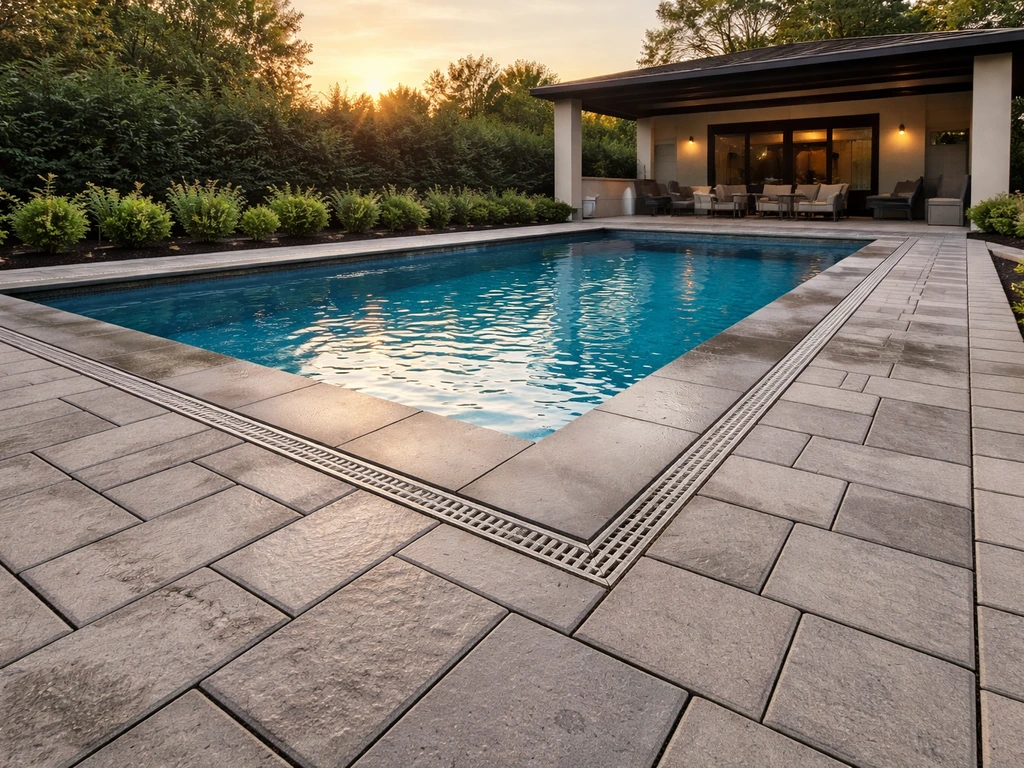
What 'law pools and patio' actually means for your project
Law Pools and Patio is a licensed contractor listed through Alabama's state licensing database, so some people land on this phrase while searching for a local installer. If that's you, the practical next step is to contact them directly and ask about their current project availability, licensing details, and whether they handle both the pool shell and the surrounding hardscape or subcontract one side of the work.
But the phrase also pops up for people trying to plan a pool-and-patio integration from scratch, and that's the bigger conversation worth having here. There's also a reasonable chance you typed 'law pool' when you meant 'lap pool,' which is a specific residential pool type worth understanding. A lap pool is a long, narrow pool, typically 40 to 75 feet long, 8 to 10 feet wide, and around 4 to 5 feet deep throughout. It's designed purely for exercise swimming, not leisure lounging, and it changes your patio planning significantly compared to a standard freeform or rectangular leisure pool.
So before you get into materials and drainage, figure out which of these three situations you're in: you want to contact a specific contractor, you're planning around a lap pool, or you're planning a leisure pool and patio combo. The rest of this guide walks you through the planning regardless of which pool type you choose, but flags where the two paths diverge.
Planning your layout: clearances, flow, and where things go
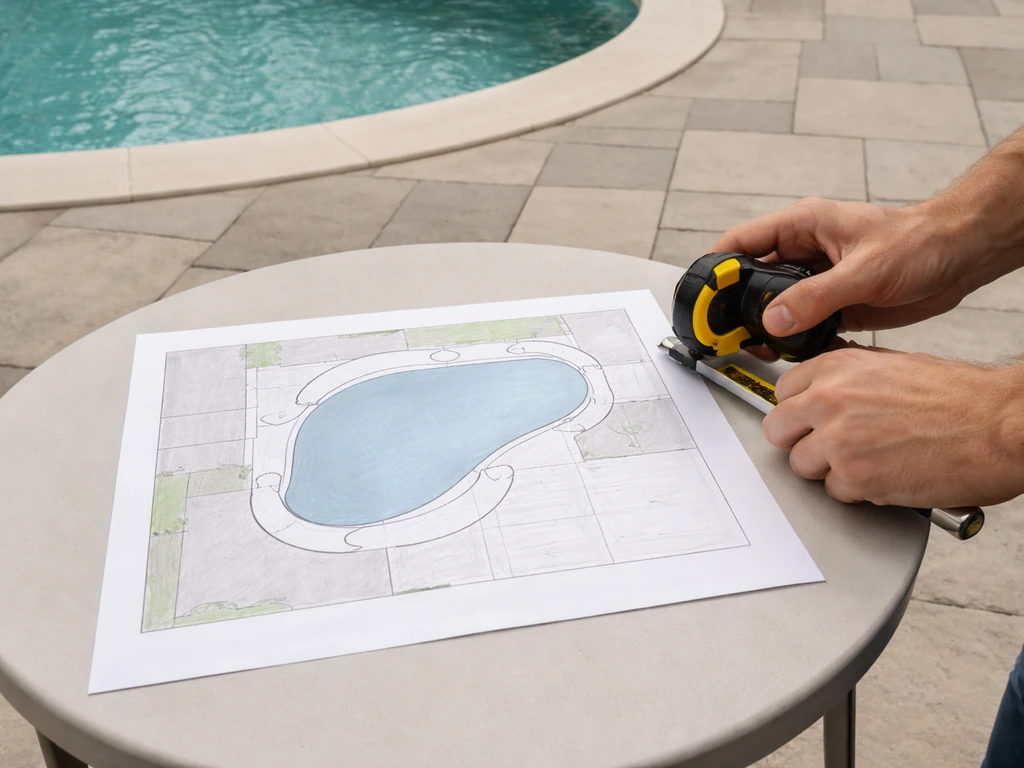
The biggest layout mistake homeowners make is treating the pool and patio as two separate projects that happen to share a yard. They're one system, and the layout decisions made for one directly affect the other. Start with your property lines and any local setback requirements before you draw anything, because most municipalities require a minimum distance between a pool and the property boundary, usually somewhere between 5 and 15 feet depending on your area.
Clearances that actually matter
Around a standard leisure pool, plan for at least 4 to 6 feet of patio deck on all sides that people will walk. That gives you room to place loungers, walk around safely when wet, and keep patio furniture from crowding the pool edge. For a lap pool running down a side yard, the clearance math is tighter: many installations work with just a couple of feet of clearance on each long side to preserve the swim lane and fit within a narrow lot. In that case, most of the usable patio space gets pushed to one or both ends of the pool, which is where you'd stage seating, towel storage, and a hose station.
Zoning your pool-patio space
Think of the pool-patio zone in three rings. The inner ring is the pool deck itself, the surface within 3 to 5 feet of the water edge. This zone needs the most durable, slip-resistant, and water-tolerant surface you can afford, and furniture placement here should be minimal. The middle ring is your main activity zone: lounge chairs, an umbrella, maybe a small table. Keep this at least 5 feet from the pool edge so you're not constantly dealing with splashing onto your seating. The outer ring is where a grill station, outdoor kitchen, or dining table makes sense. This zone can use softer materials or even grass if you want it, since it stays drier.
Circulation paths matter more than most people expect. You need a clear, obvious route from the house to the pool that doesn't require walking through the dining or grill area. Wet people carrying drinks and towels should have a straight, unobstructed 4-foot-wide path. If your layout forces everyone to squeeze through a gate or around furniture, you'll feel it every single pool day.
Choosing materials that can handle water, chlorine, and sun
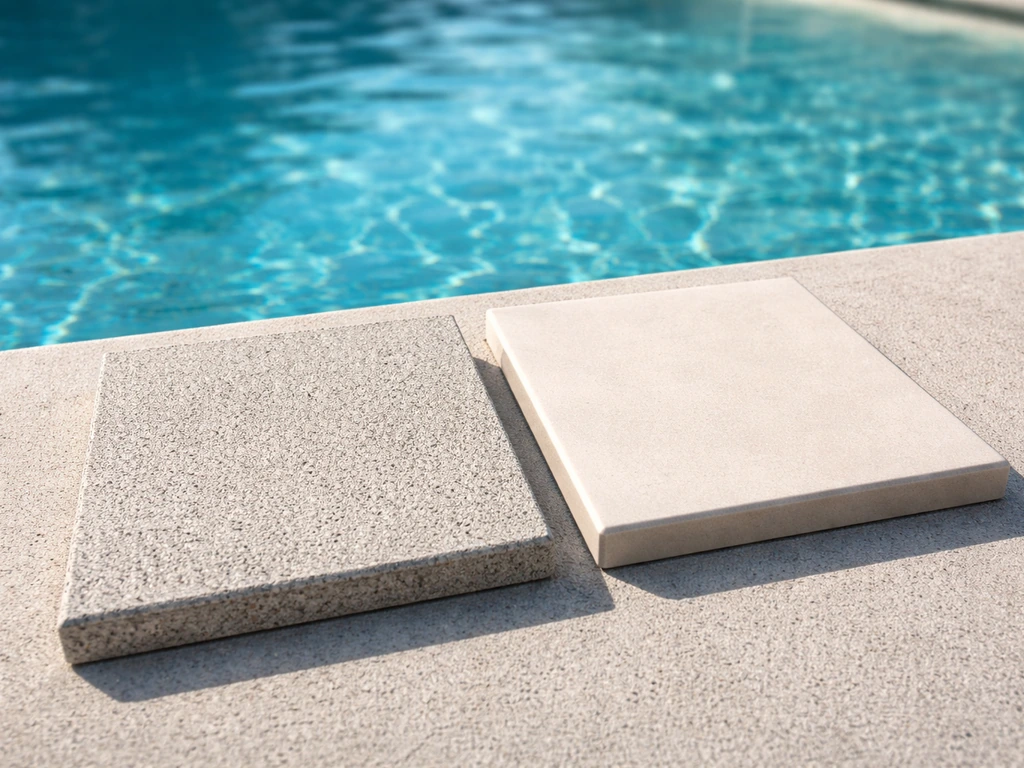
The pool environment is genuinely harsh on materials. Chlorine splash, constant UV exposure, wet-dry cycles, and barefoot traffic are a combination that destroys the wrong surface quickly. Here's how the main options stack up.
| Material | Slip Resistance | Chlorine/Chemical Resistance | UV Durability | Typical Cost Range | Best For |
|---|---|---|---|---|---|
| Concrete pavers | Good (textured finish) | Excellent (nonporous, especially with sealer) | Excellent | $15–$30/sq ft installed | Full pool deck and surrounding patio |
| Poured/stamped concrete | Moderate (can be slick when wet) | Good with sealer | Good (fades over time) | $8–$20/sq ft installed | Budget-focused, large areas |
| Composite decking | Good (0.55 wet CoF typical) | Moderate (avoid low-quality brands) | Good (varies by brand) | $20–$40/sq ft installed | Raised decks, partial pool surround |
| Natural stone (travertine/slate) | Good (filled/tumbled finish) | Good | Excellent | $20–$45/sq ft installed | Premium look, cooler underfoot |
| Pressure-treated wood | Poor when wet | Poor (warps, splinters) | Poor | $10–$20/sq ft installed | Not recommended near pools |
Concrete pavers are the most popular choice for pool decks for good reason. Dense, nonporous pavers resist algae and mildew growth naturally, and adding a quality sealer makes them nearly impervious to chemical splash and staining. If one paver cracks, you replace just that piece instead of grinding out and patching an entire concrete slab. For composite decking around a pool, look specifically for products rated for pool and hot-tub environments: the best ones have low water absorption, are barefoot-friendly in summer heat, and carry a real slip-resistance rating for wet surfaces. TimberTech, for example, publishes wet coefficient of friction values around 0.55 on their spec sheets, which is a meaningful data point when comparing products.
Whatever material you choose for the inner deck zone, avoid anything with a smooth, polished finish. Honed travertine, polished porcelain, and glossy concrete are all beautiful until someone takes a wet-footed step and goes down hard.
Drainage and water management: the part most people skip
Poor drainage is the number one long-term regret I hear from homeowners with pool patios. Water that sits on the deck or pools near the house foundation causes surface damage, promotes algae and mold growth, and can undermine the structural base under your pavers or concrete. Getting this right at the build stage costs almost nothing extra. Fixing it afterward is expensive.
The slope you need
Your pool deck surface should slope away from the pool at a minimum of 1/8 inch per linear foot, up to 1/4 inch per foot. That seems like a tiny number, but over a 12-foot deck, that's 1.5 to 3 inches of drop, which is enough to move water reliably toward your drain points. The Florida Building Code explicitly requires a minimum 1/8-inch-per-foot slope for pool decking, and it requires that drainage be directed away from the pool water, not toward it.
Drain options worth knowing
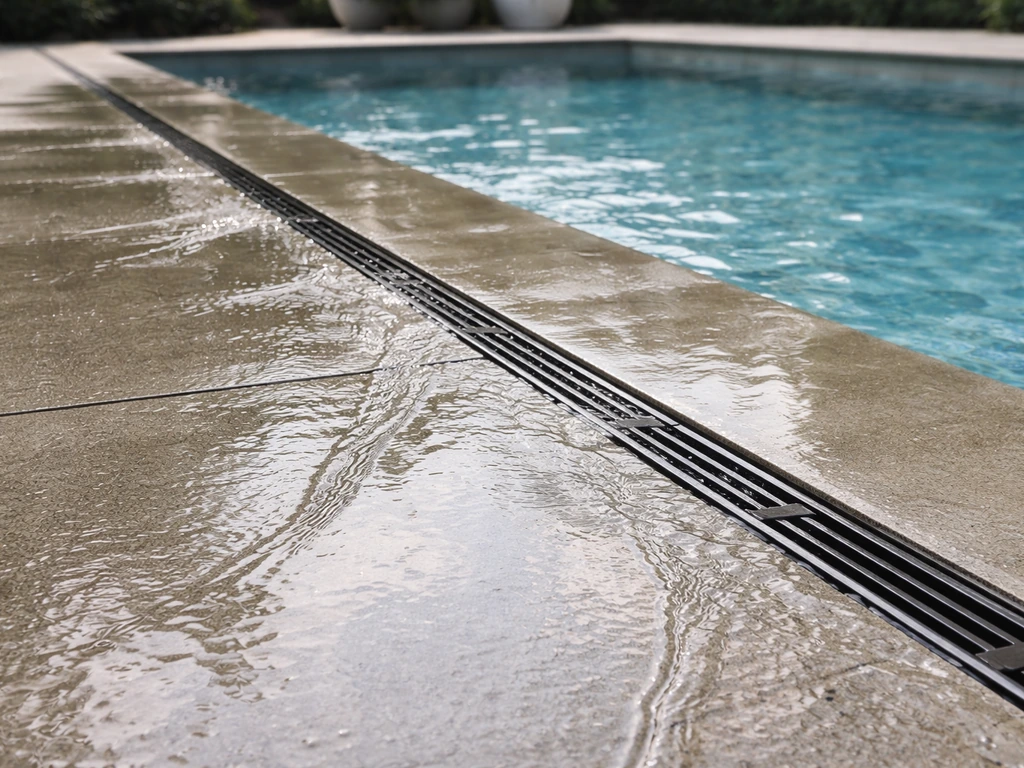
For large or complex pool decks, a channel drain system installed along the perimeter of the deck is far more effective than relying on surface slope alone. Products like the NDS Dura Slope system use a built-in channel gradient (around 0.7% slope built into the unit itself) to keep water moving without requiring precise grading of every inch of your deck surface. Slot drains set flush with the paver surface are another clean option that homeowners tend to appreciate aesthetically.
If you're building on a podium, elevated deck, or over a waterproofed structure, you need a proper waterproofing membrane under the pavers, not just a standard base. Hybrid underlayment systems designed for plaza and pool decks use dual waterproofing layers, typically a polymer cement base coat plus a fluid-applied membrane, to protect the substrate below. Skipping this step on an elevated deck almost always leads to costly repairs within a few years.
Safety and code considerations for pool-adjacent patios
This section isn't meant to scare you, but it does require your attention before you finalize any plans. There are real codes, real safety risks, and real liability implications when a pool is part of your property.
Barrier and fencing requirements
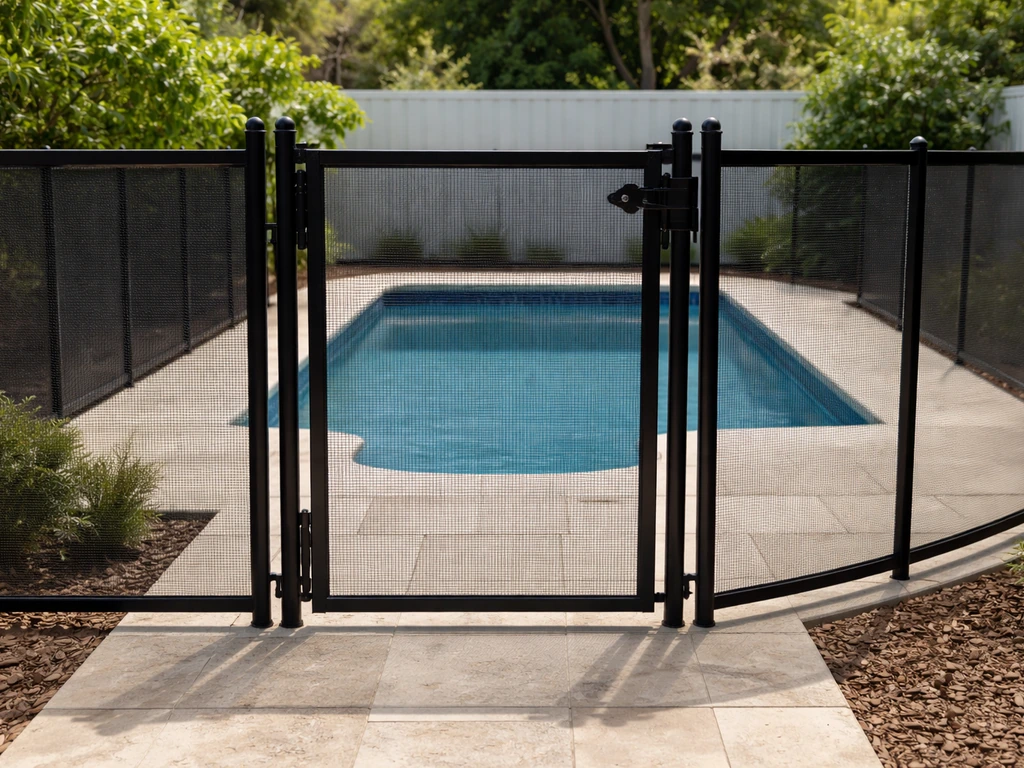
The IRC Chapter 3 (specifically Section R326) establishes barrier requirements for residential pools attached to one- and two-family homes. Most jurisdictions require a fence or barrier at least 4 feet tall that completely surrounds the pool and limits uncontrolled access, especially for children. One important thing to know: using a pool cover does not eliminate the barrier requirement. Per the 2021 International Swimming Pool and Spa Code, a manually installed cover does not substitute for a required barrier. The U.S. CPSC Safety Barrier Guidelines also recommend door alarms and pool alarms as supplemental layers, not replacements for physical barriers.
Electrical and GFCI requirements
NEC Article 680 governs all electrical work near pools, and it requires GFCI protection for any receptacle within 20 feet of the inside wall of the pool. This means your outdoor outlets on the patio, any exterior lighting circuits, and any powered equipment near the water all need to be on GFCI-protected circuits. This is not optional and not something to DIY unless you're a licensed electrician. A failed GFCI near a pool is a serious safety hazard.
Slip resistance and accessibility
ADA Section 302 requires that accessible routes and ground surfaces be stable, firm, and slip-resistant. Even if your household doesn't currently include anyone with mobility challenges, slip-resistant surfaces are simply the right call around a pool for everyone. For pool stairs and handrails specifically, the ADA requires 1. 5 inches of clearance between a handrail and the wall it's mounted on, and stair flights should have handrails on both sides.
For ADA-accessible pool stairs, the U. S. Access Board’s Chapter 10 guide specifies compliant handrail requirements, including clearance guidance such as 1. 5 inches between the handrail and the wall where the handrail is mounted [1.
5 inches of clearance between a handrail and the wall it's mounted on](https://www. access-board. gov/ada/guides/chapter-10-swimming-pools-wading-pools-and-spas/). Florida Building Code also requires a minimum 7 feet of vertical clearance above the pool deck and water surface, which affects any pergola, covered patio, or overhead structure you're adding near the pool.
DIY vs. hiring pros: what's realistic
I'll be direct here: the pool itself is almost always a professional job. The excavation, plumbing, structural engineering, electrical, and permitting involved in installing a pool shell are not realistically DIY territory for most homeowners. Where you can meaningfully save money is on the surrounding patio hardscape, specifically if you're comfortable with physical labor and have time.
A 300 square foot paver patio takes a professional crew roughly 35 to 40 hours to complete. A capable DIYer doing the same job should budget 40 to 50 hours, accounting for the learning curve on base compaction and paver leveling. Labor typically makes up about half the total cost of a paver installation, so doing it yourself on that 300 sq ft patio could save you $2,000 to $4,000 depending on your region.
That said, there are tasks within the patio portion you should still hire out: grading and drainage work (mistakes here are expensive to fix), any electrical work within 20 feet of the pool, and any concrete forming or pouring larger than a simple slab. Permitting for a patio built where the pool used to be can also require site review or updated plans depending on what changes you make to the deck and drainage patio where pool used to be. Permitting is also something a contractor typically handles, and first-time pool-patio projects almost always require permits for both the pool and the hardscape.
| Task | DIY-Friendly? | Notes |
|---|---|---|
| Pool shell installation | No | Requires licensed contractor, structural engineering, permits |
| Pool plumbing and electrical | No | NEC Article 680 compliance requires licensed electrician |
| Grading and drainage | Proceed carefully | Slope errors are costly to fix; consider pro for large or complex areas |
| Paver patio installation | Yes (with prep) | Base compaction quality is critical; rent a plate compactor |
| Composite decking | Yes | Standard carpentry skills apply; check manufacturer's wet-area specs |
| Fence/barrier installation | Yes | Must meet local code height and gate requirements |
| Sealing and maintenance | Yes | Annual DIY task after initial installation |
When talking to contractors, ask specifically whether their quote includes the patio hardscape or just the pool, whether they pull all required permits, and what their drainage plan looks like. The quality of that drainage plan tells you a lot about how experienced they are with integrated pool-patio work.
Keeping your pool-patio looking great long-term
The ongoing maintenance for a pool-patio zone isn't complicated, but it does require consistency. Chlorine splash, UV exposure, and constant moisture create conditions where algae, mildew, and efflorescence (white mineral deposits on pavers) can take hold quickly if you're not staying on top of it.
Sealing: when and how often
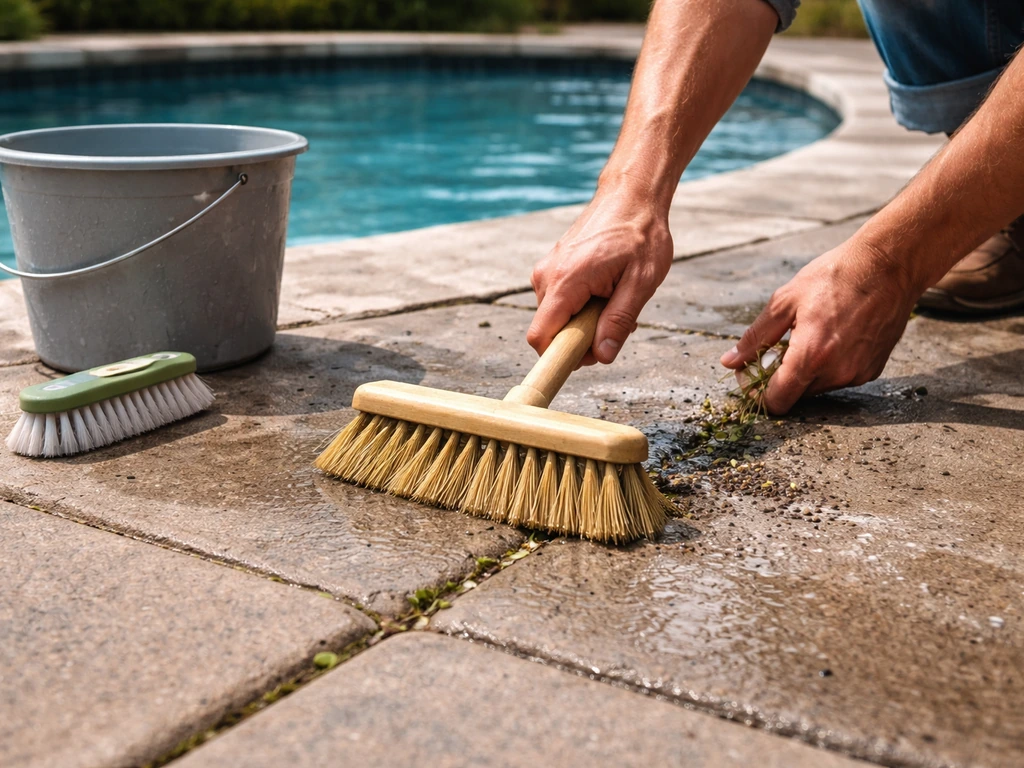
Concrete pavers and natural stone around a pool should be sealed every 2 to 3 years with a penetrating sealer rated for pool environments. Penetrating sealers soak into the material and block moisture without leaving a slick surface film, which matters for safety. Avoid topcoat/film-forming sealers on pool decks because they create a slippery surface when wet and tend to peel under constant moisture cycles. After applying sealer, do a quick water-bead test every spring: if water soaks in instead of beading up, it's time to reseal.
Cleaning routine
Sweep or blow off the deck at least weekly during pool season to remove debris before it stains or promotes mold. For deeper cleaning, a mild detergent wash with a scrub brush handles most algae and mildew buildup. A pressure washer at low to medium pressure (under 1500 PSI) works well for pavers and concrete, but be careful with composite decking and follow the manufacturer's cleaning guidelines. Avoid acid-based cleaners on stone or pavers near the pool, as residual acid can affect pool water chemistry.
Seasonal prep
- Spring opening: inspect pavers and joints for frost heave or shifting, re-sand joints where needed, check drain channels for debris, and reseal if the water-bead test fails
- Summer active season: weekly sweeping, monthly wash-down, check pool surrounds for algae spots on north-facing or shaded sections of the deck
- Fall closing: clear all debris before it composts into joint sand, cover furniture or store it, inspect coping stones around the pool edge for any cracking or movement
- Winter: in freeze-thaw climates, verify your deck base was properly compacted and drains well, since standing water that freezes under pavers is the main cause of shifting and cracking
Your quick-start checklist and next steps for today
If you're ready to move forward, here's what to actually do today and this week to get your project off the ground.
Site measurement checklist
- Measure your yard and mark out property lines; note any setback requirements from your local zoning office
- Measure the intended pool footprint plus at least 5 feet of patio deck on each walkable side
- Identify where house drainage, downspouts, and existing grade slopes currently direct water
- Note the location of any underground utilities (call 811 before digging anything)
- Measure distance from the proposed pool wall to your house's exterior outlets and existing electrical panels
- Identify the natural circulation path from your main house door to where the pool entry will be
Site readiness checklist
- Check your municipality's pool permit requirements before contacting contractors
- Confirm your HOA (if applicable) has no pool or fence restrictions that would affect your design
- Determine whether your local code requires an inspection before and after pool installation
- Identify if your site has fill soil, expansive clay, or rock, as these affect excavation cost significantly
- Confirm your electrical panel has capacity for pool pump and lighting circuits
Questions to ask local pool and patio installers
- Does your quote include both the pool shell and the surrounding hardscape, or are those separate scopes?
- Who handles the drainage plan, and what slope and drain system are you recommending for this site?
- Do you pull all required permits, or is that my responsibility?
- What pool deck materials do you typically recommend for this climate, and why?
- How do you handle the transition zone between the pool coping and the deck surface?
- What is your warranty on both the pool structure and the hardscape work separately?
- Do you subcontract the electrical work, and is that sub licensed for NEC Article 680 pool electrical?
If you're comparing contractors or looking for inspiration beyond a single installer, it's worth exploring how other pool-and-patio specialists position their services. Quality pools and patios builders and today's pool and patio outlet-style showrooms can give you a sense of material options, pricing ranges, and design trends before you commit to a single contractor.
If you want to see options in person, a local today’s patio outlet-style showroom can help you compare pavers, decking, and finish samples before hiring today's patio outlet. Quality pools and patios builders and today's pool & patio showrooms can help you preview material options, pricing ranges, and design trends before you commit to a contractor.
Seeing finished projects in person, or even a showroom floor, is genuinely useful when you're still deciding between pavers, composite, or concrete for your deck surface.
The bottom line: whether 'law pools and patio' led you here looking for a contractor or a planning guide, the project in front of you is very doable with the right preparation. Get your measurements done, nail your drainage plan early, choose materials rated for real pool environments, and don't skip the permit conversation. Everything else, from furniture placement to final sealing, is much easier to sort out once those fundamentals are locked in.
FAQ
If I already have a deck, can I build a pool patio on top of it, or do I need to start from scratch?
Often you do need to start from a compatible substrate. Pools-patio areas require proper drainage and, if you are on an elevated or waterproofed structure, an appropriate waterproofing membrane and plaza-style underlayment system beneath the pavers. Before you reuse an existing deck, have a contractor verify the slope, structural capacity, and whether the current surface can support drainage without trapping water.
How far from the pool should my patio furniture be, especially when people are getting in and out of the water?
Beyond general spacing, plan for a “no-furniture” safety strip within a few feet of the water edge so wet-foot traffic does not funnel into chair legs and slippery edges. For most layouts, that keeps seating in the middle ring at least several feet back and reserves the inner ring for clearance, towels, and limited items.
What’s the right way to choose slip resistance for pool areas, since “not slippery” is too vague?
Look for a measurable slip-resistance rating and confirm it is intended for wet, chlorine/splash, barefoot conditions. Avoid relying on appearance alone, like matte or “outdoor” labels. Also ask whether the rating applies after the material gets wet repeatedly, since some finishes test well dry but become risky when constantly saturated.
Is a pool cover enough to prevent safety issues, especially for kids and pets?
No, a cover is not a substitute for required barriers. Many codes focus on physical separation, such as a fence or barrier that surrounds the pool, and that barrier is still expected even if you add a cover. For added safety, use alarms only as supplemental layers, not as the primary prevention method.
How do I plan drainage if my lot slopes toward the house or if there is a high water table?
You need a drainage strategy that moves water away from the pool and away from the foundation, not just “collects” it. Expect to use perimeter channel drains, controlled outlets, and possibly additional grading or subdrain solutions. If your lot naturally drains toward the home, bring this up early because it can change the deck slope design and the cost of repairs if it is done wrong.
Can I use a pressure washer to clean paver patios around the pool every season?
You can, but use low-to-medium pressure and stay cautious with joint sand and delicate materials. Very high pressure can dislodge paver joints and worsen efflorescence or algae spread. For composite decking, follow the manufacturer’s cleaning guidance instead of guessing, since composites can be damaged by harsh tools.
Should I seal my pavers right away after installation, or wait?
In many cases you should wait until new pavers, stone, or concrete cure and moisture conditions stabilize so the sealer can bond properly. Ask your installer when the surface will be ready, then use a water-bead test in spring to confirm performance. If water soaks in quickly, it usually means resealing is needed sooner than expected.
What details should I ask contractors to confirm about the integrated pool-and-patio drainage plan?
Ask where the water goes (outlets and direction away from the pool and house), what slope targets they build to, whether they use perimeter channels or slot drains, and what they do at transitions between pool deck and other surfaces. A strong answer should include how they prevent water from collecting near the foundation and how they handle complex areas like corners and gates.
Do I need permits for both the pool and the patio hardscape, and what happens if I change the layout after permits are approved?
Most first-time projects require permits for the pool and the surrounding hardscape. If you change the deck footprint, drainage layout, elevations, or where the pool used to be, you may need site review or updated plans. Changes after approval can delay the project or trigger inspections, so confirm the change process with the contractor before finalizing design choices.
What electrical items typically trigger extra requirements around pool patios?
Anything within the designated zone near the pool, including outdoor receptacles, lighting, and powered equipment, usually needs GFCI protection. Tell your contractor every planned device, such as landscape lighting, speakers, spa controls, or phone chargers, so you do not discover a compliance issue after the deck is installed.