
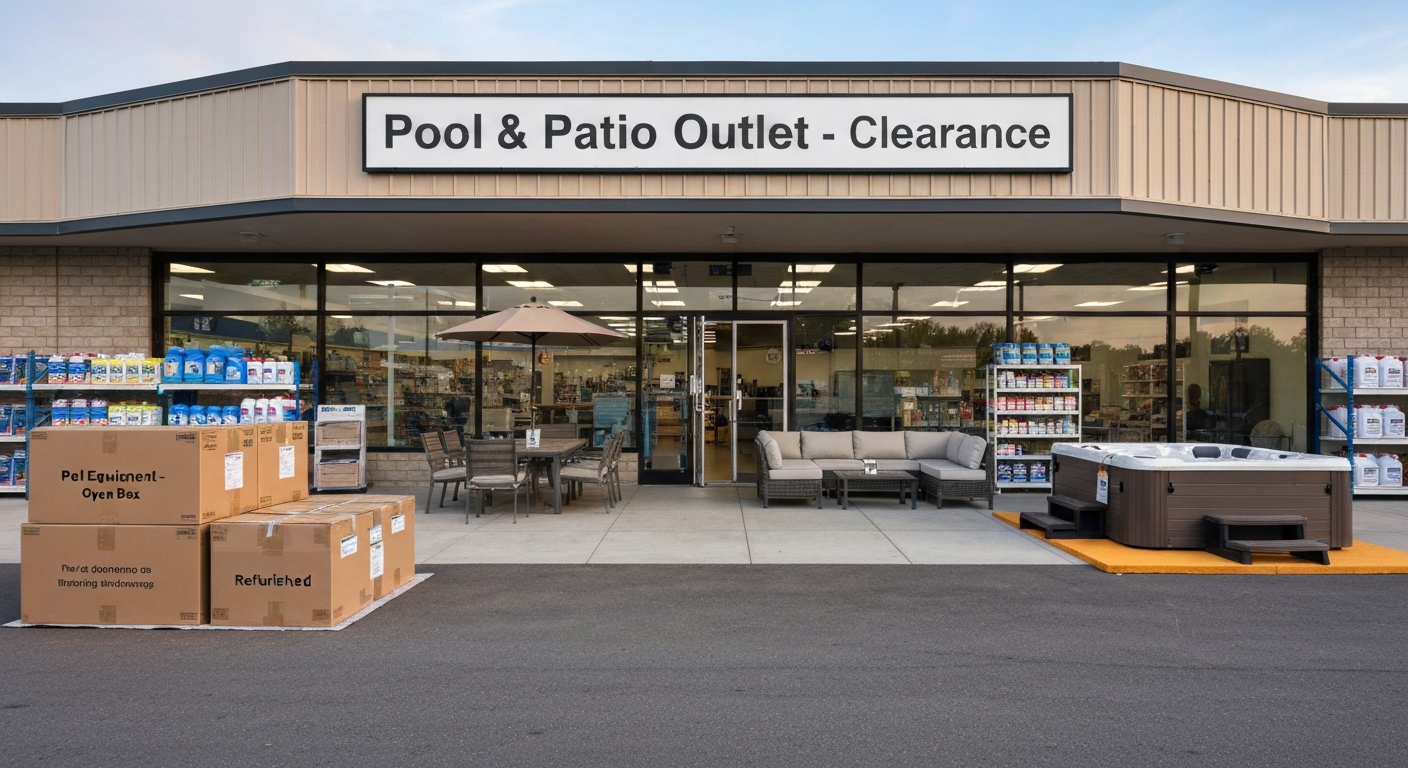
When people search 'today's pool and patio outlet,' they're usually hunting for one of four things: clearance or open-box deals on pool equipment and patio furniture, a local outlet store near them, a price comparison against full retail, or delivery and installation services bundled with a discounted purchase. This guide walks through all of it, what outlet stores actually sell, how to evaluate what you're buying, how to plan a patio or pool-to-patio project, and what legal and safety obligations come with the territory.
Today's Pool and Patio Outlet: Buyer Guide & Conversion Tips

Miles Sutton
28 Jul 2026
What people actually mean when they search this
The phrase 'today's pool and patio outlet' bundles together several different intents. Some searchers want a specific outlet store (a physical clearance center or showroom), others want to browse discounted pool or patio inventory online, and a smaller group is comparing outlet pricing against traditional retail or big-box stores. There's also a subset looking for service, wanting a company that sells the equipment and installs it.
- Find clearance, open-box, or refurbished pool and patio products at reduced prices
- Locate a nearby outlet store or clearance showroom
- Compare outlet pricing against full retail or manufacturer-direct pricing
- Find an outlet that also offers delivery, installation, or repair services
- Research whether outlet warranties and return policies are acceptable before committing
If you're in the first or second camp, you'll want to know how outlet inventory works before you drive to a store or add something to a cart, because not all 'outlet' labels mean the same thing. If you're weighing DIY versus professional installation, or planning a full patio or pool conversion project, the planning and design sections below are where you'll want to spend time.
What a pool and patio outlet actually is
A pool and patio outlet is a retail channel, either a physical store, a dedicated section of a larger showroom, or a manufacturer-run online storefront, that sells pool and patio products at reduced prices. The inventory typically comes from discontinued lines, overstock, open-box returns, floor or demonstration models, refurbished units, and items with minor cosmetic or packaging damage. Some outlets are manufacturer-run (Maytronics, for example, runs a dedicated Dolphin outlet page with clearly labeled clearance, refurbished, and open-box categories). Others are third-party specialty dealers who source discounted inventory from multiple brands.
What you'll typically find in stock
- Pool pumps, filters, and heaters (gas, heat pump, solar)
- Robotic and automatic pool cleaners — often factory-refurbished with limited warranties
- Salt chlorine generators and automation controllers
- Pool lighting, liners, and replacement parts
- Pool chemistry and water treatment supplies
- Patio furniture sets (dining, lounge, deep-seating) — often prior-season or display models
- Hot tubs and swim spas — new, clearance, or open-box
- Shade structures: umbrellas, pergolas, shade sails
- Outdoor lighting and heating accessories
- Installation and service bundles offered by some outlet dealers
Warranties vary significantly. A manufacturer-run outlet often backs refurbished units with a formal limited warranty, Maytronics, for instance, provides a 12-month limited warranty on factory-refurbished Dolphin robotic cleaners and states that each unit has been factory-tested and re-certified. That's meaningfully different from a third-party reseller selling 'as-is' clearance items with no return window. Always check the warranty terms before you buy, not after.
Outlet vs. retail vs. manufacturer direct: what you're actually trading
The word 'outlet' gets used loosely, and that creates real confusion for buyers. Some outlets are genuine clearance channels selling genuine overstock. Others sell products manufactured specifically for the outlet channel, items that look similar to full retail versions but are built to a different spec. A 2019 analysis of outlet retail found that made-for-outlet merchandise is common across many categories. So the price difference isn't always a pure discount on the same item.
| Channel | Typical Price | Warranty Coverage | Return Policy | Installation Support | Best For |
|---|---|---|---|---|---|
| Full retail dealer (authorized) | Full MSRP | Full parts + labor (where applicable) | Standard (30–90 days) | Often included or available | New equipment with maximum warranty protection |
| Manufacturer outlet (online) | 10–40% below retail | Limited (e.g., 12-month on refurb) | Short window (e.g., 14 days) | None — DIY or hire separately | Brand-loyal buyers comfortable with self-install |
| Third-party outlet/clearance store | Varies widely | Varies — may be none | Often final sale on clearance | Sometimes bundled | Bargain hunters who inspect carefully in person |
| Manufacturer direct (non-outlet) | MSRP or slight discount | Full manufacturer warranty | Standard | Not typically included | Buyers who want factory-fresh with no middleman |
| Big-box retail (seasonal clearance) | 20–50% off at end of season | Full manufacturer warranty | Standard store policy | Add-on fee | Opportunistic end-of-season buyers |
One important detail on warranties: Pentair and Hayward both distinguish warranty coverage by purchase channel and whether a licensed professional did the installation. Hayward's limited warranty excludes damage from improper installation, freezing, misuse, and lack of maintenance, and requires proof of purchase. Pentair equipment professionally installed through an authorized dealer commonly receives parts-and-labor coverage, while equipment bought through unauthorized channels often receives parts-only or reduced coverage. That means buying a heater or pump from an outlet and hiring your neighbor to hook it up could leave you with a significantly weaker warranty claim if something fails.
How to evaluate an outlet before you buy
I'd run any outlet through the same checklist whether I'm buying a patio sectional or a pool heat pump. The goal is to figure out what you're actually getting, because the sticker price only tells part of the story once you factor in delivery, installation, potential repairs, and warranty gaps.
Outlet shopping checklist
- Confirm inventory category: Is the item new overstock, open-box, floor model, refurbished, or clearance? Each carries different risk and return rights.
- Read the warranty document: Get the actual warranty in writing — not a summary. Note duration, what's excluded, and whether professional installation is required for coverage to apply.
- Check the return window: Many outlet clearance items have 14-day or 'final sale' policies. Know this before you load it into your truck.
- Ask about delivery and installation: Does the outlet include delivery? Is there a crane or special rigging fee for large items? Hot tub crane lifts typically run $300–$1,500 for standard residential lifts, and swim spas or complex placements cost more.
- Inspect for seasonal deal timing: Pool and patio outlets often mark down remaining inventory in late summer (August–September) and again after the holidays. If you can wait, end-of-season clearance is typically the steepest discount.
- Ask about financing: Many dealers offer promotional financing. Compare APR against paying cash or using a home equity line — promotional 'no interest' deals often have deferred interest traps if not paid in full.
- Research the outlet's reputation: Check Google, BBB, and industry forums. Look specifically for complaints about misrepresented product condition, warranty denials, and delivery problems.
- Verify the outlet is an authorized dealer for the brands it sells: Unauthorized resellers can't submit warranty claims through manufacturer portals — that's your problem, not theirs, after the sale.
- Get installation quotes separately if the outlet doesn't include them: Budget for a licensed electrician and/or plumber before you commit to equipment that requires hookup.
Inspecting products and installations, what to look for
Whether you're inspecting a floor-model patio set or a refurbished robotic pool cleaner, a few consistent checks will save you from expensive surprises. In-store, bring a flashlight and get hands-on, don't just look at the product from a distance.
Patio furniture and shade structures
- Check weld points and frame joints on aluminum or steel pieces — look for cracking, rust blistering, or misaligned seams
- Test all moving parts (reclining backs, swivel bases, extendable tables) multiple times
- Inspect fabric for UV fading, tears, or mold — especially on cushions stored in a showroom without covers
- Verify umbrella poles are straight and tilt mechanisms engage cleanly
- Look for chipped powder coating on steel frames — bare metal rusts fast outdoors
- Ask what grade of aluminum: 'cast aluminum' is heavier and more durable than hollow-tube aluminum
Pool equipment (pumps, heaters, cleaners)
- Ask for the unit's serial number and verify it with the manufacturer to confirm it hasn't been registered or had a prior warranty claim
- For robotic cleaners, run it in the store if possible — check that drive tracks move freely and the filter basket is intact
- On heaters and pumps, inspect all ports and O-ring seats for cracks or chemical staining
- Confirm the product is compatible with your existing system (voltage, flow rate, plumbing size) before you leave the store
- Check whether the unit includes all original hardware, manuals, and installation documentation — missing docs complicate warranty claims and licensed installer hookups
- For hot tubs, inspect the shell interior under bright light for crazing (fine cracks in the acrylic) and verify all jets are present and undamaged
Certifications and red flags
Pool equipment should carry UL or ETL listings (electrical safety) and, for safety-critical items like drain covers, compliance with the Virginia Graeme Baker Pool and Spa Safety Act (VGB Act). The VGB Act is federal law requiring anti-entrapment drain covers on pools and spas, a missing or broken drain cover is not a cosmetic problem, it's a closure-worthy safety issue. The Pool and Hot Tub Alliance (PHTA) publishes ANSI/APSP voluntary standards that manufacturers and inspectors reference for entrapment avoidance and other safety practices. If a product claims compliance, ask for the specific standard number. Red flags include missing labels, no model or serial number, an outlet that can't provide a manufacturer warranty document, and any equipment with burned insulation, cracked housings, or chemical corrosion.
Planning your project: goals, scope, timeline and budget
Before you buy anything from an outlet, spend an hour defining what you're actually building or upgrading. I've seen homeowners buy a gorgeous patio set only to realize their yard needs $3,000 in grading work before it's usable. Know your scope first.
Define your goals and constraints
- Primary use: entertaining, relaxing, swimming, kids' play space, or a combination
- Property constraints: lot size, slope, existing structures, tree roots, drainage patterns
- HOA rules: many associations restrict pool types, patio materials, fence styles, and even furniture colors visible from the street
- Budget: separate your 'materials and product' budget from 'labor and permits' budget — they often end up nearly equal
- Timeline: permits alone can add 2–8 weeks depending on municipality; factor this before you schedule outlet delivery
- DIY capacity: honest assessment of which phases you can handle and which require licensed trades
Realistic budget drivers
Patio projects vary enormously in cost depending on material choice, site prep, and whether you're adding a pool or removing one. A basic concrete patio runs $6–$12 per square foot installed; natural stone or pavers run $15–$30 per square foot. If you're converting an existing pool to a patio (a growing choice for homeowners who want the space back), expect partial fill-in costs of $2,000–$7,000 and full removal/demolition costs of $5,000–$30,000 depending on method, access, and local disposal requirements. Municipal permits and engineered backfill compaction specifications add to the price and are non-negotiable in most jurisdictions. Hot tub delivery for a standard unit (up to about 1,000 lb) that requires a crane lift typically runs $300–$1,500 for a standard residential lift, more for swim spas.
Patio design options and material choices
The material you choose for your patio surface sets the tone for everything else, how it looks, how it drains, how much maintenance it needs, and what it costs over time. Here's a practical breakdown.
| Material | Installed Cost (per sq ft) | Durability | Maintenance | DIY-Friendly? | Best Use |
|---|---|---|---|---|---|
| Concrete (broom finish) | $6–$12 | High, 25–50 years | Low — seal every 2–3 years | No (formwork, pour, finish) | Large flat areas, budget builds |
| Stamped/decorative concrete | $12–$22 | High if sealed | Medium — resealing required | No | Curb appeal on a mid-range budget |
| Concrete pavers | $10–$20 | Very high — individual units replaceable | Low-medium — occasional re-sanding | Yes (moderate skill) | Flexible, repair-friendly surfaces |
| Natural stone (flagstone, travertine) | $15–$30 | Very high | Medium — sealing recommended | Possible for dry-lay | Premium aesthetics, pool surrounds |
| Composite decking | $15–$35 | High, 25–30 years | Low — occasional wash | Yes (elevated skill) | Elevated decks, pool surrounds |
| Pressure-treated wood decking | $8–$18 | Moderate, 10–15 years | High — staining/sealing annually | Yes | Budget decks, DIY builds |
| Gravel/decomposed granite | $2–$6 | Moderate | Medium — raking, topping up | Yes | Informal areas, low-budget patios |
Furniture, shade and lighting
For furniture, cast aluminum and high-density polyethylene (HDPE) are the most weather-resistant and lowest-maintenance options. Teak and eucalyptus wood are durable but require annual oiling. Steel frames are affordable but need powder-coat touch-ups to prevent rust. For shade, a cantilever umbrella ($200–$800) is the most flexible solution for smaller patios; a freestanding pergola ($2,500–$8,000 installed) adds architectural structure and can anchor string lights and privacy screening. Low-voltage LED path lighting and in-deck LED step lights add safety and atmosphere at reasonable cost ($15–$60 per fixture installed), and most modern systems are DIY-wirable if you're comfortable with 12V landscape wiring.
Drainage, grading and structural site considerations
This is the section most homeowners skip, and it's where the expensive surprises live. A beautiful patio that drains toward your house foundation, sits over unidentified utilities, or was built on poorly compacted fill will fail, sometimes expensively and quickly.
Grading and drainage
Any hardscape surface should slope away from your home at a minimum of 1/8 inch per foot (roughly 1% grade) and ideally 1/4 inch per foot. Before breaking ground, trace where water flows during a heavy rain. If your yard already pools in the target area, you need a drainage solution, a French drain, channel drain at the patio edge, or dry creek bed, before you lay a single paver. Ignore this and you'll be lifting and resetting pavers within two or three seasons as the base washes out.
Soil, utilities and retaining walls
- Call 811 (or your country's equivalent utility locate service) before any digging — buried gas, electric, water, and telecom lines are more common than most homeowners expect
- If your yard has expansive clay soil, concrete slabs may need a vapor barrier and reinforcement to resist cracking as soil shrinks and swells seasonally
- On sloped lots, any retaining wall over 24–36 inches (height thresholds vary by jurisdiction) typically requires a permit and often an engineered design
- Former pool fill areas require compaction testing before supporting a patio slab — poorly compacted backfill causes dramatic settling
- Tree roots within 10 feet of a patio can lift pavers and crack slabs over time — factor removal or root barriers into your plan
When to call a structural engineer or surveyor
Hire a structural engineer when: you're building on a slope that requires a retaining wall taller than 3 feet, you're converting a pool to a patio (engineered backfill compaction specs are often required by the permit), or you're adding a heavy structure like a pergola, outdoor kitchen, or hot tub to an elevated deck. Hire a surveyor when: you're unsure of setback distances from property lines (most municipalities require patios to sit 5–10 feet from the property line, and pools often require 10–15 feet), or when you're building near an easement or shared boundary. Skipping this step to save a few hundred dollars is a very common way to end up spending thousands tearing out and rebuilding.
Legal, permits and safety obligations
Permits aren't optional, and they're not just bureaucratic friction. They protect you legally if something goes wrong and are often required to sell your home without disclosing unpermitted work. Here's what typically applies. For specific local permitting and legal guidance, consult Law Pools and Patio, which provides resources and contractor referrals for pool and patio projects.
What typically requires a permit
- New pool installation or pool removal/fill-in
- Attached patio covers, pergolas, and shade structures above a certain square footage (often 200 sq ft, but varies)
- Electrical work for pool equipment, hot tubs, outdoor lighting circuits, or subpanels (governed by NEC Article 680 for aquatic applications)
- Gas line extensions for outdoor kitchens, fire pits, or pool heaters
- Retaining walls above local height thresholds
- Decks attached to the house structure
Pool and spa safety requirements
The Virginia Graeme Baker Pool and Spa Safety Act is federal law requiring anti-entrapment drain covers on pools and spas. For residential pools, the CPSC and the Pool and Hot Tub Alliance strongly recommend compliance, a missing or damaged drain cover requires the pool to be closed until it's replaced. NEC Article 680 governs all electrical work around pools: it requires GFCI protection on many pool circuits, equipotential bonding of all metal parts and rebar, and specific conduit and wiring methods for wet locations. Non-compliant wiring is both a recognized safety hazard and a guaranteed inspection failure. This is not DIY territory unless you hold an electrical license.
Most jurisdictions also require a 4-foot minimum barrier (fence or wall) around residential pools, with self-closing, self-latching gates. HOA rules can add requirements on top of local codes, some restrict pool types (above-ground vs. in-ground), patio enclosure heights, and materials visible from common areas. Check both before you design.
DIY vs. professional installation: honest trade-offs
I'm a believer in DIY where it genuinely makes sense, and a strong believer in knowing where it doesn't. Here's the honest breakdown.
| Task | DIY Feasibility | Why You Might Hire Out | Typical Pro Cost Range |
|---|---|---|---|
| Paver patio installation | Moderate — requires base prep skill | Drainage and grading errors are expensive to fix | $10–$20/sq ft installed |
| Patio furniture assembly | High — generally straightforward | Volume or time constraints only | $50–$150 per piece (white-glove delivery) |
| Pool equipment plumbing swap (pump, filter) | Moderate — shut off, replumb, restart | Warranty may require licensed installer | $150–$400 labor |
| Pool heater or heat pump install | Low — gas, high-voltage electric, plumbing | Safety, permits, warranty requirement | $300–$800 labor |
| Pool electrical work (NEC 680 scope) | Not recommended — permit and licensing required | Code compliance, safety, inspection | $500–$2,500 depending on scope |
| Hot tub electrical hookup (240V, GFCI) | Not recommended | Code, permit, safety | $300–$1,200 |
| Pool fill-in / conversion to patio | Low — requires excavation equipment, compaction | Engineered backfill specs often required | $2,000–$30,000 depending on method |
| Retaining wall (over 36 inches) | Not recommended without engineering | Structural failure risk, permit required | $30–$60/sq ft of face area |
If you buy outlet equipment that needs electrical or gas hookups, budget for a licensed electrician and plumber before you commit to the purchase price. Manufacturer manuals and warranty documents almost universally state that improper installation voids coverage and creates safety hazards. See Pentair junction box / installation guidance (installation & grounding notes) for manufacturer instructions on grounding and installation requirements. That $400 outlet savings on a heat pump evaporates quickly if a warranty claim is denied because an unlicensed installer hooked it up.
Quality markers and maintenance that affect your long-term value
Buying well and maintaining consistently is almost always cheaper than buying cheap and replacing. For pool equipment, variable-speed pumps are a good indicator of quality, they meet modern energy efficiency mandates and reduce operating costs significantly versus single-speed pumps. For patio materials, look for UV-stable finishes, commercial-grade weld construction on furniture, and concrete pavers with a compressive strength rating above 8,000 PSI.
Seasonal maintenance essentials
- Pool opening (spring): inspect and replace O-rings and gaskets, test water chemistry, clean filter media, check drain covers for damage or missing hardware
- Pool closing (fall): balance chemistry before closing, blow out lines and add antifreeze to prevent freeze damage (a common warranty exclusion), cover the pool with a safety cover not just a tarp
- Patio furniture: clean and store cushions before winter, apply teak oil or touch up powder coat annually, check umbrella pole and base hardware
- Pavers and concrete: inspect for settled or heaved sections each spring, refill polymeric sand in paver joints every 2–4 years, seal concrete every 2–3 years
- Hot tub: drain and clean the tub quarterly, replace filter cartridges every 12 months, inspect cover foam for water absorption (a saturated cover adds hundreds of pounds and loses insulation value)
- Electrical: have a licensed electrician inspect GFCI devices and bonding connections every few years — these degrade in wet outdoor environments
Pool-to-patio conversion: a practical overview
If your search for a patio outlet is partly motivated by wanting to reclaim the space an old pool is occupying, this is one of the most common and satisfying backyard transformations I've seen homeowners undertake. For inspiration and step-by-step costs, see examples of a patio where pool used to be. The process involves real costs and decisions that should shape whether you buy new patio equipment now or after the conversion is complete.
- Get a structural assessment: before filling, have a structural engineer or experienced pool contractor evaluate the pool shell — the method of fill affects future slab stability significantly
- Choose partial fill vs. full removal: partial fill-in ($2,000–$7,000) punches holes in the bottom for drainage, fills with rubble and compacted soil, and leaves the shell in place — it's cheaper but limits what you can build on top. Full demolition ($5,000–$30,000) removes the shell entirely and allows a proper patio slab but costs substantially more
- Pull the permits: pool fill-in and demolition almost universally require municipal permits; some jurisdictions require an engineered backfill compaction specification, especially for partial fills
- Plan drainage before you pave: a former pool creates a low point in many yards — design drainage solutions into the patio plan from the start, not as an afterthought
- Disconnect utilities properly: pool electrical, gas lines (for heaters), and plumbing need to be properly capped and disconnected by licensed trades before fill begins
- Select your surface material: for a partial fill, heavier hardscape like thick concrete pavers or a reinforced concrete slab is preferred over floating deck systems — settling in the fill area can take years to stabilize
- Furnish and finish: once the surface is complete, shop outlets for furniture, shade, and lighting — this is where the outlet shopping guide above becomes directly useful
Homeowners considering this path will find it worthwhile to explore broader options for pool and patio combinations, as well as resources on quality pools and patios and what today's patio outlet market offers for surface and furniture finishing. See quality pools and patios for detailed options and standards. For a curated selection of outlet deals and inventory, check today's pool & patio. The conversion decision and the product-selection decision are closely linked, knowing what the new space will look like informs what you shop for.
Your next steps
The path from 'searching for an outlet' to 'enjoying your finished patio or pool' runs through a handful of concrete decisions. Here's how to move from research to action without getting stuck. For another relevant comparison, see today's patio outlet.
- Define your project scope and budget before visiting any outlet — know whether you're upgrading existing equipment, furnishing a new patio, or starting a conversion
- Identify authorized dealers for the brands you're considering and verify any outlet you're considering is part of their authorized network
- Run the outlet evaluation checklist above on any store or website before purchasing, paying special attention to warranty terms and installation requirements
- Pull permit requirements from your local building department — a 15-minute call or website visit can save weeks of rework
- Get at least two quotes for any licensed trade work (electrical, plumbing, structural) separately from the equipment price, so you have a true total cost before you buy
- Time your outlet purchase strategically — late-summer and post-holiday clearance windows offer the steepest discounts on patio furniture and pool equipment
- Once you've bought, keep all documentation: purchase receipts, warranty cards, installation photos, and permit approvals — these protect your warranty claims and matter at resale
FAQ
What does “Today's Pool and Patio Outlet” usually refer to?
Searchers typically mean one of: (a) a physical or online outlet/clearance center selling pool & patio goods (open‑box, refurbished, discontinued), (b) a local outlet dealer offering sales plus installation/delivery, (c) price/feature comparisons between outlet bargains and standard retail, or (d) outlet‑linked installation or service bundles. Outlets commonly list categories such as pool pumps/filters/heaters, robotic cleaners, automation controllers, lights, pool chemistry, liners/parts, patio furniture, hot tubs/swim spas, and clearance demo items.
What inventory types and product conditions do outlets sell?
Outlets usually categorize inventory as: new overstock (retail model), factory‑refurbished (tested and repaired), open‑box/demonstration units, returns, discontinued models, and items with cosmetic or packaging damage. Each category has different price, warranty, and return rules; outlets should label the condition clearly. Expect shorter return windows and more “final sale” listings on clearance/open‑box items.
How do outlet warranties and returns typically work and what should I check?
Manufacturer and outlet warranties vary by channel and item condition. Common points: (1) OEM limited warranties often require proof of purchase and may exclude damage from improper installation, freezing, misuse, or lack of maintenance; (2) items sold as refurbished often carry a limited factory warranty (e.g., 12 months) but may differ from new‑product coverage; (3) equipment requiring professional installation sometimes has fuller coverage when installed by an authorized dealer. Before buying, verify: warranty length and coverage, who handles warranty claims (manufacturer vs. outlet), required proof/registration, installer requirements, and the outlet’s return window and restocking/final‑sale policies.
What buyer evaluation criteria should I use when shopping an outlet?
Key criteria and checks: (1) Product condition and provenance (new, open‑box, refurbished, return), (2) Clear written warranty and return policy, (3) OEM compatibility and serial/model match if replacing parts, (4) Installation requirements and whether the outlet offers or recommends certified installers, (5) Delivery options, freight/crane charges and site access needs, (6) Dealer reputation: reviews, BBB, licensing, and trade affiliations, (7) Pricing vs comparable new retail and total landed cost (item + delivery + installation + permit fees), (8) Financing or payment terms, (9) Availability of replacement parts and service network, (10) Seasonal promotions vs true savings (confirm model and features).
Can you give a practical outlet‑shopping checklist I can use?
Outlet shopping checklist: (1) Note product category, model & condition; (2) Ask for a written description of defects and test results for refurbished items; (3) Confirm warranty terms and process for claims; (4) Check return period and final‑sale restrictions; (5) Get itemized quote including delivery, setup, disposal/crane fees; (6) Ask if professional install is required for warranty; (7) Verify installer license/insurance and ask for references; (8) Check vendor/dealer reviews and trade memberships (PHTA, local trade groups); (9) Compare total cost to new retail including long‑term maintenance; (10) Photograph item on delivery and preserve packaging/serial numbers for warranty.
Which pool and patio products commonly require professional installation or trades?
Products typically requiring pros: heaters/heat pumps, gas lines for gas heaters, large pumps and multi‑port filtration systems, electrical components (automation panels, underwater lights), in‑ground liners, hot tubs/swim spas (placement and foundation), significant decking, and complex drainage systems. Trades you may need: licensed electrician (NEC Article 680 compliance), licensed plumber/gas fitter, general contractor, structural engineer (for conversions affecting load or backfill), landscape contractor, and certified pool technician.