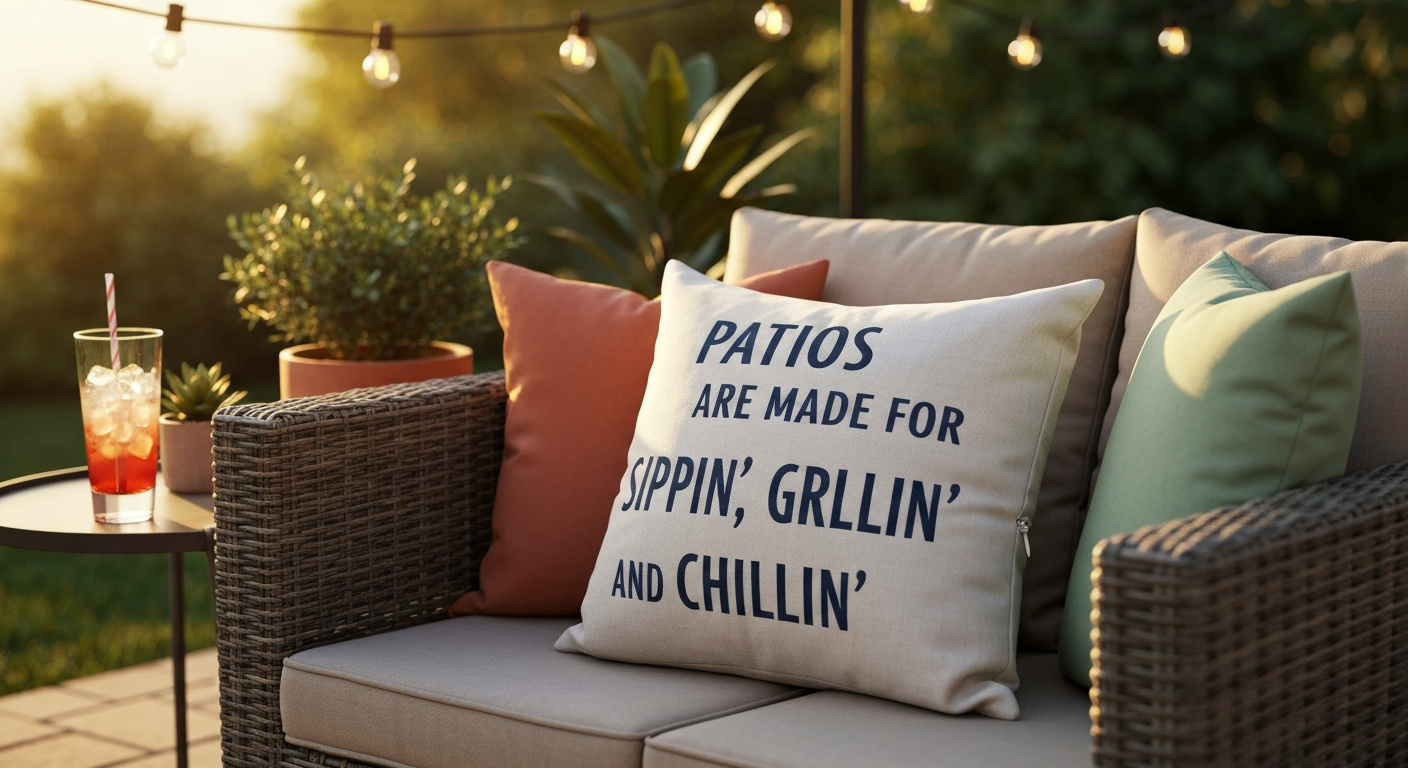
A patio rules pillow is a decorative outdoor throw pillow printed with a short, personality-driven phrase that sets the tone for how you use your outdoor space. Think 'No Shoes, No Worries' or the ever-popular 'Patios Are Made for Sippin', Grillin' and Chillin'.' People buy or make them because they add a quick hit of warmth and humor to patio furniture without a major redesign, and because swapping out a pillow is one of the easiest seasonal refreshes you can do.
Patio Rules Pillow: Buyer's Guide, DIY Steps & Care Tips

Miles Sutton
13 Aug 2026
What a patio rules pillow actually is
At its core, a patio rules pillow is just a weather-resistant throw pillow with a custom phrase printed or embroidered on the face. The 'rules' framing plays on the idea of a house rules sign, but applied to the outdoors: it tells guests (and reminds the household) what the backyard is for. The category shows up everywhere from big-box retailers to small Etsy shops, and ranges from mass-produced stock phrases to fully custom designs you create yourself from an SVG file and a Cricut.
The concept has grown well beyond novelty. Because outdoor pillows take serious abuse from UV exposure, humidity, pets, and rain, the phrase on the fabric is only half the story. The fabric choice, insert type, and printing method all determine whether your pillow looks great for one summer or five. This guide walks through every piece of that puzzle.
Who actually wants one of these pillows
The honest answer is that this pillow works for a surprisingly wide range of people, but each group has slightly different priorities when buying or making one.
- Homeowners who want a finished, personalized look on their patio without committing to new furniture — a custom pillow is low cost and low risk.
- DIY enthusiasts who already own a Cricut or Silhouette and want to put it to use with downloadable SVG files and heat transfer vinyl.
- Pet owners who need something that can survive dog hair, muddy paws, and frequent washing — fabric and fill choices matter a lot here, and knowing which materials hold up to pets makes the purchase much smarter.
- HOA residents who want patio personality within whatever limits their association sets on furniture colors, signage, and decor. A pillow is almost always within those guidelines, but it is worth knowing the rules before going bold with color or size.
If you fall into the pet owner or HOA resident camp, the fabric and fill sections below are especially worth reading carefully. Pet owners need covers that wash easily and inserts that dry fast after a wet dog sits on them. HOA residents often deal with restrictions on visible signage or color schemes, and a pillow is typically exempt from those rules, but checking your community documents first saves headaches.
Popular phrases, wording ideas, and custom design inspiration
The phrases that sell best tend to fall into a few clear buckets: relaxation-focused, humor-driven, house-rules style, and seasonal. Here are some of the most searched and most copied options right now, along with a few that tend to feel fresher than the usual suspects.
- Patios Are Made for Sippin', Grillin' and Chillin' — the single most popular phrase in this category right now, showing up on Etsy SVG listings, Pinterest boards, and Home Depot decor roundups as a top-trending patio design.
- No Shoes, No Worries
- This Is Our Happy Place
- Life Is Better Outside
- Outdoor Living Rules
- Sun, Sand, and a Cold Drink in Hand (especially popular for coastal and pool patios)
- Dogs Welcome, People Tolerated (a strong performer for pet-friendly households)
- Gather Here
- Keep Calm and Grill On
- Good Vibes Only
The 'Patios Are Made for Sippin', Grillin' and Chillin'' phrase deserves a closer look because it has developed into a full design ecosystem. Pinterest and mainstream home-decor sites commonly show the phrase 'Patios are made for sippin', grillin' and chillin'' on signs, pillows, and printable art as a recurring trend in patio decor and pillow copy. On Etsy, you can find it sold as a digital SVG/PNG/DXF cut file for as little as $1.79 to $3.50 per download, formatted for Cricut and Silhouette machines. The same phrase appears on ready-made signs, pillow covers, and printable art. If you want to use it as a starting point for a DIY pillow, buying a cut file is the most affordable path, and many sellers bundle coordinating designs (barbecue icons, cocktail graphics, flame motifs) so your whole patio decor set feels cohesive.
For custom wording, think about what actually happens on your patio. A household that grills every weekend and has a dog has a completely different story to tell than one that uses the patio primarily for morning coffee. Specific and personal phrases almost always land better than generic ones. 'The [Your Last Name] Backyard: Shoes Off, Drinks Up' is more memorable than 'Outdoor Living Rules.'
Where to source SVGs and how to use custom artwork without headaches
Before you spend hours designing something from scratch, check these sources in order of cost and effort.
- Etsy: The fastest source for ready-to-use patio SVG cut files. Most patio-phrase files are under $4 and come in SVG, PNG, and DXF formats. Read the license section of each listing carefully — most personal-use licenses cover making items for yourself or as gifts, while a commercial license (often a separate paid tier) is needed if you plan to sell finished pillows.
- Creative Market: Sells SVG assets under tiered license models. Their standard Commercial License covers many common uses, but high-volume production or redistribution may require an extended or enterprise license. Read the item-specific terms, not just the platform's general FAQ.
- OpenClipart and public-domain repositories: Files released under CC0 or equivalent public-domain terms can be used commercially without payment or permission. Always verify the license on the specific file, not just the platform's general policy.
- Fiverr or Upwork: If you want a fully original custom design, freelance designers on these platforms can deliver one for $20 to $100 depending on complexity. Fiverr's terms of service generally grant buyers IP rights to delivered work upon payment, but for true ownership security, ask the designer for a written work-for-hire agreement. Under U.S. copyright law (Copyright Office Circular 30), a commissioned work is not automatically a work made for hire without a signed written agreement, so that extra step matters if you plan to sell or license the design.
Once you have your SVG file, the workflow depends on your printing method (covered in the printing section below). For Cricut or Silhouette users, the general steps are: import the SVG into your machine's software, resize it to fit your pillow cover, cut heat transfer vinyl (HTV), weed the excess material, and press it onto the fabric with a heat press or household iron at the temperature specified for your HTV brand. Most HTV manufacturers publish time, temperature, and pressure settings for common outdoor fabrics.
Outdoor-durable fabrics explained
This is where a lot of people make expensive mistakes. Not every fabric labeled 'outdoor' performs equally, and the difference between a pillow that fades in one season versus one that looks sharp for five years usually comes down to how the color was applied to the fiber.
Sunbrella (solution-dyed acrylic)
Sunbrella is the industry benchmark for outdoor upholstery fabric, made by Glen Raven using a solution-dyeing process where pigment is baked into the acrylic fiber before weaving, not applied as a surface coating. This means UV light cannot strip the dye from the surface because the color goes all the way through the fiber. Sunbrella's heavy-duty lines, such as the Horizon series, are rated at approximately 19.8 oz per square yard with Wyzenbeek abrasion ratings up to 200,000 cycles. The brand carries multi-year warranties on fade resistance. It is the most expensive option by a significant margin, but for a pillow that lives outside year-round in a sunny climate, it is genuinely worth the cost.
Solution-dyed polyester
Solution-dyed polyester uses the same color-in-fiber principle as solution-dyed acrylic but at a lower price point. A typical spec like eTek's 300D solution-dyed polyester comes in at around 170 GSM (roughly 5 oz per square yard), which is lighter than Sunbrella but still meaningfully more fade-resistant than sprayed or printed polyester. Industry testing against AATCC 169 (the standard UV exposure test for outdoor textiles) shows many solution-dyed acrylics and polyesters targeting Grade 4 or better colorfastness after 1,750 to 2,200 kilojoules of simulated sunlight exposure. For budget-conscious buyers who still want multi-season durability, solution-dyed polyester is the practical middle ground.
Standard polyester and blends
Regular polyester and polyester blends are the most common fabric in mass-market outdoor pillows. The color is typically applied as a dye or surface print rather than solution-dyed, which means UV exposure will visibly fade these fabrics faster, often within a single summer in high-sun climates. They are the cheapest option and work fine for covered patios or spaces with limited direct sun. For a DIY pillow where you are applying your own HTV or sublimation print, a tight-weave polyester is actually required for sublimation to work at all (sublimation dye only bonds to polyester fibers), so this fabric category has a legitimate place in the DIY workflow.
Materials at a glance: pros, cons, and real trade-offs
| Fabric | Durability | UV/Fade Resistance | Water Resistance | Best For | Relative Cost |
|---|---|---|---|---|---|
| Sunbrella (solution-dyed acrylic) | Excellent — up to 200,000 Wyzenbeek cycles on heavy-duty lines | Excellent — color baked into fiber, multi-year warranty | Good — resists moisture, dries quickly, bleach-cleanable | Full-sun, year-round outdoor use; high-traffic patios | $$$$ |
| Solution-dyed polyester | Good — lighter weight than Sunbrella but still solid | Very good — Grade 4+ colorfastness in standard UV testing | Good — water-repellent; not waterproof without added treatment | Moderate sun exposure; budget-conscious buyers wanting multi-season life | $$$ |
| Standard polyester / blends | Moderate — surface dye fades faster than solution-dyed options | Fair — fades noticeably in direct sun within 1–2 seasons | Fair to good — depends on weave and any DWR coating applied | Covered patios, low-sun settings, or DIY sublimation projects | $–$$ |
| Indoor cotton / canvas (not recommended outdoors) | Poor when wet — mildew risk, weakens with repeated sun/moisture cycles | Poor — fades quickly, no UV stabilization | Poor — absorbs moisture, slow to dry | Indoor use only; occasional covered porch with no direct sun or rain | $ |
One practical note: outdoor fabric suppliers and furniture manufacturers consistently recommend removable covers in solution-dyed acrylic or solution-dyed polyester because they can handle both soap-and-water cleaning for everyday dirt and a bleach solution for mildew without damaging the fabric. Sunbrella specifically documents an approved mildew-removal mixture of 1 cup household bleach plus 1/4 cup mild soap per gallon of water for spot cleaning, followed by thorough rinsing and air drying. That kind of cleanability is a real advantage if you have pets or live somewhere humid.
Inserts, fill materials, and getting the sizing right
The insert is what gives a pillow its shape and feel, and for outdoor use, the wrong fill can turn a nice-looking pillow into a wet, mold-smelling lump after the first rain. Here is what the options actually look like in practice.
Fill material options
- Polyester fiberfill (polyfill): The most widely available and least expensive option. Hydrophobic versions (made from hollow-fiber or microfiber polyester) repel water better than standard polyfill and are the go-to for decorative throw pillows that will not see heavy use. If your pillow will live on a covered porch and come inside before rain, polyfill is perfectly adequate.
- Down and feather: Soft and luxurious but a genuinely bad choice for true outdoor use. Down absorbs moisture, takes a long time to dry, clumps badly when wet, and can develop mildew odor quickly. Reserve down inserts for fully covered indoor-outdoor rooms where rain is never a factor.
- Outdoor open-cell quick-dry foam (Dry-Fast or reticulated foam): The correct choice for cushions and pillows that will be rained on or used by wet pets. Reticulated open-cell foam has a lattice-like structure that allows water to drain through and air to circulate, dramatically shortening dry time compared to standard foam. Suppliers like Sailrite and FoamOrder sell this material in densities around 1.8 lb per cubic foot with ILD (firmness) ratings typically in the 25 to 45 range. Softer ILD values (25–30) suit back pillows; firmer values (35–45) work better for seat cushions.
- Water-resistant zippered inserts: Pre-made inserts with hydrophobic polyester fill inside a water-resistant liner are sold at Walmart and similar retailers. These are a practical middle-ground option — they repel splashes and handle light exposure to moisture, though they are not fully waterproof. Read vendor specs carefully because the distinction between 'water-resistant' and 'waterproof' is meaningful.
Sizing your insert correctly
The universal rule in pillow styling is to size your insert 1 to 2 inches larger per dimension than your cover for a full, plump look. If your cover is 18 by 18 inches, use a 20 by 20 inch insert. For lumbar pillows (typically 12 by 20 or 14 by 22 inches), a 1-inch overage per dimension is usually enough because the rectangular shape naturally fills out more. Undersizing the insert is the single most common mistake people make, it results in a floppy, flat pillow that looks cheap regardless of how nice the fabric is. For outdoor quick-dry foam inserts, cut to the exact cover dimensions or 0.5 inches larger, since foam does not compress the same way fiberfill does.
| Cover Size | Recommended Insert Size | Best Fill for Outdoor Use |
|---|---|---|
| 14 x 14 in | 16 x 16 in | Hydrophobic polyfill or water-resistant insert |
| 16 x 16 in | 18 x 18 in | Hydrophobic polyfill or water-resistant insert |
| 18 x 18 in | 20 x 20 in | Hydrophobic polyfill, water-resistant insert, or quick-dry foam |
| 20 x 20 in | 22 x 22 in | Quick-dry open-cell foam (1.8 lb/ft³, 25–35 ILD) for rain-exposed use |
| 12 x 20 in lumbar | 13 x 21 in | Hydrophobic polyfill or water-resistant insert |
| 14 x 22 in lumbar | 15 x 23 in | Hydrophobic polyfill or quick-dry foam |
Printing and customization methods: which one is right for your project
How the design gets onto the fabric matters as much as the fabric itself. Each method has a different cost structure, equipment requirement, and durability profile.
Sublimation printing
Sublimation uses heat to convert solid dye into a gas that bonds directly with polyester fibers, becoming part of the fabric rather than sitting on top of it. The result is a vibrant, soft print with no hand feel (you cannot feel the design when you touch it) and excellent wash and UV durability. The critical limitation is that sublimation only works on fabrics with at least 65 percent polyester content, and it produces best results on white or very light-colored fabric. It does not work on natural fibers like cotton or on solution-dyed acrylic. For DIY use, you need a sublimation printer (converted Epson EcoTank models are popular entry points), sublimation ink, sublimation transfer paper, and a heat press. This method is ideal for photo-quality or full-color gradient designs.
Heat transfer vinyl (HTV)
HTV is the most accessible DIY method for text-based and single-color designs. You cut the design from a roll of vinyl using a cutting machine (Cricut, Silhouette, or similar), weed away the excess material, and press the remaining design onto the fabric with a heat press or household iron. This is the natural match for the SVG cut files sold on Etsy for $1.79 to $3.50. Outdoor-rated HTV formulas exist specifically for fabrics that will see UV exposure and washing, look for HTV marketed as outdoor, permanent, or weather-resistant rather than standard craft HTV. Durability is good for 2 to 3 years under normal outdoor conditions with proper care. HTV works on a wider range of fabrics than sublimation, including solution-dyed acrylic and polyester blends, but thick or highly textured outdoor fabrics can make adhesion inconsistent.
Screen printing
Screen printing pushes ink through a mesh stencil directly onto fabric, creating a durable, opaque print that holds up well to washing and outdoor exposure when done with UV-stable inks. It is cost-effective at volume (once screens are burned, each additional print costs very little) but expensive for one-offs because setup costs, burning screens, mixing inks, make small runs impractical for DIY. This method is best suited to people making 20 or more identical pillows for an event, a rental property, or a small business. For individual home use, sublimation or HTV will be more practical.
| Method | Works On | Color Capability | Durability Outdoors | DIY Accessible? | Best Use Case |
|---|---|---|---|---|---|
| Sublimation | 65%+ polyester, light colors only | Full color, photo-quality | Excellent — dye bonds with fiber | Yes, with sublimation printer + heat press | Full-color or gradient designs on polyester covers |
| Heat Transfer Vinyl (HTV) | Most fabrics including acrylics | Limited by cuts (solid colors per layer) | Good — 2–3 years with outdoor HTV | Yes, with cutting machine + iron or press | Text-based phrases and simple SVG designs |
| Screen printing | Most woven fabrics | Multi-color possible with multiple screens | Very good with UV-stable inks | Not practical for small runs | Bulk orders of 20+ identical pillows |
Pet-friendly and HOA-compliant pillow choices
If you have dogs or cats using your patio furniture, a few specific decisions make your pillow investment last much longer. If you want ideas for venues or public spaces that welcome pets, check curated lists of patios where dogs are allowed for inspiration and local options. For specific guidance on making your outdoor space pet-friendly, see our dog-friendly patio rules. First, choose a removable, zippered cover in a washable solution-dyed polyester or Sunbrella fabric, both tolerate machine washing on a gentle cycle and can handle the bleach-based mildew treatment described earlier without color damage. Second, use a quick-dry foam insert or a water-resistant polyfill insert, not down. A wet dog sitting on a down-filled pillow is a disaster. Third, avoid HTV or screen-printed designs on the sitting surface of any pillow a pet uses regularly, the abrasion from claws and movement will degrade the print faster than on a back pillow. Sublimation prints hold up better to this kind of use because the dye is embedded in the fiber rather than adhered to the surface.
For HOA residents, the good news is that patio pillows are almost universally exempt from the kinds of restrictions that apply to furniture, fencing, and structures. That said, some associations do regulate visible color palettes on front-facing patios or restrict signage that could be read as commercial or political messaging. A phrase like 'Patios Are Made for Sippin', Grillin' and Chillin'' is purely decorative and almost certainly does not trigger sign ordinances, but if your HOA is particularly restrictive it is worth skimming the relevant section of your CC&Rs before ordering a neon-pink pillow with a bold slogan. If you need specifics, check your community's hoa patio rules for guidance on what’s allowed.
Styling and placement tips that actually work
A patio rules pillow works best as an accent rather than a theme. Place one or two phrase pillows among solid-color or subtly patterned pillows rather than filling every seat with text. The classic arrangement on a loveseat or sofa is two solid pillows on the outer edges, one patterned pillow in the middle, and the phrase pillow placed in front of or leaning against one of the solids. This gives the phrase pillow visual breathing room so it reads clearly instead of competing with other patterns.
- Use your pillow phrase to set the dominant color palette — pull one or two accent colors from the SVG design and repeat them in your solid and patterned pillows.
- On dining chairs or Adirondack chairs where pillows need to stay put, look for covers with ties or non-slip backing.
- Lumbar pillows (12 x 20 or 14 x 22 inches) are better choices for dining chairs; square 18 x 18 or 20 x 20 inch pillows suit sofas and loveseats.
- If your patio furniture is a neutral (gray, tan, natural wicker), a phrase pillow in a warm color like terracotta, sage, or navy creates contrast without clashing.
- Keep phrase pillows at eye level or slightly below when seated — placing them too high on a stacked arrangement makes them harder to read and interact with.
Cleaning, care, and seasonal storage
Regular cleaning extends the life of both the fabric and any applied design. For Sunbrella and solution-dyed acrylic covers, the manufacturer-approved cleaning routine is a mild soap and water spot clean for routine dirt, and the bleach-based mixture (1 cup household bleach, 1/4 cup mild soap per gallon of water) for mildew, applied to the affected area, agitated gently, then rinsed thoroughly and air dried. Do not machine dry Sunbrella or HTV-decorated covers on high heat, the vinyl can delaminate and the fabric can shrink or distort. Solution-dyed polyester covers can typically be machine washed on cold/gentle and air dried.
For seasonal storage, the most important step is making sure everything is completely dry before sealing it in a storage bin or bag. Damp fabric in a closed container is a perfect mildew incubator, even with resistant fabrics. Store covers and inserts separately if possible, standing the inserts on edge so air can circulate. A breathable storage bag (not a sealed plastic tub) is preferable for fabric covers. Quick-dry foam inserts compress well for storage and spring back to shape reliably, which is another reason to prefer them over standard foam for outdoor use.
Quick buying checklist before you order or start your DIY
- Decide on your phrase or design and check the license of any SVG file you plan to use (personal use vs. commercial use).
- Choose your fabric based on sun exposure: Sunbrella for full-sun/year-round use, solution-dyed polyester for moderate exposure, standard polyester for covered patios or DIY sublimation projects.
- Select your printing method based on design complexity and quantity: HTV for simple text-based SVG designs, sublimation for full-color artwork on polyester, screen printing only if you need 20+ identical pieces.
- Pick your insert based on rain exposure: quick-dry open-cell foam for fully exposed pillows, water-resistant polyfill for moderate exposure, standard polyfill for covered areas only.
- Size your insert 1 to 2 inches larger per dimension than your cover for a full, plump appearance.
- Confirm your cover has a removable, zippered closure for easy washing.
- If you have pets, verify the cover fabric is bleach-cleanable and the insert is quick-dry or water-resistant.
- If you are in an HOA community, skim your CC&Rs for any color or signage restrictions before finalizing your design.
- Before storage at season end, ensure all covers and inserts are completely dry and store in a breathable bag or bin.
FAQ
What factual details are needed to define “patio rules” pillows and list popular phrases and SVG copy?
Concrete facts: examples of top-selling phrases (e.g., “Patios are made for sippin’, grillin’ and chillin’”), common formats (SVG/PNG/DXF cut files), typical marketplace pricing for digital files ($1.79–$3.50), and evidence of trend usage on decor sites/Pinterest. Source types to cite: marketplace listings (Etsy, Creative Market), home‑decor trend articles (Home Depot, Pinterest roundups), and example product pages or listings showing the phrase and file formats.
What material and fabric performance facts must be included to advise buyers on outdoor durability?
Concrete facts: properties and trade names of durable outdoor fabrics (Sunbrella/solution‑dyed acrylic, solution‑dyed polyester, polyester variants), performance metrics (AATCC/lightfastness grades, Wyzenbeek abrasion cycles, GSM/oz/yd² ranges), manufacturer cleaning guidance (Sunbrella bleach/soap ratio for mildew), and comparative claims for resistance to UV, mildew, and abrasion. Source types: manufacturer technical data sheets (Sunbrella TDS), supplier TDS (eTek, Sattler), and reputable care guides from manufacturers/retailers.
What specific insert types, specs, and sizing guidance are required?
Concrete facts: insert constructions (open‑cell/reticulated quick‑dry foam cores, dry‑fast foams, polyester/Dacron fills, water‑resistant zippered inserts), typical density/ILD ranges and GSM/oz specs from suppliers, distinction between water‑resistant vs waterproof inserts, and sizing rules-of-thumb (insert 1–2" larger per dimension for a plump look). Source types: cushion/foam supplier TDS (Sailrite, FoamOrder), retail product pages (Walmart, furniture sites), and pillow accessory guides (Brocia).
What printing/customization and transfer method facts are necessary for a how‑to section?
Concrete facts: capabilities, pros/cons, and substrate compatibility for main methods—sublimation (best on polyester or coated fabrics), heat transfer vinyl (HTV) / heat press (works on many fabrics but watch temperature/coverage), screen printing (best for larger runs; inks for outdoor durability), and direct‑to‑garment/inkjet transfer limitations for outdoor fabrics. Also include cutter file formats (SVG/PNG/DXF), typical resolution/bleed requirements, and recommended inks/finishes for UV/mildew resistance. Source types: printing equipment/manufacturer guides (sublimation/HTV producers), Cricut/Silhouette documentation, and screen‑printing supplier notes.
What licensing, IP, and permissibility facts are needed for using premade SVGs or commissioning designs?
Concrete facts: marketplace license models (Creative Market tiered commercial licenses), public‑domain/CC0 sources (LibreClipart) and their license pages, freelance platform IP provisions (Fiverr TOS), and U.S. copyright rules about ‘work made for hire’ requiring written agreement (U.S. Copyright Office Circular 30). Source types: marketplace license FAQs, public‑domain site license pages, freelance platform Terms of Service, and government IP guidance.
What pet‑friendly considerations and concrete recommendations should be included?
Concrete facts: fabric choices and treatments that resist pet hair, stains, and claws (solution‑dyed acrylics are easier to clean; tighter weaves resist claws), recommended cover and insert combos (removable zippered covers + quick‑dry foam or water‑resistant inserts), and practical cleaning methods for pet stains. Source types: manufacturer care guides (Sunbrella), outdoor cushion care articles, and vendor product descriptions for pet‑friendly inserts.