
You can absolutely have a patio where dogs are allowed, whether you're designing one from scratch, retrofitting an existing slab, navigating HOA rules, or just trying to find a restaurant patio that welcomes your dog on a Saturday morning. The process looks different depending on whether you're a homeowner, renter, or business owner, but the fundamentals are the same: durable surfaces that drain well, secure boundaries, a few comfort features, and an understanding of the rules that apply to your situation.
Patios Where Dogs Are Allowed: Design, Rules & Checklist

Miles Sutton
24 Jul 2026
Who this guide is for and what you'll walk away with
This guide is written for homeowners who want to build or adapt a patio specifically for life with dogs, renters who need to negotiate with a landlord or HOA, DIYers ready to get into the build details, and anyone who just wants to know how to find a dog-friendly patio at a local restaurant or park. By the end, you'll have a clear picture of the legal landscape (including HOA and fair housing rules), a step-by-step build and retrofit plan, a materials comparison, a maintenance schedule, and actual template wording you can copy and customize for your own situation.
Residential patios vs. public and commercial dog-allowed patios: what's actually different
The phrase 'patios where dogs are allowed' means very different things depending on the context, and mixing them up leads to a lot of confusion, so let's separate them clearly.
A residential dog-friendly patio is a private outdoor space at a home or rental property where the owner or tenant creates a dedicated area for their dogs. The design decisions are largely yours, constrained by local building codes, HOA rules if applicable, and lease terms. You choose the surface, the gates, the drainage, and the layout.
A public or commercial dog-allowed patio is an outdoor dining area, park seating area, or retail space that has explicitly chosen to permit customer dogs. These spaces are subject to a completely different layer of regulation. In the U.S., the FDA Food Code 2022 prohibits live animals on food establishment premises except in narrow cases, but it specifically carves out a path for pet dogs in outdoor dining areas when the local regulatory authority approves it and the operator meets specific conditions. States and counties then implement their own versions: California Health and Safety Code Section 114259.5, for example, allows restaurant operators to permit pet dogs on outdoor patios at their discretion, provided there's a separate outdoor entrance, dogs are leashed, no food prep happens on the patio, and signage and sanitation protocols are in place. Salt Lake County runs a formal variance program where restaurants apply, submit a safety plan, pay a fee, and get seasonal approval. Some counties in Ohio treat pets differently from service animals under their local food code enforcement.
One critical distinction: service animals are not the same as pet dogs in this context. Under the ADA (Titles II and III), businesses must allow service animals everywhere the public is allowed, and staff may only ask two questions when the disability isn't obvious: whether the dog is a service animal required because of a disability, and what work or task it has been trained to perform. This applies regardless of local pet policies.
Is a dog-friendly patio right for your home or business? A quick decision checklist
Before you invest time or money, it's worth being honest about whether a dedicated dog-friendly patio actually fits your situation. Run through this checklist:
- Do you have outdoor space with at least 6 to 8 feet of clearance in one direction for a small dog zone, or 10 to 12 feet for larger breeds?
- Is the space currently fenced, or is there a reasonable path to adding a fence or gate without structural complications?
- Do you know whether your HOA, condo association, or lease permits exterior modifications (or pets at all)?
- Have you checked local ordinances for leash laws, sanitation requirements, and any permit triggers for ground-level patios or fences?
- Are you prepared to commit to a weekly or twice-weekly cleaning routine (urine neutralization, waste removal, surface rinsing)?
- If you're a business: have you contacted your local health department to confirm the approval process for pet dogs in outdoor dining areas?
- If you're a renter: are you willing to submit a formal written request and potentially provide documentation for an assistance animal accommodation?
- Is your current drainage adequate, or does water pool on the patio after rain? (This matters a lot once a dog is using the space daily.)
- Are there toxic plants within reach of the patio boundary that would need to be removed or relocated?
If you answered yes to most of these, you're in a good position to move forward. If drainage, HOA approval, or space is a real constraint, the sections below address each one specifically.
Legal, municipal, and HOA considerations you need to know before you build or negotiate
Local leash and sanitation laws
Most U.S. municipalities have leash laws that apply to dogs in public spaces, and many extend those rules to common areas in multi-family properties. Even on your own residential patio, local sanitation ordinances typically require prompt waste removal. Before you start any project, spend 20 minutes on your city or county website searching for animal control ordinances. If you can't find a clear answer, a quick call to your local animal control office usually gets you a straight response.
Permits and building codes for residential patio work
Adding a ground-level patio slab or paver area often doesn't require a permit in many jurisdictions if it's under a certain square footage and doesn't involve a roof structure, but adding a fence, gate, or pergola almost always does. The International Residential Code, as adopted by most municipalities, requires finished grade to slope away from the foundation: 6 inches of drop within the first 10 feet from the foundation (IRC R401.3). If your patio sits close to your house and drainage runs toward the foundation, you'll need to address that with swales, drains, or permeable materials regardless of the dog factor. Always verify permit requirements with your local building department before breaking ground.
HOA and CC&R rules
HOAs and condo associations routinely include pet restrictions in their CC&Rs, sometimes banning certain breeds, limiting the number of pets, or restricting pets from common areas including patios and balconies. If your HOA has such rules, you have two paths: request a rule variance or modification through the standard HOA process, or, if you have a qualifying assistance animal (emotional support animal or service animal), pursue a reasonable accommodation under the Fair Housing Act. See our HOA patio rules for specifics on CC&R restrictions and the standard variance or accommodation processes.
Under HUD's Fair Housing Act guidance and the FHA itself, housing providers, including HOAs and landlords, are generally required to grant reasonable accommodation requests for assistance animals, even when CC&Rs or lease terms otherwise prohibit pets. A housing provider can only deny the request if granting it would impose an undue financial or administrative burden, create a direct threat, or fundamentally alter the nature of the housing. This is a meaningful protection, and it applies even in communities with strict no-pet policies. The template in the next section covers both scenarios.
Liability
If you have guests whose dogs visit your patio, check your homeowner's or renter's insurance policy. Some policies exclude dog bite liability for certain breeds or require a rider for any animal-related claims. For commercial spaces, your general liability policy needs to explicitly cover incidents involving customer pets on your outdoor patio.
Template HOA and landlord request: sample wording you can actually use
The key to a successful HOA or landlord request is being specific, proactive about addressing their concerns, and framing the ask around minimal impact. Here's a template you can adapt:
[Your Name] | [Property Address] | [Date]
To: [HOA Board / Property Manager Name]
Subject: Request to Designate Patio Area for Approved Pet Use / [OR: Reasonable Accommodation Request for Assistance Animal]
Dear [Board / Manager],
I am writing to request approval to use my private patio space at [unit/address] as a designated area for my dog, [Dog's Name], a [breed, approximate weight]. I am committed to maintaining the patio in good condition and ensuring no impact on neighboring units or common areas.
To address common concerns proactively, I am prepared to: (1) install a self-closing, latching gate to contain the dog within the patio boundary; (2) use a no-odor enzyme cleaner for weekly surface cleaning and prompt waste removal after each use; (3) keep the dog leashed or within the enclosed patio area at all times; (4) carry renters/homeowners insurance with appropriate liability coverage; and (5) comply with all local leash and sanitation ordinances.
I have attached [photos of the patio, a simple layout sketch, or documentation of assistance animal status if applicable]. I am happy to discuss any additional conditions the board or management would require.
Thank you for your consideration. I can be reached at [phone/email].
Sincerely, [Your Name]
Customization tips: If you're submitting a Fair Housing Act reasonable accommodation request for an assistance animal, add a paragraph stating: 'This request is made pursuant to the Fair Housing Act and HUD guidance on reasonable accommodations for assistance animals. I am prepared to provide documentation from a qualified professional verifying the disability-related need if required.' If your HOA has a formal variance form, fill that out in addition to this letter. If you're asking a landlord (not an HOA), address it to your property manager and reference your lease number. Keep the tone collaborative, not confrontational, and offer to meet in person.
How to find public patios that allow dogs and what to ask before you go
Finding dog-friendly restaurant patios and public outdoor spaces takes about five minutes of research if you know where to look. For a quick, printable cheat-sheet summarizing common outdoor dining and homeowner patio policies, see the patio rules pillow as a concise reference you can share with guests or your HOA. The most reliable resources are BringFido.com, DogFriendly.com, and Yelp's pet-friendly filter. Google Maps also lets you filter for 'dog-friendly' and shows attributes businesses self-report. For parks and trails, your city or county parks department website usually has a map of leash-required vs. off-leash areas.
The problem with any directory is that policies change, especially after management changes or health department inspections. Always call ahead or confirm via the business's website before driving there with your dog. Here's what to ask:
- Do you allow dogs on your outdoor patio? (Confirm it's the patio, not the interior.)
- Is there a separate outdoor entrance so my dog doesn't need to walk through the restaurant?
- Are there any size or breed restrictions?
- Do you provide water bowls, or should I bring my own?
- Is the patio covered or shaded? (Especially relevant in summer.)
- Are there any times when dogs aren't allowed (peak hours, private events)?
Most businesses that allow dogs are happy to answer these quickly. If the staff seems uncertain, ask to speak with a manager who can confirm the policy. Remember: even if a business has approved dogs on its patio, your service animal has a separate legal right to be there regardless of that policy under the ADA.
For businesses looking to attract dog-owning customers: getting listed on BringFido and adding the 'dogs allowed' attribute to your Google Business Profile are free and effective. Beyond that, following your local health department's approval process (like the Salt Lake County variance program or your state's equivalent of California's Health and Safety Code provisions) gives you the official green light to advertise dog-friendly status without risk.
Building a dog-friendly patio from scratch: a step-by-step plan
Step 1: Plan the layout and zones
Start by dividing the space into at least two zones: an active zone (play, exploration, potty area) and a rest zone (shade, dog bed, water station). For a medium-sized dog, a minimum active zone of about 10 by 12 feet gives enough room to move without feeling cramped. The rest zone can be as small as 4 by 6 feet. Sketch this on paper or use a free tool like Google Drawings before you order any materials.
Step 2: Check permits and drainage requirements
Pull your local permit requirements before ordering anything. A ground-level paver patio under 200 square feet may not need a permit in your jurisdiction, but a fence or gate almost always does. Confirm the IRC drainage requirement (6-inch drop in the first 10 feet from the foundation) and plan your surface slope accordingly. Aim for a 1 to 2 percent slope away from the house across the entire patio surface.
Step 3: Choose and install your surface
Surface choice is the single most important decision for a dog-friendly patio. Here's an honest comparison of the most common options:
| Material | Durability | Drainage | Paw Safety | DIY Difficulty | Rough Cost (per sq ft installed) | Best For |
|---|---|---|---|---|---|---|
| Concrete (standard) | Very high | Poor without slope/drains | Can get very hot; rough texture can wear pads | Medium | $6–$12 | Base layer; pair with mats or drainage grooves |
| Concrete (broom-finished) | Very high | Moderate with proper slope | Better grip than smooth; still gets hot | Medium | $7–$14 | Active zones with moderate sun exposure |
| Permeable/porous pavers | High | Excellent | Good; stays cooler than solid concrete | Medium-High | $15–$25 | Best all-around residential choice for drainage |
| Standard clay/concrete pavers | High | Moderate (joints help) | Good if set properly; watch for shifting edges | Medium | $10–$20 | Versatile; easy to replace individual units |
| Decomposed granite (DG) | Moderate | Excellent | Good; stays cool; fine on paws | Low-Medium | $3–$7 | Active and play zones; needs edging to contain |
| Pea gravel / crushed stone | Moderate | Excellent | Fine for most dogs; can track indoors | Low | $2–$5 | Budget drainage zones; pair with larger-format borders |
| Artificial turf | Moderate (UV degrades) | Good with proper base | Excellent; stays relatively cool with infill | Medium | $10–$20 | Rest zones; small spaces; year-round use climates |
| Natural grass | Low | Variable | Best for paws; high maintenance with dogs | Low | $1–$3 (seed) | Partial zones only; not suitable for high-traffic dog areas |
| Composite decking | High | Poor without gaps | Good; doesn't splinter | Medium-High | $20–$35 | Raised patios; excellent with proper gapping for drainage |
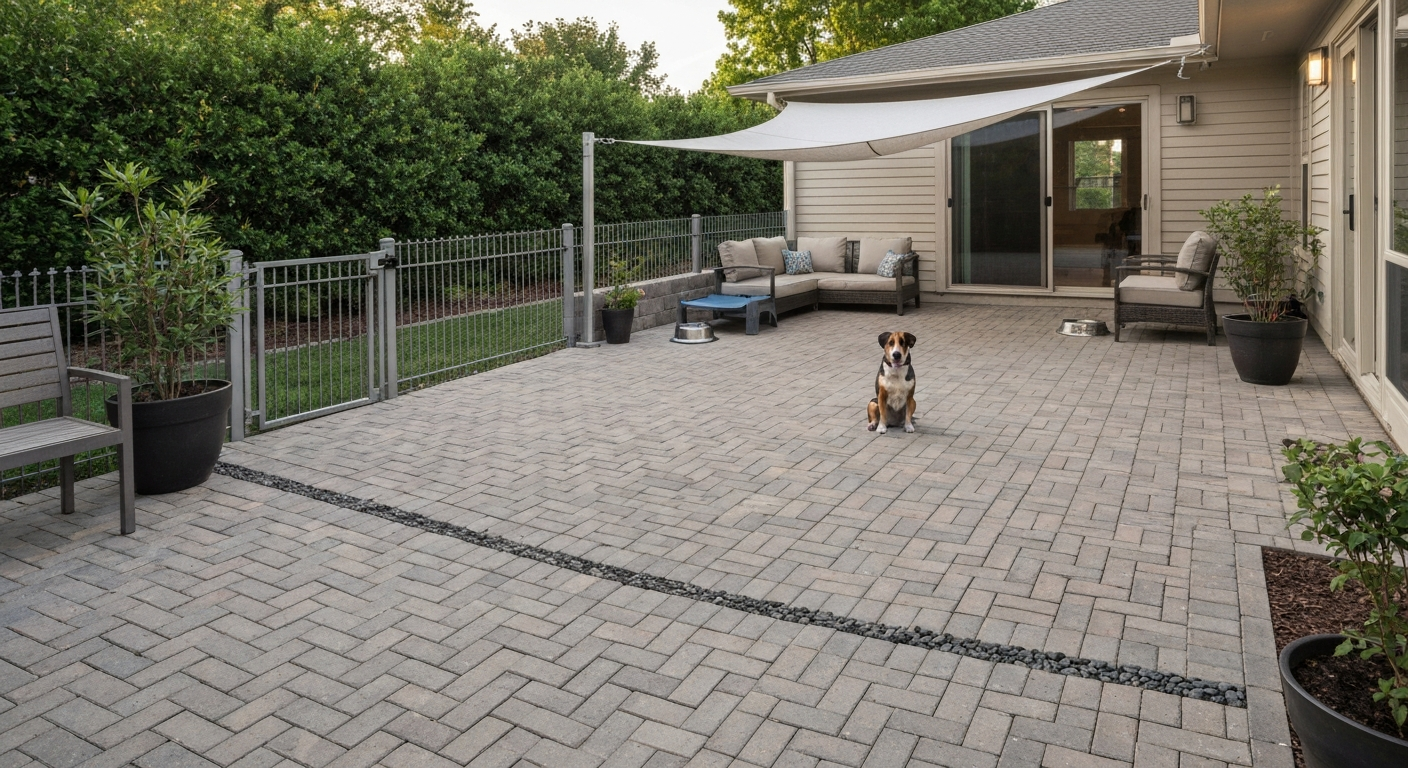
My recommendation for most homeowners: permeable interlocking pavers over a properly compacted crushed-rock base with a geotextile fabric layer. They drain well, stay cooler than solid concrete, are easy to replace if a section shifts, and look great. The upfront cost is higher than DG or gravel, but the long-term maintenance is much lower. If budget is tight, a broom-finished concrete base with a designated DG potty zone (edged with metal or plastic landscape edging) is a solid second choice. Avoid smooth concrete and solid wood decking as the primary surface if your dog will be using it daily, one gets dangerously hot, the other gets slippery when wet and urine-stained.
For permeable pavers specifically: university extension guidance from Virginia Tech and the University of Florida recommends a professional install if your slope exceeds about 5 to 6 percent, since steeper grades require underdrains, baffles, or specialized design to prevent the system from failing. See AE530: Permeable Pavement Systems (UF/IFAS) for guidance noting slope limits and the need for underdrains or special design on steeper grades. On a standard residential lot with a gentle slope, DIY installation over a properly prepared base is realistic for an experienced DIYer, but the base preparation (usually 6 to 8 inches of compacted crushed stone) is the part most people underestimate.
Step 4: Install fencing, gates, and secure latches
The gate is the most critical safety element of any dog-friendly patio. Use a self-closing, self-latching gate with a latch positioned out of your dog's reach (or a double-action latch that requires two separate movements to open). For large or escape-prone breeds, the fence height should be at least 5 to 6 feet. Aluminum or vinyl fencing resists urine corrosion better than untreated wood. If you're adding a gate to an existing wood fence, a stainless steel or powder-coated gate hardware set costs around $30 to $80 and is a straightforward weekend upgrade.
Step 5: Add shade, water access, and comfort features
Shade is non-negotiable if your dog will be on the patio during summer afternoons. A fixed pergola with shade cloth, a sail shade, or a patio umbrella anchored securely are all workable options. For water access, a dedicated outdoor spigot with a dog water bowl station (stainless steel bowl in a weighted holder) is far more practical than carrying water out each time. If you're building new, roughing in a hose bib near the patio adds maybe $150 to $300 to a plumber's visit and saves years of hassle.
Step 6: Remove or fence off toxic plants
Before you declare the patio done, walk the perimeter and identify every plant within reach of your dog. Common toxic plants that appear in residential landscaping include sago palm, azalea, oleander, foxglove, lily of the valley, and certain varieties of ivy. The ASPCA maintains a searchable toxic plant database that's worth bookmarking. Remove toxic plants from the patio zone entirely, or install a secondary border planting barrier to keep the dog away from them.
Step 7: Plan pest control carefully
Many common pesticides, herbicides, and fertilizers are toxic to dogs. If you use a lawn service, confirm that any products applied near the patio area are pet-safe after drying (or get the specific product names and check the ASPCA database). For flea and tick control on the patio perimeter, food-grade diatomaceous earth applied to dry surfaces is a low-toxicity option, though it requires reapplication after rain.
Retrofitting an existing patio for safe dog use: step-by-step
Step 1: Assess what you have
Walk the existing patio and ask: Does water pool here after rain? Are there cracked or uneven surfaces that could catch a paw? Is the boundary secure? Does direct afternoon sun bake the entire surface? Each of those is a separate fix with a different cost and effort level. Prioritize them: drainage and containment first, surface condition second, shade and comfort third.
Step 2: Fix drainage before anything else
A patio that pools water becomes a hygiene problem fast when a dog is using it daily. If the slab or paver surface has no slope or drains toward the house, you have a few retrofit options: install a channel drain at the low end of the patio (a straightforward plumber or landscaper job, roughly $300 to $600 installed), use a surface grinder to add slight sloping channels in a concrete slab, or overlay the existing surface with permeable pavers. Adding a designated DG or gravel drainage strip along one edge is also effective and inexpensive.
Step 3: Address surface safety and temperature
If you have a smooth concrete patio, the two issues to fix are slip risk when wet and heat retention in summer. A brush-on anti-slip additive mixed into a concrete sealer (or a standalone anti-slip coating) costs around $50 to $100 for a 200-square-foot patio and is a genuine one-afternoon project. For heat, outdoor foam or rubber interlocking tiles in the dog's rest zone provide a cooler, more comfortable surface than bare concrete without any permanent modification.
Step 4: Add or upgrade containment
If the existing patio has partial fencing or an open side, the fastest retrofit is a freestanding metal gate panel anchored to existing posts or a wall-mounted gate. Powder-coated steel or aluminum panels in standard 4-foot and 6-foot heights are available at most home improvement stores for $80 to $200. For a more permanent solution, extending an existing fence line with matching material and adding a keyed or double-action latch takes a half-day of work and usually costs $150 to $400 in materials depending on the fence type.
Step 5: Create a designated potty zone
Trying to train a dog to use an entire concrete patio as a bathroom is a maintenance nightmare. Instead, designate one corner with a 3-by-4-foot section of DG or pea gravel as the potty area. Frame it with metal landscape edging, lay a layer of landscape fabric first, then 3 to 4 inches of DG or pea gravel. Municipal guidance (People Parks and Dogs Strategy – Implementation Guide (City of Vancouver)) notes that decomposed granite and compacted crusher‑fines installed over drainage rock are widely used for durable, ADA‑accessible surfacing when properly installed, while artificial turf is chosen where year‑round wear control and wash‑down maintenance are priorities. This zone is easy to rinse, easy to refresh (add fresh DG annually), and far more hygienic than having urine sitting on concrete all day.
Step 6: Install a dog station
A simple dog station (a hook for the leash, a mounted water bowl holder, and a small weatherproof bin for waste bags and a scoop) consolidates everything in one spot and makes daily maintenance faster. These can be built from a cedar fence post and basic hardware for under $40, or purchased as prefab units for $60 to $150.
Furnishings, accessories, and finishing touches
For furniture, choose pieces with washable, quick-dry fabric (Sunbrella and similar solution-dyed acrylics hold up well to pet hair and the occasional hose-down) and weight them down or anchor them so a dog jumping up doesn't tip a chair onto a person. Avoid wicker with open weave that a dog can chew through quickly, and avoid low glass-top tables with dogs that have long, sweeping tails.
If your patio will be used by guests with dogs, a small sign near the gate listing basic house rules (leash required outside the enclosure, waste bags provided, keep pets away from garden beds) sets expectations clearly and reduces awkward conversations. If you want a small decorative sign by the gate, consider a ready-made 'patios are made for sippin, grillin, and chillin' SVG that you can cut on a hobby CNC or order as a weatherproof plaque to reinforce house rules and add personality patios are made for sippin, grillin, and chillin SVG. For businesses, visible signage is often a legal requirement under local health department approval conditions anyway.
Cleaning, maintenance, and odor control: a realistic schedule
The single biggest mistake dog owners make with patios is underestimating how quickly urine odor builds up on hard surfaces, especially in heat. Enzyme-based cleaners (look for products containing beneficial bacteria plus enzymatic compounds) are the only things that actually break down uric acid rather than just masking it. Keep a spray bottle of diluted enzyme cleaner near the patio and use it daily on any urine spots.
| Frequency | Task |
|---|---|
| Daily | Remove solid waste immediately; spray urine spots with enzyme cleaner; rinse water bowl |
| Weekly | Full surface rinse with hose; apply enzyme cleaner to entire potty zone; check gate latch and hinges; refresh water station |
| Monthly | Deep clean surface with enzyme cleaner and scrub brush; inspect fence posts and hardware for corrosion; check for toxic plant growth near boundary; apply concrete sealer if needed (broom-finished concrete) |
| Seasonally (spring/fall) | Refresh DG or gravel potty zone (rake and add fresh material as needed); reseal concrete if needed; inspect drainage; tighten any loose fence hardware; wash all outdoor fabrics and cushions |
| Annually | Replace geotextile fabric under DG/gravel zone if drainage is slowing; inspect paver base for settling; review and restock waste bag dispenser and enzyme cleaner supply |
For stain removal on concrete: a mixture of hydrogen peroxide (3%) and a few drops of dish soap, left on the stain for 10 to 15 minutes before scrubbing, removes most organic stains without damaging the surface. For darker staining from long-term urine accumulation, a commercial oxalic acid-based concrete cleaner will lift it, but it will also slightly lighten the concrete, so apply it evenly across a section rather than spot-treating.
Winter care depends heavily on your climate. In freeze-thaw climates, avoid rock salt on paver or concrete surfaces (it damages the surface and is harmful to dog paws); use sand or a pet-safe calcium magnesium acetate deicer instead. Cover the DG potty zone with a tarp or move the dog to a temporary indoor mat for potty use during the worst months to avoid freeze-thaw churn that compacts and hardens the DG.
Cost ranges and when it's worth hiring a pro
Here's a realistic cost overview for common dog-friendly patio projects in 2026:
| Project | DIY Cost Range | Pro-Installed Cost Range | Notes |
|---|---|---|---|
| Basic retrofit (gate, anti-slip coating, potty zone) | $150–$400 | $500–$1,200 | Most homeowners can DIY this with a weekend |
| New paver patio (200 sq ft, permeable pavers) | $1,800–$3,500 | $4,000–$8,000 | Base prep is the hard part; DIY realistic for experienced builders |
| New concrete patio (200 sq ft, broom-finished) | $1,000–$2,500 | $2,500–$5,000 | Concrete pours are not beginner DIY; hire for slabs over 150 sq ft |
| Fencing addition (50 linear ft, aluminum) | $600–$1,200 | $1,500–$3,000 | DIY fencing is very achievable; gate hardware matters most |
| Shade structure (pergola with shade cloth) | $400–$1,200 | $2,000–$5,000 | DIY kits are widely available and work well for most applications |
| Full new dog-friendly patio build (paving, fence, shade, drainage, station) | $3,500–$7,000 | $9,000–$18,000+ | Pro recommended if site has drainage complications or slope issues |
Hire a pro when: your site has a slope over 5 to 6 percent and you're using permeable pavers (drainage design gets complicated quickly); you need a building permit and aren't comfortable navigating the inspection process; the project involves rerouting drainage or adding a hose bib; or you're working with a material like poured concrete where the timing and execution window is narrow. For everything else, an experienced DIYer with solid prep work and the right tools can handle most of this.
If you're designing a patio and want professional help at the planning stage, dog-friendly patio rules and HOA considerations both intersect with local code compliance, and getting those right before you build saves expensive rework later.
A quick-reference materials summary
Based on everything above, here's the short version of how to think about materials for each zone of a dog-friendly patio:
- Active and general use zone: permeable interlocking pavers (first choice) or broom-finished concrete with a channel drain (budget choice)
- Potty zone: decomposed granite or pea gravel over landscape fabric, framed with metal edging, minimum 3x4 feet
- Rest and shade zone: composite decking panels, outdoor foam tiles over existing concrete, or artificial turf on a proper drainage base
- Perimeter and borders: aluminum or vinyl fencing (urine-resistant), self-closing gate with double-action latch, minimum 5-foot height for medium and large breeds
- Water and comfort: stainless steel bowl in a weighted holder, outdoor hose bib within reach, shade cloth or sail shade rated for UV resistance
Final checklist before your dog uses the patio
- Permits pulled and inspections passed for any new fence, gate, or structural addition
- HOA or landlord approval obtained in writing (or Fair Housing accommodation request submitted and documented)
- Surface slope confirmed: water drains away from the foundation at 1 to 2 percent minimum
- Gate tested: self-closing, self-latching, latch out of dog's reach
- Toxic plants removed from within reach of the patio boundary
- Potty zone established with DG or gravel and landscape fabric
- Enzyme cleaner stocked and daily routine planned
- Shade and water access in place
- Outdoor furniture anchored or weighted
- Dog station installed with waste bags and water bowl
- Pest control products verified pet-safe
- Insurance policy reviewed for animal-related liability coverage
FAQ
What counts as a 'patio where dogs are allowed' and how do residential and public/commercial patios differ?
A 'dog-allowed patio' is any outdoor seating or yard area where pet dogs are permitted. Residential patios are private (single-family yards, apartment balconies, condo patios) and are governed by homeowner/landlord rules and local nuisance/animal-control ordinances. Public/commercial patios (restaurants, cafés, shopping centers) are governed by public‑health/food-safety codes (FDA Food Code and local adoptions), ADA rules for service animals, and local jurisdiction variances or guidance. Commercial patio permissions often require operator controls (separate entrance, leashes, sanitation) and sometimes formal variance/permit approval.
What legal and regulatory issues should I check before allowing dogs on a patio?
Check: (1) Local leash, licensing, and animal-waste laws; (2) Local adoption of the FDA Food Code and any county health-department rules for pets in outdoor dining areas; (3) State/local building and drainage codes affecting patio modifications; (4) ADA/service-animal rules (businesses must allow service animals in public areas); (5) HOA CC&Rs, rental lease terms, and HUD/Fair‑Housing reasonable‑accommodation rules for assistance animals. Contact local animal-control and your county health department for specifics.
How do I ask an HOA or landlord to allow dogs on a patio (sample template)?
Use a concise, respectful written request that explains the reason, proposed controls, and offers to cover costs. Example: "Dear [HOA Board/Landlord], I request permission to allow my dog on my patio/balcony. The dog is house-trained and leashed/supervised; I will install [gate/latch/surface], maintain sanitation (daily waste removal, weekly surface cleaning), and repair any damage at my expense. I can provide proof of vaccinations/licensing and agree to reasonable limits (size/number/hours). Please advise required approvals or conditions. Sincerely, [Name, Unit, Contact]." Attach photos and a one-page maintenance plan.
How should businesses ask about a restaurant or café patio's dog policy?
Call ahead and ask: "Do you allow pet dogs on your outdoor patio? If so, are there conditions (leash required, separate entrance, hours, vaccinations, size limits)? Do you have signage or sanitation stations?" If the answer is unclear, ask to speak to the manager and confirm any local permit or insurance requirements. Always respect the operator's decision and ADA requirements for service animals.
What are the best surface materials for dog-friendly patios and the main pros and cons of each?
Common materials: - Concrete (sealed): durable, inexpensive, easy to clean; can get hot/rough; may crack; add broom finish or stain. - Pavers/interlocking permeable pavers: attractive, permeable options available, repairable; higher cost, requires proper base and joint stabilization. - Artificial turf: soft, low mud, easy rinsing; can retain odors, needs infill and proper drainage; upfront cost. - Natural turf (sod): comfortable, cool; high maintenance, wears out in high traffic, mud/holes. - Decomposed granite (DG)/crusher fines: good drainage, durable, natural look; can track dust, may need weed control and compaction. - Gravel: excellent drainage, inexpensive; uncomfortable for paws if large stone, can scatter. - Composite or wood decking: comfortable and shaded; prone to chewing, scratching, needs slip-resistant finishes and good drainage. - Porous/permeable concrete: reduces runoff, good for drainage; higher installation complexity and cost. Choose by budget, drainage needs, climate, and pets' behavior.
How do I design patio layout and zoning for play vs. rest areas?
Separate active/play and quiet/rest zones. Place play zone on durable, well‑draining surfaces (DG, turf, gravel) with room for movement and fetch. Place rest zone under shade near furniture on cooler surfaces (pavers, decking) with soft bedding. Provide a clear path (36 in min for ADA) between zones. Position water/cleanup stations near an edge with drainage. Use planters, low barriers, or partial fencing to define zones and protect garden beds.