
Patio resurfacing in Fort Worth typically costs between $3 and $12 per square foot depending on the material you choose, and for most slabs that are structurally sound but cracked, faded, or just plain ugly, it's a far smarter investment than a full tear-out and replacement. This guide walks you through every decision you'll face: figuring out whether your slab can actually be saved, choosing the right material for Fort Worth's brutal summers and clay-heavy soil, understanding what the city requires for permits, and deciding whether to hire a local patio builder or tackle it yourself.
Patio Resurfacing Fort Worth: DIY vs Pro Guide, Costs, Permits, Materials

Miles Sutton
18 Jul 2026
Who This Guide Is For
If you own a home in Fort Worth and your back patio looks tired, stained, or cracked, this article is written for you. It covers the full range of situations: DIYers who want to resurface a modest 200-square-foot slab on a weekend, property owners of patio homes in planned communities dealing with HOA rules, and homeowners who are ready to hire a contractor but want to walk into that conversation informed. You'll come out knowing exactly what questions to ask, what to watch out for, and what Fort Worth's specific conditions mean for your project.
Resurface or Replace? How to Decide
This is the most important question you'll answer before spending a dime. The honest answer is that resurfacing works beautifully when the underlying slab is structurally stable. When it isn't, laying a new surface on top is like putting fresh paint on a rotting wall. Here's how to read what your slab is telling you.
Signs You Can Resurface
- Hairline or shallow shrinkage cracks (typically less than 1/4 inch wide) that haven't moved or widened over time
- Surface scaling, spalling, or pitting that's cosmetic rather than structural
- Uniform fading, staining, or discoloration that cleaning alone won't fix
- A generally level slab with no more than minor low spots that hold standing water
- The slab is at least 3.5 inches thick and hasn't been resurfaced multiple times already
Red Flags That Point to Replacement
Fort Worth sits on some of the most active expansive clay soils in Texas. The Blackland Prairie and related Vertisol soils that run through Tarrant County shrink dramatically in dry summers and swell again after rain. Local geotechnical reports document Potential Vertical Rise (PVR) values that can reach 1.5 inches or more at some sites. That kind of soil movement causes structural slab failure that no overlay will fix. Replace rather than resurface if you see any of these:
- Cracks wider than 1/2 inch, or cracks where one side has heaved or dropped relative to the other (vertical offset or 'step' cracking)
- Active settlement, meaning the slab is visibly sinking on one side or corner
- Exposed or corroding rebar
- Large areas of delamination where the surface layer separates from the base in sheets
- Multiple previous resurface layers already applied (bond failure becomes near-certain)
- A slope that now drains toward the house foundation rather than away from it
- Frost heave or severe frost damage that has buckled the slab (less common in Fort Worth but not impossible in hard freeze winters)
A rough cost comparison makes the decision easier. Full concrete demolition and replacement in Fort Worth generally runs $6 to $15 per square foot all-in. A quality resurfacing job runs $3 to $12 per square foot depending on the system. If your slab is structurally compromised, that $3 to $7 in apparent savings on resurfacing disappears within two or three years when the new surface starts cracking along the same fault lines.
Fort Worth Climate, Timing, and Permits
What the Weather Actually Means for Your Project
Fort Worth's climate is not kind to outdoor concrete work. NOAA's 1991-2020 climate normals for the Dallas-Fort Worth station show average July highs around 97°F, and surface temperatures on a sun-baked concrete slab routinely hit 130°F to 150°F on summer afternoons. The American Concrete Institute's ACI 305R guidance on hot-weather concreting is explicit: placing and curing concrete or overlays when ambient temps exceed 90°F without active controls (shading, cooled mixing water, accelerated curing schedules) invites cracking and bond failure. That same NOAA data shows Fort Worth averages around 38 inches of annual rainfall with a noticeably wet spring (April through May) and a secondary wet window in September and October.
On the cold end, Fort Worth averages between 10 and 20 days per year at or below freezing. The hard-freeze winters of 2021 and 2024 are a reminder that genuine freeze events happen here. Freshly placed overlays and coatings need a minimum substrate temperature of 50°F to cure properly, and most manufacturers specify 40°F to 95°F ambient temperature ranges. Violating those limits voids warranties and creates failures.
Best Months to Resurface in Fort Worth
The sweet spot is March through early May and then October through November. Temperatures in those windows are typically in the 55°F to 85°F range, humidity is manageable, and you're outside the peak rainy periods. If you must work in summer, plan for very early morning starts (pre-8 a.m. concrete placement), shade the work area, and use a curing compound immediately. Avoid December through February for any water-based overlay or coating system unless you can guarantee substrate temperatures stay above 50°F.
Permits and the City of Fort Worth
Here's where a lot of Fort Worth homeowners get surprised. The City's residential permitting guidance notes that basic flatwork on your own property (resurfacing an existing slab with no structural changes) may not require a building permit in many cases. Fort Worth's blank" rel="noopener noreferrer">Residential Permitting – City of Fort Worth guidance notes that some flatwork (driveway/flatwork on the owner’s property) may not require a building permit, but accessory structures and most attached/covered features generally do, homeowners should confirm with Development Services before work begins. However, this is not a blanket exemption. If your project involves adding a patio cover, a screened enclosure, a pergola attached to the house, or any structural element, a building permit is almost certainly required. The City's Development Services Department uses the 'Scope My Project' and Accela tools to help homeowners figure out exactly what's needed for their specific situation, and I'd strongly recommend using those before you commit to any design.
The City also enforces stormwater and lot drainage rules. If your resurfacing project changes how water flows across your lot, including redirecting runoff from a new impervious surface, you may trigger a drainage review. For large-scale grading work affecting one acre or more, a separate grading permit is required. Contractors who pull permits on your behalf must be registered with the City of Fort Worth Development Services. Ask any contractor you hire to confirm their registration status before work begins.
Permit fees are listed in the City's current Development Services Fee Schedule, which is published on the City's website. Costs vary by project scope, so pull the current schedule rather than relying on older figures.
How to Assess Your Existing Patio Before You Buy Anything
Don't skip this step. Walking through this checklist takes about 30 minutes and saves you from picking the wrong material or calling a contractor with incomplete information. Do it on a dry day when the slab hasn't been rained on in at least 48 hours.
- Structural visual scan: Walk the entire slab and mark every crack with chalk. Note the width (use a credit card at 1/32-inch as a rough gauge), direction, and whether any edges are offset vertically.
- Tap test for delamination: Use a hammer or a heavy coin and tap the surface in a grid pattern every 12 to 18 inches. A hollow sound means the surface is separating from the substrate. Large hollow zones are a red flag for overlay systems.
- Drainage check: Run a garden hose on the slab for two minutes and watch where the water goes. Ideal slope is 1/8 inch per foot away from the house. If water pools in the middle or runs toward the foundation, note the low points.
- Joint condition: Locate all control joints and expansion joints. Are they still intact, or are they cracked, widened, or crumbling? Overlay systems must honor existing joints, so damaged joints need repair before resurfacing.
- Settlement check: Use a long level or a straight 2x4 (8 feet minimum) to check for high and low spots. More than 3/4-inch variation across 10 feet may require grinding high spots or self-leveling compound before you can overlay.
- Substrate moisture test: Tape a 12x12-inch sheet of plastic film to the slab with all edges sealed and leave it for 24 hours. Condensation under the plastic means moisture is migrating up through the slab, which will compromise most coating and overlay bonds.
- Thickness estimate: If you have an exposed edge (at a step or edge drop-off), measure the slab thickness. Anything under 3 inches is a marginal candidate for heavy overlay systems.
- Previous coatings check: If the surface has been painted, sealed, or previously overlaid, test adhesion by pressing duct tape firmly and pulling it fast. Surface material that pulls up with the tape means the existing coating must be fully removed before any new system goes down.
Resurfacing Options: What's Available and How to Choose
Fort Worth homeowners have more options than most people realize, ranging from a $1-per-square-foot DIY bag of resurfacer to a custom stamped and stained overlay that runs $10 to $12 per square foot installed. Here's a practical comparison of the main systems before I dig into each one.
| Material | Typical Cost (installed, per sq ft) | DIY-Friendly? | Heat/UV Performance | Slip Resistance | Fort Worth Clay Soil Risk | |
|---|---|---|---|---|---|---|
| Concrete overlay (basic) | $3–$6 | Yes (bag systems) | Good | Moderate (add texture) | Low if joints honored | |
| Stamped concrete overlay | $7–$12 | No (pro recommended) | Good | Moderate to Good | Low if properly cured | |
| Concrete or clay pavers | $8–$15 | Moderate | Excellent | Good to Excellent | Moderate (needs base) | |
| Epoxy coating | $3–$6 | Yes (kit systems) | Poor to Moderate (yellows) | Good (add broadcast chip) | Low | |
| Polyurea/polyaspartic coating | $5–$10 | No (fast-set, pro only) | Excellent | Excellent | Low | |
| Porcelain or natural tile | $10–$18 | No | Excellent | Varies by finish | High (grout cracking) | |
| Microtoppings | $6–$10 | No | Good | Moderate (seal required) | Low if joints honored | |
| Brick / patio do tijolo repair | $8–$16 | Moderate | Excellent | Excellent | Moderate (sand-set flex) |
The table above uses installed cost ranges from Fort Worth-area contractor quotes as of mid-2026. DIY material costs are roughly 40 to 60 percent of installed prices. For any material where the Fort Worth clay soil risk is listed as 'moderate' or higher, I recommend a professional site assessment before committing, especially if your slab is near a tree line or shows any previous movement.
Concrete Overlays: The Workhorse Option
A concrete overlay is a thin layer of cementitious material, typically 1/4 inch to 1 inch thick, bonded to your existing slab. Products like QUIKRETE Re-Cap (product #1131) are specifically designed for this use. QUIKRETE's technical data specifies a minimum 1/8-inch and maximum 1/2-inch thickness per application, bond coat requirements, and minimum surface preparation standards. For heavier decorative systems like spray knockdown or skim-coat overlays, contractors use polymer-modified systems from manufacturers like Super-Krete, which have their own technical data sheets specifying substrate CSP (Concrete Surface Profile) requirements.
The ICRI (International Concrete Repair Institute) defines Concrete Surface Profile on a scale from CSP-1 (very smooth) to CSP-10 (very rough). Most overlay systems require CSP-2 to CSP-4, which means your existing slab needs to be mechanically profiled by grinding, scarifying, or shot-blasting before application. This isn't optional. Skipping surface prep is the single most common reason overlays delaminate within a year.
Common Concrete Overlay Systems
- Skim-coat / micro-topping overlays: 1/16 to 1/8 inch thick, very smooth finish, used for color and minor surface renewal rather than structural correction
- Spray or knockdown texture overlays: 1/8 to 3/8 inch thick, creates a non-slip textured surface popular in pool surrounds and patios
- Self-leveling overlays: 1/4 to 1 inch thick, flows to correct minor unevenness, excellent for slabs with drainage issues
- Polymer-modified repair mortars: used to fill cracks, spalls, and low spots before the finish coat goes down
In Fort Worth's heat, overlay application timing matters enormously. ACI 305R guidance recommends that concrete products not be placed or discharged when temperatures exceed 95°F. In July and August, this means you're looking at pre-dawn or very early morning work windows only. Most professional Fort Worth contractors who know their material will not schedule overlay pours between noon and 6 p.m. during summer months. For DIY bag products like QUIKRETE Re-Cap, follow the substrate temperature guidelines on the product data sheet, not just the air temperature.
Concrete overlays are an excellent choice when your slab is sound and you want a fresh look at a reasonable price. Their main limitation is that they won't fix drainage problems, and they must honor every existing control joint in the original slab. Any joint in the original slab that isn't mirrored in the overlay will eventually reflect a crack through the new surface.
Stamped Concrete: Design Flexibility at a Higher Price
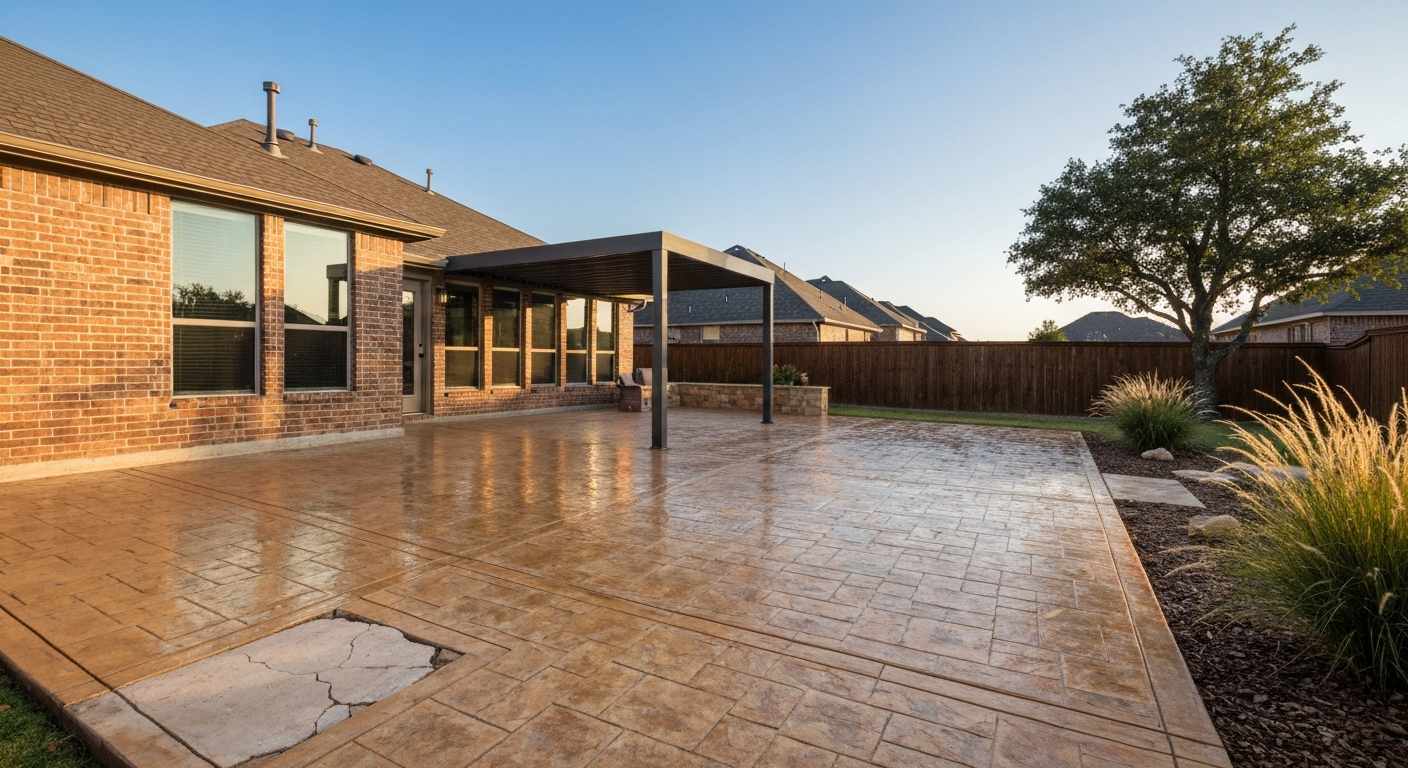
Stamped concrete can be applied as a new pour over a prepared slab or as a stamped overlay on an existing surface. In both cases, it uses patterned mats pressed into the concrete while it's still plastic, combined with integral color, color hardeners, or acid staining to mimic stone, brick, slate, or wood. The results can be genuinely beautiful, and in Fort Worth neighborhoods where custom outdoor spaces are common, stamped concrete gives you a high-end look for less than natural stone or tile.
Design Flexibility
The range of patterns is wide: Ashlar slate, random flagstone, cobblestone, wood plank, herringbone brick, and dozens of others. Color options are essentially unlimited when you combine base color with release agents and stains. A skilled stamped concrete contractor in Fort Worth can match almost any aesthetic, from a Craftsman bungalow to a contemporary outdoor living room.
Longevity and Common Issues
Properly installed and sealed stamped concrete lasts 25 years or more. The main maintenance requirement is resealing every 2 to 3 years, because the sealer is what protects the color and keeps the surface from becoming porous. Fort Worth's UV intensity accelerates sealer breakdown, so lean toward the 2-year end of that range. The most common failure mode is sealer peeling and surface flaking when the initial sealer was applied too thick, applied to a damp surface, or when a water-based sealer was used over a solvent-based one. The second most common problem is color fading from UV exposure, which is why choosing a UV-stable sealer matters here more than in many other climates.
Slip resistance is a legitimate concern with stamped concrete. Smooth stone patterns can be slippery when wet, especially around pools. Broadcast anti-slip additives or shark-grip texture can be mixed into the sealer to address this. I'd consider this non-negotiable for any stamped surface adjacent to a pool or in a shaded area that stays damp.
One honest caveat: stamped concrete overlays on an existing slab are more technically demanding than basic resurfacing. They require precise timing (stamping a concrete overlay that's even slightly too stiff or too wet produces terrible results), and mistakes are very hard to fix without removing the entire layer. I'd strongly recommend hiring a professional with a documented portfolio of Fort Worth stamped work rather than treating this as a DIY project.
Pavers: The Most Flexible Long-Term Option
Pavers are a fundamentally different approach from overlay systems. Instead of bonding a new surface to your existing slab, you either install pavers directly over the slab (in a mortar-set or sand-set system) or you remove the old slab and lay pavers on a properly prepared base. Each approach has distinct implications for Fort Worth conditions.
Types of Pavers
- Concrete pavers: The most affordable option, available in dozens of shapes and colors. Typical 60mm (2.36-inch) thickness. Highly durable in Fort Worth heat. Cost: $8 to $12 per square foot installed.
- Clay brick pavers (patio do tijolo): Traditional fired-clay brick with excellent heat tolerance, natural color variation, and very good slip resistance from their textured surface. More expensive than concrete pavers at $10 to $16 per square foot installed, but they don't fade and can last 50-plus years with proper base preparation.
- Permeable pavers: Designed with gaps or open-joint systems that allow water to pass through into a gravel sub-base. An excellent choice for Fort Worth homeowners dealing with drainage problems or stormwater compliance requirements. The City's lot drainage rules make this option worth serious consideration if you're adding impervious coverage.
- Natural stone pavers (travertine, limestone, flagstone): Beautiful and durable, but Fort Worth's clay soil movement makes mortar-set stone installations risky. Sand-set is generally more forgiving. Travertine in particular can be slippery when wet and needs a sealer in this climate.
Installation Over Existing Concrete vs. New Base
Installing pavers over an existing concrete slab is possible and common, but it adds height, which matters at doorway thresholds and steps. A 2.36-inch paver plus a 1-inch sand or mortar setting bed means your new patio surface is 3.5 inches higher than the old one. Check your door threshold clearance and step risers before committing to this approach. Installing over an existing slab also means the existing slab's drainage slope is locked in, so if your current slab drains poorly, the pavers will too.
Installing pavers on a new base (demolish old slab, compact subgrade, lay compacted gravel base, then sand setting bed, then pavers) gives you the best long-term result, especially on Fort Worth's expansive clay soils. A properly prepared base with 4 to 6 inches of compacted crushed limestone or Class II base aggregate over compacted native subgrade gives the pavers room to flex individually when the clay moves underneath, rather than cracking as a monolithic slab would. Sand-set pavers can also be easily repaired: if one or several settle or crack, you lift them, re-level the sand base, and reset them. That repairability is a real-world advantage on clay soils.
Tradeoffs for Fort Worth Conditions
| Factor | Concrete Pavers | Clay Brick Pavers | Permeable Pavers |
|---|---|---|---|
| Heat/UV performance | Excellent (may lighten over time) | Excellent (color is baked in) | Excellent |
| Slip resistance | Good (textured surface) | Excellent (rough texture) | Good to Excellent |
| Drainage | Standard (needs slope) | Standard (needs slope) | Excellent (permeates in place) |
| Soil movement tolerance | Good (sand-set flex) | Good (sand-set flex) | Good (designed for flex) |
| Repair ease | Easy (individual replacement) | Easy (individual replacement) | Easy (individual replacement) |
| HOA compatibility | Usually accepted | Often preferred | Usually accepted |
| Relative cost | Moderate | Higher | Moderate to Higher |
Epoxy and Polyurea Coatings
Epoxy and polyurea (or polyaspartic) coatings are thin-film systems rolled or squeegeed onto a prepared concrete surface. They don't add meaningful thickness (typically 10 to 40 mils dry film thickness) but they dramatically change the surface's durability, slip resistance with broadcast chip or quartz aggregate, and appearance. These are the systems you see in garage floors and commercial kitchens, and they're increasingly popular for residential patios.
The key distinction for Fort Worth is UV stability. Standard epoxy coatings will yellow and chalk noticeably in direct Texas sun within one to two years. If your patio is covered or in deep shade, epoxy is fine and considerably cheaper. For uncovered, south- or west-facing patios in full Fort Worth sun, polyurea or polyaspartic systems are significantly more UV-stable and are the professional standard for exterior applications. Most polyurea systems also cure in as little as 1 to 4 hours, which matters in a hot climate where you want to minimize open-window cure time.
Both systems require aggressive surface prep. Manufacturer datasheets (such as Super-Krete's product line) specify shot-blasting or diamond grinding to achieve the required CSP profile, complete crack treatment, and careful moisture testing. The 24-hour plastic-sheet test I described in the assessment section is especially important for these coatings: moisture vapor transmission through the slab will cause coating delamination, and it's one of the most common failure modes in coatings installed by inexperienced applicators.
Tile and Microtoppings
Porcelain tile is a beautiful choice and handles Fort Worth heat and UV extremely well. The problem in this region is that mortar-set tile over a concrete slab on expansive clay soil is a recipe for cracked grout lines and eventually cracked tile within a few years if the slab moves at all. If you want tile, use a large-format porcelain (24x24 or larger) over a crack-isolation membrane, and budget for grout maintenance. This is a higher-end installation ($10 to $18 per square foot) that really should be done by a tile contractor experienced with exterior installations in Texas.
Microtoppings are ultra-thin (1/16 to 1/8 inch) cementitious or polymer-modified systems applied over a prepared slab. They're prized for their smooth, modern, seamless look and ability to take pigment for dramatic color effects. They're also the most demanding system to apply correctly. Surface prep must be impeccable, control joints must be addressed, and the applicator needs real skill. Microtoppings are generally a professional-only installation and work best on covered, protected surfaces rather than fully exposed patios in Fort Worth's sun and rain cycles.
Surface Prep and Installation: Step by Step
Regardless of which system you choose, surface preparation accounts for at least 60 percent of the project's success. This is true whether you're doing a bag-mix overlay yourself or hiring a crew for a decorative stamped system. Here's the general sequence that applies across all resurfacing work, with notes on where specific systems diverge.
- Clean the slab completely. Pressure-wash at 3,000 PSI minimum. Remove all oil, grease, paint, sealers, and efflorescence. Use a concrete degreaser for any oil stains and let it dwell for the manufacturer-specified time before rinsing. The surface must be clean enough that you'd be comfortable eating off it.
- Achieve the required CSP (Concrete Surface Profile). For most overlays and coatings, this means mechanical grinding with a diamond cup wheel or shot-blasting. CSP-2 (light grind) works for thin coatings; CSP-3 to CSP-4 (heavier profile) is needed for most overlays. Renting a walk-behind grinder for a 200-square-foot patio costs $80 to $150 per day at most Fort Worth tool rental shops.
- Repair all cracks. Hairline cracks under 1/16 inch: rout and fill with a flexible polyurethane or epoxy crack filler. Cracks 1/16 to 1/4 inch: use a semi-rigid epoxy filler to bridge and stabilize. Cracks over 1/4 inch: evaluate whether this is structural movement (see the resurface-vs-replace section) before proceeding. Let all crack repairs cure fully before overlaying.
- Address control joints. Mark every existing control joint location. Your new surface must either match these joints exactly or use a flexible sealant to allow for movement. Filling joints rigidly with overlay material will result in cracking through the new surface within one to two seasons.
- Test and treat substrate moisture. If the plastic-film test shows moisture vapor, allow additional drying time (minimum 72 hours in dry conditions) or apply a moisture-vapor-reduction primer if specified by your chosen system's TDS.
- Apply bond coat or primer. Most overlay systems require a bonding agent or primer applied to the clean, profiled surface immediately before the overlay. For epoxy and polyurea systems, the base coat itself serves as the primer. Follow the manufacturer's pot life and recoat window instructions exactly.
- Apply the resurfacing material. For bag overlays (like QUIKRETE Re-Cap), mix to manufacturer specs and apply at the specified thickness with a gauge rake or squeegee. For stamped systems, timing is critical: stamp when the surface accepts a thumbprint without sticking but doesn't smear. For coatings, use the specified coverage rate from the TDS.
- Texture and finish. For bare overlays, a broom finish or knockdown texture provides slip resistance. For coatings, broadcast anti-slip aggregate (quartz or aluminum oxide) while the coating is still wet.
- Cure properly. This is where Fort Worth's heat most often causes problems. Keep the fresh surface shaded, misted (not soaked) if needed, and avoid foot traffic until fully cured per manufacturer specs. For cementitious overlays in summer heat, cure times may be shorter but surface drying may be misleadingly fast. Plastic sheeting or curing compound applied immediately after finishing helps prevent premature surface moisture loss.
- Re-establish joints and apply final sealer or topcoat. Cut or re-tool control joints to match original locations, apply sealer or polyurethane topcoat per manufacturer specs, and allow full cure before furniture is placed or the surface is used.
Typical Fort Worth Cost Ranges and Budget Examples
Here are three realistic budget scenarios based on Fort Worth-area project data. These are estimates for mid-2026 and include materials and labor for professionally installed work, or materials only for DIY.
| Scenario | Size | System | DIY Material Cost | Installed Cost (Pro) | Notes |
|---|---|---|---|---|---|
| Basic refresh | 200 sq ft | Bag overlay + broom finish + sealer | $120–$200 | $600–$1,200 | Straightforward DIY candidate |
| Mid-range upgrade | 350 sq ft | Spray knockdown overlay + color + sealer | $400–$600 | $1,750–$3,000 | Professional recommended for color consistency |
| Premium decorative | 400 sq ft | Stamped concrete overlay, 2 colors + sealer | Not practical DIY | $4,000–$5,200 | Hire a stamped specialist |
| Paver replacement | 300 sq ft | Concrete pavers on new base (old slab demo'd) | N/A (labor-intensive) | $3,600–$4,800 | Best for problem slabs on clay soil |
| Polyurea coating | 250 sq ft | Diamond grind + polyurea + chip broadcast | Not practical DIY | $1,750–$2,750 | Best UV performance for open patios |
Permit fees, if required, add $100 to $400 for most residential patio-related work in Fort Worth, based on the City's Development Services fee schedule. If you're adding a cover or enclosure to the project, budget separately for that structural permit.
DIY vs. Hiring a Pro: A Straight Answer
This is a genuinely useful decision to think through before you spend money. Some resurfacing projects are excellent DIY candidates. Others really aren't, and the consequences of a botched job are expensive to fix.
Do It Yourself If...
- Your patio is 300 square feet or smaller and the slab is in good structural condition
- You're applying a basic overlay system (bag product like QUIKRETE Re-Cap) with a broom or knockdown finish
- You have access to a rented surface grinder and are comfortable with physical prep work
- You've read the product's full technical data sheet and can follow it exactly
- You're working in spring or fall when temperatures are cooperative
- You're comfortable with the result being utilitarian rather than decorative
Hire a Professional If...
- You want stamped concrete, decorative microtoppings, or polyurea coatings
- Your slab shows any signs of structural movement or significant settlement
- The patio is larger than 400 square feet (scale makes timing and consistency much harder DIY)
- You're planning to combine resurfacing with a cover, enclosure, or custom design feature
- You're in a patio home community with HOA oversight
- You need permits pulled and inspections scheduled
Hiring a Fort Worth Patio Contractor: What to Ask
When you're searching for a patio builder in Fort Worth, TX, the number of results can be overwhelming. See our Fort Worth patio construction page for vetted local builders, typical timelines, and project galleries. Here's a practical checklist for vetting contractors. I've found that the questions about surface prep and joint treatment separate knowledgeable contractors from the ones who'll cause you headaches.
- Are you registered with the City of Fort Worth Development Services? (Required for most permitted work.)
- What surface preparation method do you use, and what CSP profile will you achieve? (A vague answer is a red flag.)
- How do you handle control joints in the existing slab? (They must be honored in the new surface.)
- Can I see three recent local examples of this specific system installed in Fort Worth? (Ask for addresses or photos with verifiable locations.)
- What are the temperature and weather conditions under which you will and won't install?
- What warranty do you offer, and what does it cover? (Material defects vs. installation workmanship are different.)
- Who pulls the permit if one is required for this project?
- What is your process for drainage assessment and slope verification before installation?
- Do you carry liability insurance and workers' compensation? (Ask for certificates, not just verbal confirmation.)
- What is the payment schedule, and do you require a signed contract before work begins?
Upgrades and Integrations: Making the Most of Your Resurfaced Patio
A resurfaced patio is a natural starting point for larger outdoor living upgrades. Fort Worth summers make shade an almost mandatory feature, and many homeowners combine a resurfacing project with adding a patio awning or a screened patio enclosure to extend their usable outdoor season. For help selecting and permitting a screened option, see our guide to patio enclosures Fort Worth for local options and requirements. If you're thinking in those directions, plan the resurfacing project with those additions in mind: column footings for a future pergola or cover need to be located before the new surface goes down, not after. Adding post footings through a freshly stamped overlay is a costly and frustrating mistake I've seen happen more than once.
Custom patio designs that incorporate built-in seating walls, outdoor kitchens, fire pits, or planters also integrate best when planned alongside the resurfacing work rather than as afterthoughts. A contractor specializing in custom patios in Fort Worth can help you design a cohesive layout that handles drainage, electrical conduit routing, and gas line placement before the surface goes down. See our guide to custom patios in Fort Worth for design ideas, contractor listings, and site-specific recommendations.
HOA and Patio Home Considerations
Fort Worth has a significant number of patio home communities, and if you live in one, your HOA almost certainly has rules about exterior materials, colors, and modifications. Before choosing a material or color, request a copy of your CC&Rs (Covenants, Conditions, and Restrictions) and submit a formal modification request if required. Many HOAs in Tarrant County specify that patio surfaces must match or complement existing materials used elsewhere on the exterior. If you live in patio homes in Fort Worth, Texas, check the HOA rules early and link your modification request to community standards where possible. Clay brick (patio do tijolo) and earth-tone concrete pavers are generally the safest bets for HOA approval. Bright epoxy chip floor systems or unusual stain colors may require a variance or may be outright prohibited.
Maintenance, Lifespans, and Warning Signs
Resurfacing is not a zero-maintenance solution. Every system needs some level of upkeep to reach its rated lifespan, and Fort Worth's climate accelerates wear compared to milder regions.
| System | Expected Lifespan | Maintenance Frequency | Key Maintenance Task | Warning Signs Needing Repair |
|---|---|---|---|---|
| Concrete overlay (sealed) | 10–20 years | Every 2–3 years | Clean and reseal | Peeling sealer, hairline cracks, color fade |
| Stamped concrete | 25+ years (surface) | Every 2 years (sealer) | Reseal; spot-repair chips | Sealer peeling, flaking, deep color fade |
| Concrete pavers | 30–50 years | Every 5 years | Joint sand replenishment, occasional re-leveling | Rocking pavers, sunken areas, efflorescence |
| Clay brick pavers | 50+ years | Every 5–10 years | Joint sand or mortar check | Spalling brick faces, settled sections |
| Epoxy coating | 3–7 years (exterior) | Annually | Clean; patch chips; full recoat when needed | Yellowing, peeling, bubbling |
| Polyurea coating | 10–15 years | Every 3–5 years | Clean; inspect topcoat | Delamination, abrasion through to concrete |
| Porcelain tile | 20–30 years | Annually | Grout inspection and sealing | Cracked grout, loose tiles, chipped edges |
| Microtoppings | 5–15 years | Every 1–2 years | Reseal topcoat | Surface scratches, worn-through areas, edge lifting |
For any system, the fastest way to extend lifespan is prompt attention to early warning signs. A 1-inch crack that gets sealed promptly stays a 1-inch crack. Ignored for a summer, Fort Worth heat and a single good rainstorm can open it to 3 inches and allow moisture into the substrate, at which point the repair bill grows significantly.
Disposing of Leftover Materials Responsibly
Leftover epoxy, polyurea components, solvents, and coating materials are classified as household hazardous waste in Texas. Do not pour them down the drain or put them in your regular trash. The City of Fort Worth operates the Environmental Collection Center (ECC) at 6400 Bridge Street, which accepts paints, solvents, adhesives, and sealed containers subject to quantity limits. Check current hours and accepted materials on the City's ECC page before you go. See the Environmental Collection Center (ECC), City of Fort Worth page for current hours, accepted materials (paints, solvents, adhesives) and quantity limits Environmental Collection Center (ECC) — City of Fort Worth. The Texas Commission on Environmental Quality (TCEQ) also publishes state guidance on HHW disposal if you're dealing with commercial quantities.
Your Next Steps
Start with the assessment checklist in this article before you do anything else. A 30-minute inspection will tell you whether you're looking at a resurface or a replacement, and that decision shapes everything downstream. If your slab passes the structural check, pick your season carefully. March through May is the best window for Fort Worth resurfacing projects, and booking a contractor in February gives you first access to spring schedules.
If you're combining resurfacing with a cover, enclosure, or custom design upgrade, contact the City of Fort Worth Development Services early to confirm what permits you'll need. Use the Accela or 'Scope My Project' tool online, or call Development Services directly. Getting permit clarity before you finalize your contractor bids saves time and prevents costly redesigns.
For DIY projects, order your materials a week before your planned start date, rent your surface grinder for the prep day, and read the full technical data sheet for your chosen product before you open a bag. For hiring a contractor, use the checklist in this article and get at least three bids with written scope-of-work documents before you sign anything. For another relevant comparison, see patio builder fort worth tx. The Patio Design Guide has detailed pages on finding local patio builders in Fort Worth, exploring custom patio designs, and planning patio awnings and enclosures to complete your outdoor space.
FAQ
What primary local government sources are required to make the guide Fort Worth–specific for permitting, fees and lot‑drainage rules?
City of Fort Worth Development Services (permits page, Residential Permitting guidance, Development Services Fee Schedule, Grading Permit pages, Lot Drainage Guide and Residential Submittal Requirements). Use these to confirm which patio projects require permits, contractor registration requirements, grading triggers (≥1.0 acre), permit fees, and stormwater/lot drainage submittal expectations.
Which climate and seasonal data sources must be consulted to recommend timing, curing windows and material selection for Fort Worth?
NOAA/NCEI monthly normals (Dallas–Fort Worth station) for average highs/lows, freeze‑day counts, and precipitation seasonality. Supplement with historical daily extremes and local microclimate observations (airport station, nearby ASOS/COOP stations) to set safe installation windows, hot‑weather concreting controls (ACI 305R) and UV/heat guidance for coatings.
What geotechnical information is necessary to decide resurface vs replace in Fort Worth soils?
Local geotechnical reports, TxDOT/Fort Worth District geotech reports and project borings that document soil types (black‑land/Vertisol, expansive clays), Potential Vertical Rise (PVR) estimates (Tex‑124‑E methods). For site‑specific decisions include an on‑site soils investigation or a short geotechnical memorandum with PVR and recommendations for subgrade preparation, reinforcement and jointing strategies.
Which industry standards and technical guides should be referenced for surface preparation and concrete/overlay performance?
ICRI surface preparation guidelines (CSP profiles), ACI documents (305R hot‑weather concreting and related placement/curing guidance), PCA repair criteria for structural failure vs cosmetic issues. Reference manufacturer Technical Data Sheets (TDS) and Safety Data Sheets (SDS) for each resurfacing product to ensure correct prep, minimum thickness, cure conditions and warranty limitations.
What manufacturer and product information is required to compare resurfacing options in detail?
Current TDS/SDS and installation manuals for representative systems: concrete resurfacers/overlays (Quikrete Re‑Cap, Super‑Krete microtoppings), stamped concrete system specs, paver/bricks manufacturer installation guides, epoxy/polyurea coating TDS (including UV/temperature limits), tile cement/adhesive data, and recommended joint/expansion details. Collect slip‑resistance (R or D ratings, coefficient of friction where available), UV/heat exposure guidance and recommended surface prep (ICRI CSP references) for each product.
What local cost data and sources are needed to produce Fort Worth‑specific typical cost ranges and budget examples?
Collect local contractor bids and price lists (patio builders, masons, coating contractors) for resurfacing options; Fort Worth material supplier price sheets; City permit fee schedules; and labor rate benchmarks for North Texas. Use multiple recent bids to build low/medium/high budget scenarios and include cost drivers (scope, demo, substrate repair, drainage, permits, finish complexity). Adjust estimates for seasonal demand and inflation.