
For most patio seating areas, you want a rug that extends at least 24 inches beyond the edge of your table or sofa on all sides, with every front leg (and ideally all four legs) resting on the rug. In practice, that usually means an 8x10 or 9x12 for a standard dining set or full lounge grouping, and a 5x8 or 6x9 for a smaller two-seat setup. If you're torn between two sizes, go bigger. If you're torn between two sizes, go bigger, and you can compare your selection against a patio deck size guide for extra sizing context. A rug that's slightly too large looks intentional; one that's too small looks like a mistake.
Patio Rug Size Guide: Measure, Plan, and Choose the Fit

Miles Sutton
29 Apr 2026
Why patio rug size matters (and what a good fit looks like)
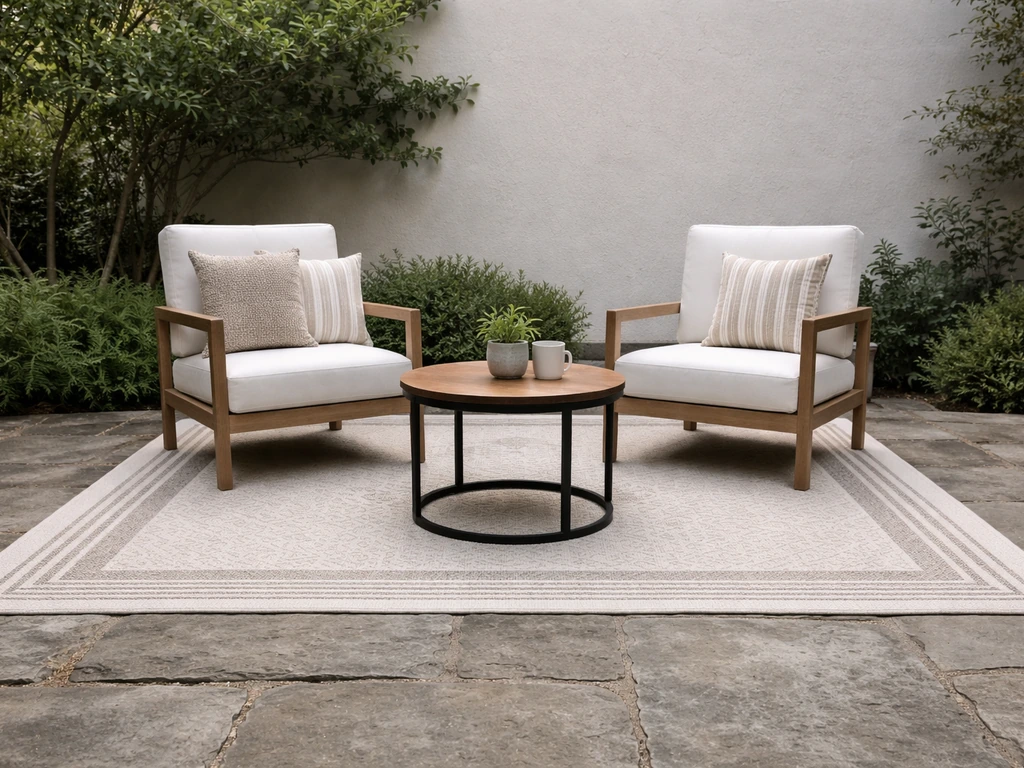
A rug does two jobs on a patio: it visually anchors the seating area so it reads as a room, and it physically defines the space so people know where the gathering zone begins and ends. Get the size wrong and the whole arrangement looks off, even if every individual piece is nice. A rug that's too small floats like an island under the coffee table, while furniture towers around it. A rug that's too large bleeds into walkways, traps moisture near your house, and can actually block door swings.
A 'good fit' means the rug is large enough that at minimum the front legs of all your furniture rest on it, and ideally all four legs sit on the surface. Around the perimeter of the rug, you want a visible border of patio surface showing, roughly 18 inches if your space allows, or at least 8 inches in tighter spots. That exposed border keeps the rug from looking wall-to-wall and lets the eye read the whole patio as a unified area rather than a covered floor.
Measure your patio and seating area (quick checklist)
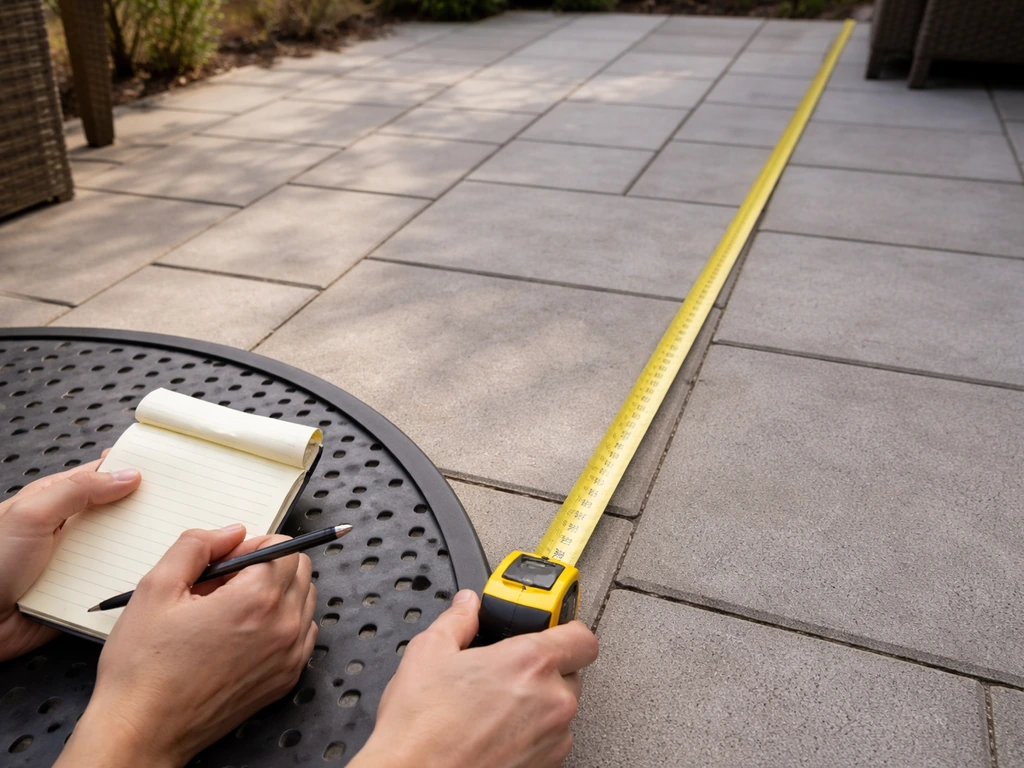
Before you shop, spend five minutes with a tape measure and write these numbers down. Getting them on paper (or your phone) saves you from buying the wrong size and having to deal with returns. If you want a quick shortcut, follow these patio size recommendations to pick the right rug dimensions for your seating area.
- Measure the total usable patio area: length and width from edge to edge, noting any fixed obstacles like posts, built-in planters, or the house wall.
- Identify where walkways need to stay clear: doorways, gate openings, and paths between zones. Mark how many inches of clearance those need (a standard door swing needs at least 30 to 36 inches from the door frame).
- Measure your furniture footprint as a group, not each piece individually. Pull chairs out to their 'in use' position and measure the whole cluster from the outermost point of one side to the outermost point of the other, both length and width.
- Note the depth of your sofa or chairs from front leg to back leg, especially for lounge seating where back legs can be several feet behind the front.
- Subtract the border you want to leave exposed (18 inches per side in a larger space, 8 inches minimum in a tight one) from the total usable area to get your maximum rug size.
- Cross-check: does your minimum rug size (furniture footprint plus 24-inch extensions) fit inside your maximum rug size? That is your target range.
Rug sizing rules for common layouts: lounge vs. dining
Dining set layouts
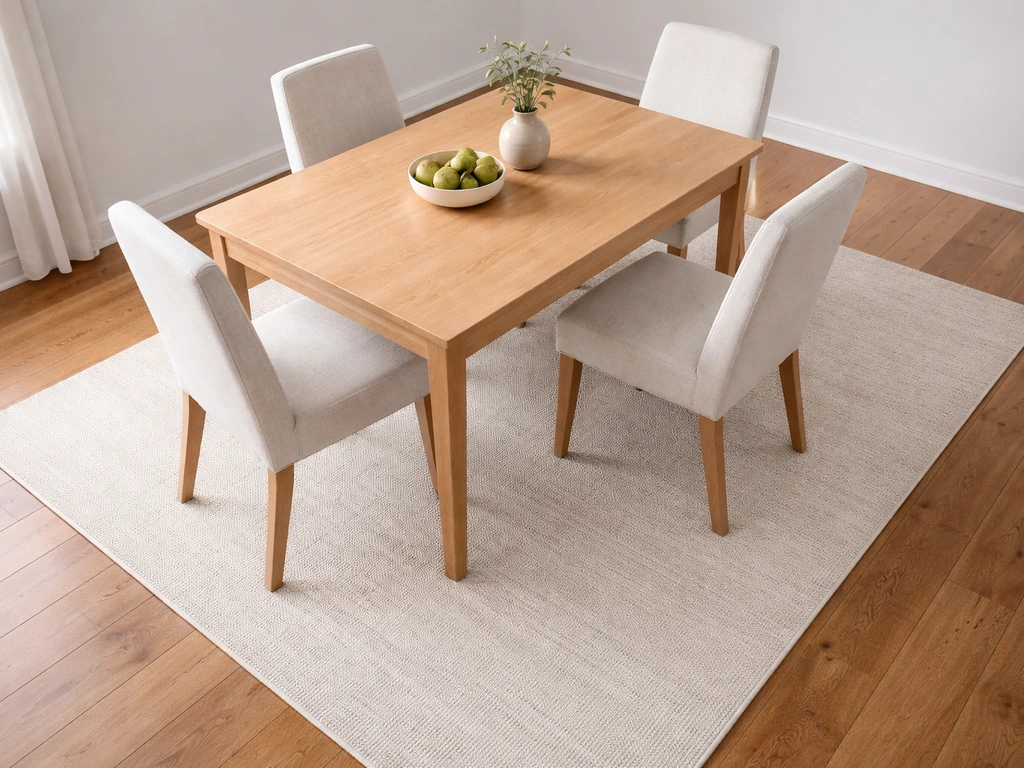
For a dining table with chairs, the rule is simple but non-negotiable: every chair leg must stay on the rug even when the chair is pulled out to sit down or stand up. If a chair leg catches the rug edge every time someone scoots back, the rug is too small and it will drive everyone crazy. The standard recommendation is to extend the rug at least 24 inches beyond the table edge on all sides, with some sources suggesting up to 30 inches if your chairs are deep. Use the patio size guide approach by measuring your table edge and planning for the same all-around extension so chairs stay on the rug. For a 36x60-inch rectangular table (seats 4), that math gives you a minimum of about 7x8.5 feet, which rounds up to a standard 8x10. For a 36x72 (seats 6), you're looking at 7x10, so again an 8x10 works, or step up to 9x12 for comfortable chair pullout room.
Lounge and conversation set layouts
Lounge areas are more flexible because you're not dealing with chairs constantly sliding in and out. The minimum standard is that the front two legs of every sofa and chair in the grouping rest on the rug. This 'front legs on' approach works well in smaller spaces where getting all four legs on would require an impractically large rug. In larger spaces, floating all the furniture on the rug with balanced margins on all sides looks more intentional and polished. A good rule: the rug should be at least one foot wider than your seating group on each side. If your sofa and two chairs span 8 feet wide, you want a rug at least 10 feet wide.
How to size for different rug shapes
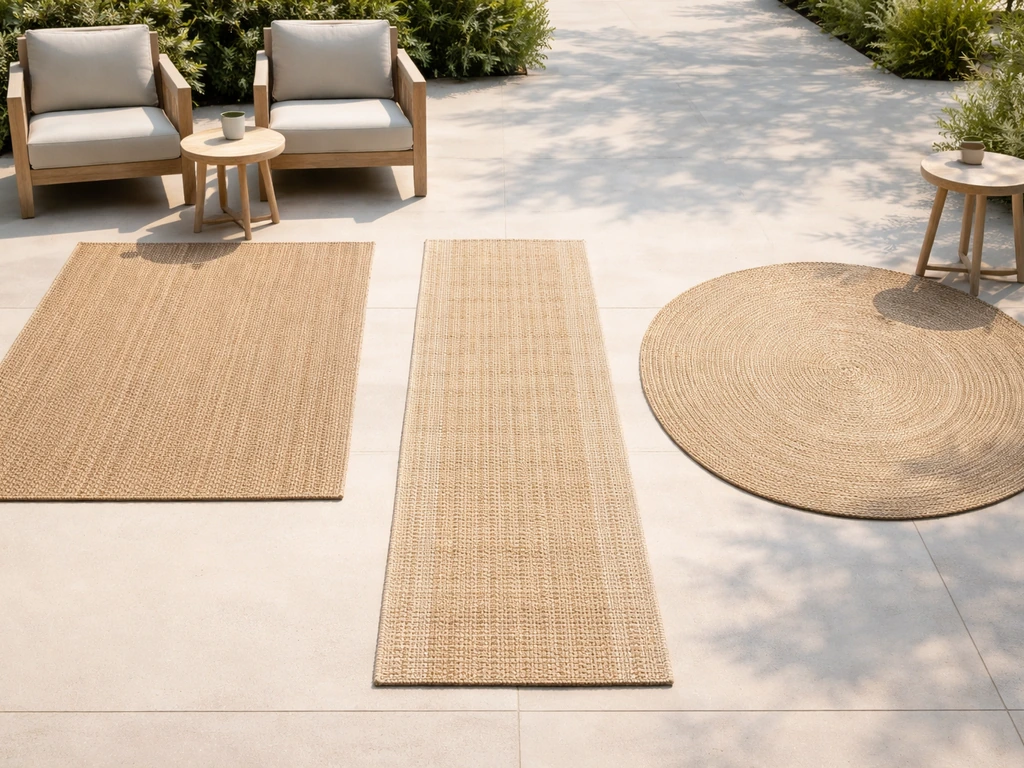
Shape changes the geometry of how you fit the rug, but the core sizing logic stays the same: enough coverage to anchor the furniture, enough border to frame it.
| Shape | Best for | Common sizes | Sizing tip |
|---|---|---|---|
| Rectangle | Dining sets, sectionals, long lounge groupings | 5x8, 6x9, 8x10, 9x12 | Most versatile. Add 24" to each table dimension to find minimum size. |
| Square | Square dining tables, symmetrical conversation sets | 6x6, 8x8, 10x10 | Match shape to table shape. Add 24" to each side of the table. |
| Round | Round tables, small bistro setups, accent zones | 4', 6', 8', 10' diameter | Add 24" to the table diameter. An 8' round works under a 48" round table. |
| Runner | Long narrow patios, poolside paths, covered walkways | 2x8, 2.5x10, 3x12 | Length should not exceed the active-use zone. Keep pathways open on both sides. |
Round rugs deserve a special mention for dining because they work particularly well under round and square tables. Wayfair calls this the '2-foot allowance' layout: the rug diameter simply needs to be about 2 feet larger than the table diameter, which gives chairs enough room to slide out. A 48-inch round table pairs cleanly with a 96-inch (8-foot) round rug. For oval tables, use a rectangle or oval rug and apply the same 24-inch extension rule to both the length and the width.
Placement tips and spacing clearances
Choosing the right size is half the job. Where you put it matters just as much.
- Door clearance: measure your door swing before placing any rug near a sliding or swinging patio door. The rug edge (plus any pile height) needs to sit outside the full arc of the door. Most doors need at least 30 to 36 inches of clearance from the door frame.
- Walkway clearance: keep at least 36 inches of clear path between the rug edge and any gate, stairs, or passage point. This prevents tripping hazards and lets the space feel open rather than cramped.
- Drainage and moisture: on ground-level patios, avoid positioning a rug directly over drain points or in areas where water pools. Even outdoor rugs trap grit and moisture underneath when they're sitting over drainage paths. Leave a few inches of patio surface exposed around any drain.
- Border spacing: target 18 inches of exposed patio surface around the rug perimeter in larger spaces. In tight spots, 8 inches is the working minimum to avoid the rug looking like wall-to-wall flooring.
- Furniture balance: center the rug under the furniture grouping, not under any single piece. Stand back and check that the rug looks equally spaced from the outer edges of the furniture on all sides.
Sizing examples with typical furniture dimensions
Here are real-world scenarios using standard patio furniture sizes, so you can find the one closest to your setup and use it as your starting point.
| Furniture setup | Furniture footprint (in use) | Minimum rug size | Recommended rug size |
|---|---|---|---|
| Bistro table (24" round) + 2 chairs | ~48" wide x 48" deep | 5' round or 4x6 | 5x7 rectangle or 6' round |
| Dining table (36"x60") + 4 chairs | ~72" wide x 96" deep pulled out | 7x9 | 8x10 |
| Dining table (36"x72") + 6 chairs | ~72" wide x 108" deep pulled out | 8x10 | 9x12 |
| Loveseat + 2 armchairs + coffee table | ~84" wide x 72" deep | 8x10 | 8x10 or 9x12 |
| 3-seat sofa + 2 chairs + coffee table | ~108" wide x 84" deep | 9x12 | 9x12 |
| Sectional (L-shape) + coffee table | ~120" wide x 120" deep | 10x10 or 9x12 | 10x14 or 10x10 square |
| Small 2-chair conversation set | ~60" wide x 48" deep | 5x7 or 5x8 | 6x9 |
Notice that in almost every case, the recommended size is either equal to or one step above the minimum. That's intentional. The minimum is the floor, not the target. A standard sofa with two armchairs lands at about 8x10, which is consistently what GrandinRoad, Mohawk, and Home Depot all point to as the go-to size for a typical lounge grouping. Mohawk Home’s “Area Rug Sizing Guide” PDF is intended to help you size patio area rugs relative to furniture groupings, including guidance for outdoor-use safety GrandinRoad, Mohawk, and Home Depot all point to as the go-to size. For a sectional or anything that reads as a large anchor piece, 9x12 is more appropriate.
Before you buy: confirming fit and handling tricky spaces
How to confirm the fit before ordering
Use painter's tape or chalk to outline your target rug size directly on the patio surface. Then set your furniture on top and live with it for a day. Pull the chairs out, walk around, open the door. This low-cost test will immediately tell you if the size is too small (chairs catch the tape line), too large (you're tripping over the edge near the walkway), or just right. It takes ten minutes and saves a lot of hassle with returns.
Dealing with irregular or partially covered patios
Not every patio is a clean rectangle, and that's where most people get stuck. If your patio is L-shaped, has a curved edge, or is only partially covered by a pergola or roof, focus the rug on the primary use zone, not the whole patio. Define the seating area first, then size the rug to anchor that zone specifically. Use the patio size guide steps to measure your space and choose a rug size that matches your table or seating layout. You can use a smaller rug to define a dining area at one end and a separate rug to define a lounge area at the other, rather than hunting for one giant rug that covers everything awkwardly.
For narrow or long patios, a runner is often a better answer than forcing a wide rectangle into a space that doesn't suit it. A 3x12 runner down the center of a long covered patio can define the path and anchor furniture along the sides without blocking access. Just make sure the runner length doesn't extend beyond the furniture zone, and keep at least 12 inches of patio surface visible on each long side.
What to do when the standard sizes don't quite work
Standard rug sizes jump in increments: 5x8 to 6x9 to 8x10 to 9x12. If your ideal size falls in between, always round up, not down. A rug that's slightly too large can be tucked under furniture or visually balanced with placement. A rug that's too small just looks wrong no matter what you do with the furniture arrangement. If you're considering a custom-cut outdoor mat instead of a standard rug, that's a different product category worth comparing separately, since the material, edge finishing, and weather performance differ significantly from a woven outdoor rug. If you're comparing a patio mat vs outdoor rug, focus on how each one handles moisture, foot traffic, and cleaning in your specific weather conditions custom-cut outdoor mat.
One last thing before you finalize: check the rug's pile height and backing against your patio surface. A thick-pile rug on an uneven stone patio will rock and shift. A rubber-backed rug on a composite deck can trap moisture and discolor the surface over time. The size decision and the material decision go hand in hand, especially outdoors where the conditions are harder on everything. Get the size right first, then make sure the construction suits where it's living.
FAQ
How much should I overlap the rug under my furniture if I want extra stability?
If your goal is stability, you can go slightly above the minimum, but keep a visible border around the perimeter. A common approach is allowing about 18 inches of exposed patio on at least one or two sides where you have walkway access, and using furniture weight (heavy table legs, non-skid pads) to prevent drifting rather than fully wall-to-wall coverage.
What if my dining chairs have wheels or casters, will rug size rules change?
Yes, you should plan for extra travel. With casters, chair legs and the seat can move farther than with stationary legs, so increase the all-around extension beyond the minimum (often aiming closer to 30 inches if your chairs are deep) and do the tape test with chairs pulled all the way back, not just sitting positions.
My patio has a door, should the rug still extend near it for anchoring?
Anchor the seating, but do not let the rug edge interfere with the door swing. During the tape test, open and close the door fully and watch for contact at the threshold. If there is conflict, keep at least the door clearance clear and shift the rug slightly so the furniture is anchored without blocking movement.
Can I use the same rug size guidance for a covered patio versus fully exposed outdoor space?
You can use the same size logic for anchoring and border, but exposure changes practical tolerance. On fully exposed patios, err toward rounding up, then choose a backing that drains well or uses a non-trapping underlayer to reduce moisture pooling near the house and along rug edges.
What should I do if my outdoor patio surface is uneven, like pavers or a slight slope?
Sizing alone will not fix rocking. For uneven patios, use a thin, supportive underpad or mat designed for outdoor use (and ensure it is compatible with the rug backing). Also reconsider going smaller, because a rug that is marginally sized is more likely to lift at edges when someone shifts position.
Do rug sizes include the fringes or border pattern, or should I measure the flat woven area?
Measure the full rug footprint you will actually place on the ground, including any border, but treat decorative elements like fringe as extra that should not bump against walkways or chair movement. If your rug has a raised edge or long pile on the perimeter, prioritize the flat base area so chair legs and pulled-out seating do not catch.
How do I choose between a standard rectangle rug and an oval/round rug for a non-round table?
Use the rectangle or oval for best geometry unless the table is clearly round or the seating naturally forms a circle. If you choose an oval or round rug for a rectangular table, apply the same extension logic on both directions, then confirm with the pullout-chair test so chair legs stay on the rug even at the farthest slide.
If my ideal size falls between standard options, is rounding up always better?
In most seating layouts, yes, because a slightly large rug can be balanced with placement and still sit under furniture. However, if the larger option would extend into a tight walkway or block door clearance, then round down for function and compensate by adjusting layout (move furniture inward) rather than forcing oversize coverage.
Is a runner a good option for a dining setup on a narrow patio?
Sometimes, but only if chairs still stay on the runner when pulled out. The runner approach works best when the furniture is centered and you can maintain rug contact under chair legs for the full seat-out motion. If chair legs will hang off the runner edge, switch to a wider rug or split into two zones with separate rugs.
Should I size the rug differently for a sectional with irregular shapes (L-shape, chaise, multiple modules)?
Plan around the main seating footprint instead of the manufacturer’s overall dimensions. Use the front-legs-on rule for the modules that you frequently sit on, then run the tape test with the chaise and any movable ottoman in place. If the chaise changes the front-leg position, base the rug size on the maximum common footprint.