
A patio rules sign should list your most important behavioral expectations in plain language, sized large enough to read from 10 to 15 feet away, printed on a weatherproof material like aluminum or PVC foam board, and mounted at eye level near the main entry point of the patio. For most shared, HOA, or short-term rental patios, that means covering quiet hours, smoking policy, pet rules, glass and alcohol guidelines, grilling restrictions, and a trash or cleanup expectation.
Patio Rules Sign: What to Write and How to Install It

Miles Sutton
5 May 2026
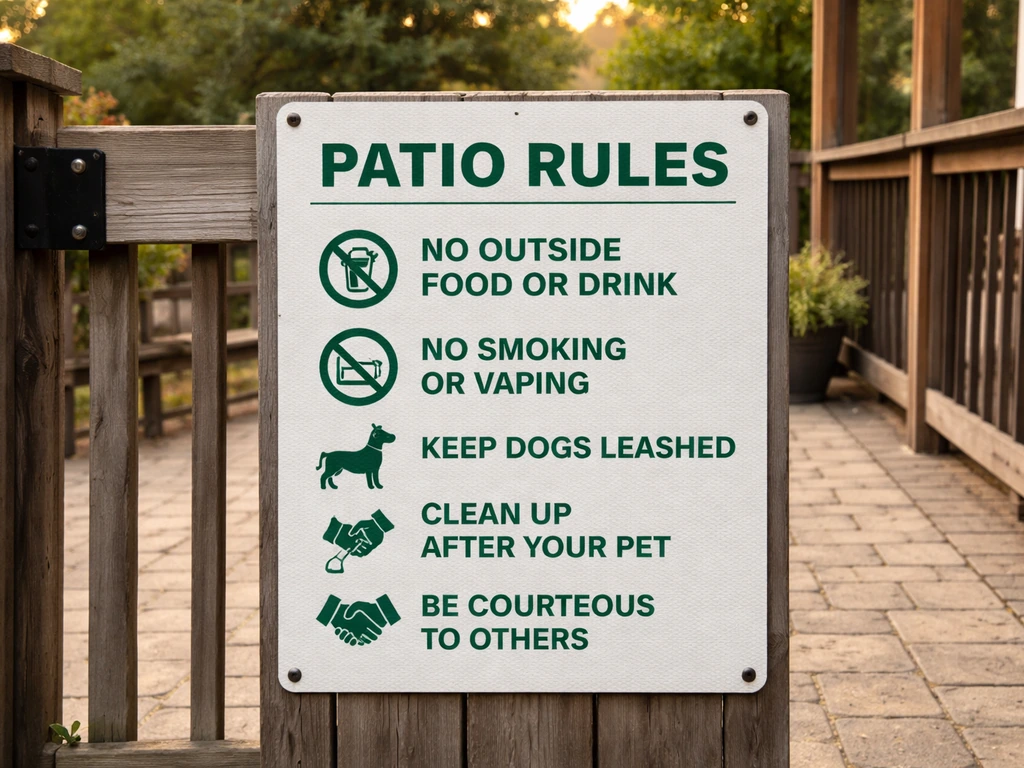
Private backyard setups can go lighter, but rental properties and community patios genuinely need every rule spelled out if you want them followed and if you want any enforcement to hold up. In real-world HOA enforcement discussions, commenters describe noise and behavior rule interpretation disagreements, showing why precise and consistent quiet expectations matter noise or behavior interpretation disagreements.
First: decide who the sign is actually for
Before you write a single word, get clear on your audience and your authority. A sign for your own backyard where you occasionally host friends is very different from a sign for a short-term rental patio, a condo shared courtyard, or an HOA amenity deck. The purpose shapes every decision that follows: what rules you can legally enforce, how many rules you need, and how formal the tone should be.
- Private backyard (personal use): Light rules, mostly reminders for guests. Tone can be friendly and informal.
- Short-term rental (Airbnb, VRBO, etc.): You need clear rules to protect your property and meet platform expectations. Every rule should be specific and verifiable.
- HOA or shared community patio: Rules must align with your HOA's governing documents. Enforcement language needs to match what the HOA can actually do.
- Apartment or condo common area: Building management or the HOA board typically sets the rules. Your sign should reflect the official policy, not personal preferences.
If you manage a shared or community space, pull your HOA or condo rules document before you write anything. Real community guidelines, like those from Oak Point HOA and Alcove Portland, specify exact quiet hours (commonly 10 pm to 7 am), grilling conditions, and pet policies. Your sign needs to match those documents exactly. Contradictions between what the sign says and what the official rules say will create headaches if you ever need to enforce anything.
What to actually put on the sign
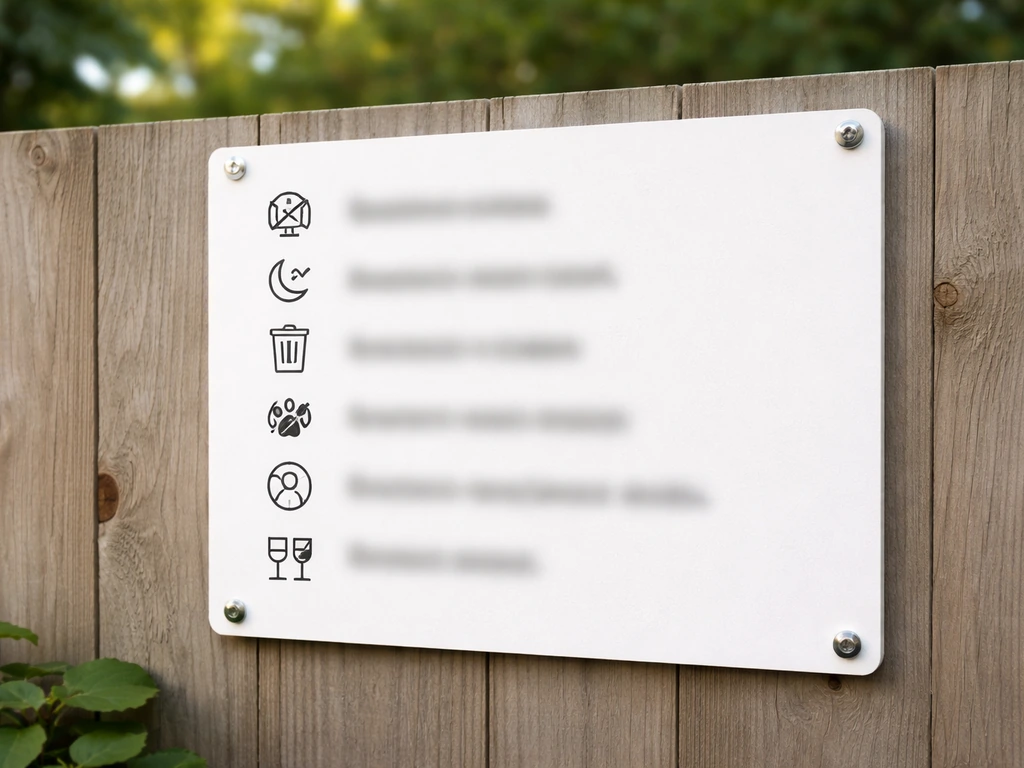
Keep this list tight. A sign crammed with 20 rules reads as noise and people skip it entirely. Aim for 6 to 10 rules maximum, covering the issues that actually come up. Here are the categories worth including for most patio situations, with practical wording guidance for each.
Quiet hours
Be specific. "Please be quiet" is useless. "No excessive noise between 10 pm and 7 am" is enforceable. If your HOA or local ordinance already sets these hours, use those exact times. Utah’s Ordinance 2023-02, for example, defines “daytime” as hours between 7:00 AM and 10:00 PM and uses defined time windows for noise rules If your HOA or local ordinance already sets these hours, use those exact times.. Many communities mirror local noise ordinances, and in HOA settings the board has the authority to fine based on those specific windows.
Smoking and open flame
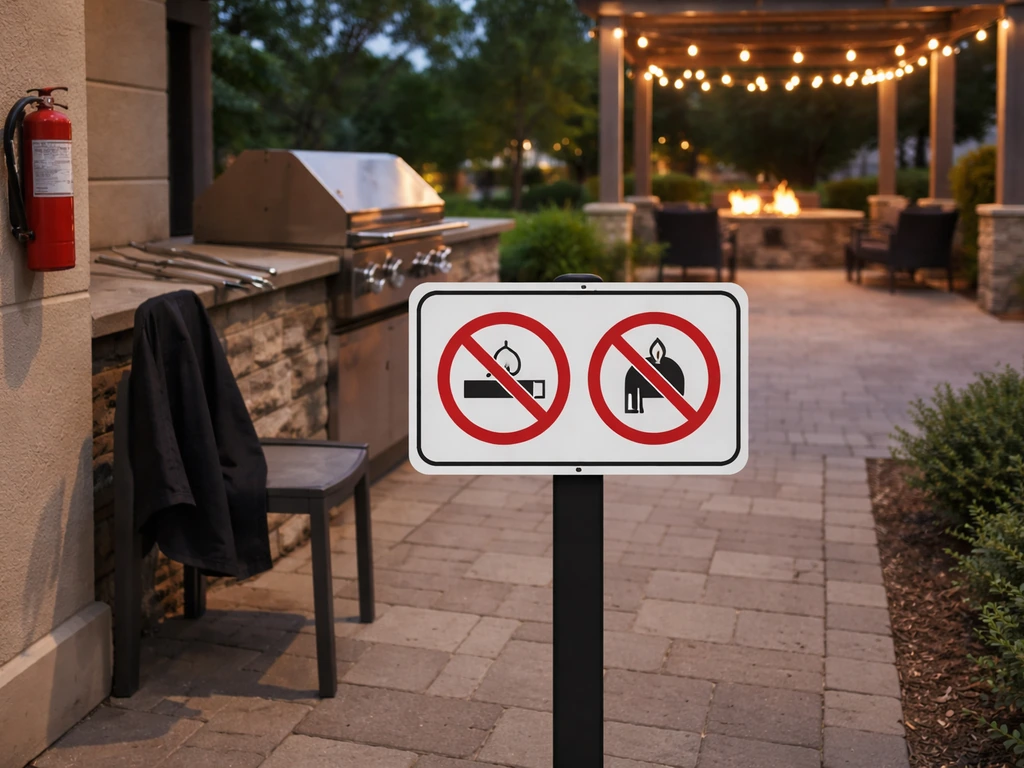
Most community patios prohibit smoking entirely, and many restrict open flames. If you allow grilling, state the conditions clearly. For example, the City of Woodbury, MN requires that no open flame be maintained within 15 feet of a structure on a ground-floor patio. If a rule like that applies in your jurisdiction, putting it on the sign protects you from liability and gives guests a concrete boundary rather than a vague warning. A simple line like "Grilling permitted on designated pad only, minimum 15 ft from building" is far more useful than "Please grill safely."
Pets
State whether pets are allowed, where they can go, and what owners are responsible for. "Pets must be leashed at all times. Clean up after your pet immediately." is the minimum. If your HOA reserves the right to remove pets that become a nuisance (as many do, including Oak Point HOA), you do not need to spell that out on the sign, but you should make sure your written rules document backs up whatever your sign implies.
Glass and alcohol
For any patio near a pool, playground, or high-traffic area, a glass prohibition is a genuine safety call, not just a preference. "No glass containers on the patio" is clear. If alcohol is restricted (rental or HOA rules), say so directly. If it is allowed but you want to limit liability, "Drink responsibly, glass containers prohibited" covers both.
Furniture, space, and usage limits
For shared patios, this matters more than people expect. "Do not move or remove patio furniture" and "Patio closes at [time]" are common entries. If there are weight or placement restrictions on planters or furniture (North Rim HOA, for instance, specifies size and securing requirements for potted plants on patios and rails), note those too, especially if an unstable planter could become a safety hazard.
Trash and cleanup
"Leave it as you found it" is a good starting point, but more specific is better: "Dispose of trash in bins provided. Recycling in blue bin only. Report spills immediately." For rental properties, adding a cleanup expectation protects your damage deposit process.
Patio hours and reservations
If the patio has set hours or a reservation system, that goes on the sign. "Open daily 8 am to 10 pm" or "Reservation required for groups of 6 or more" are the kinds of entries that prevent the most common conflicts.
Emergency contact or location info
For rental properties and community spaces, add a contact number or location reference at the bottom of the sign. "For emergencies call [number]" or "Nearest exit: east stairwell" takes up minimal space and can matter a lot in a real situation. This is also a detail that short-term rental platforms increasingly expect hosts to provide.
Outdoor sign materials: what actually holds up
The material you choose determines whether the sign looks professional in five years or peels and fades in eighteen months. There are four main options worth considering for outdoor patio use, each with real trade-offs on cost, durability, and appearance.
| Material | Best for | Weather/UV resistance | Typical cost (12x18") | Notes |
|---|---|---|---|---|
| Aluminum (flat or corrugated) | Long-term outdoor use, HOA/rental | Excellent, won't rust or fade quickly | $20–$45 | Lightest durable option, easy to mount, industry standard for outdoor signage |
| PVC foam board (Sintra) | Semi-permanent use, covered patios | Good if UV-laminated, can yellow over time | $15–$30 | Lightweight, cuts easily for custom shapes, not ideal in full sun without UV coating |
| HDU (high-density urethane) | Decorative, upscale look | Excellent, paintable and carvable | $60–$150+ | Premium option for HOA entrance or high-visibility spots |
| Plastic/acrylic | Indoor-adjacent, covered patios | Moderate, can crack in freeze-thaw cycles | $15–$35 | Good print quality but not ideal in harsh climates without backing |
| Wood (cedar, teak, or treated) | Private backyard, decorative use | Moderate with sealant, needs maintenance | $25–$80 | Looks great but requires annual sealing; not recommended for unattended rental properties |
For most homeowners doing this practically and wanting it to last, aluminum with a UV-resistant digital print is the move. It is the same material used for street signs and professional real estate signage. A 12x18 inch aluminum sign from an online print shop typically costs between $20 and $40 and arrives ready to mount. If the look matters for a nicer property, HDU or a routed wood sign with painted letters is worth the upgrade, but factor in periodic maintenance.
Finish and lamination
Whatever material you choose, opt for UV-resistant ink and a matte or semi-gloss laminate. Gloss looks sharp when new but creates glare in sunlight, making the sign harder to read. Matte laminate protects the print from UV fading and is easier to read at angles. For mounting hardware, use stainless steel or coated screws and standoffs. Standard zinc or uncoated steel screws will rust and streak the sign face within a season in most climates.
Size, wording, and layout: readable in 3 seconds
A patio rules sign is not a lease agreement. People glance at it while carrying a drink and a folding chair. If it takes more than three seconds to get the gist, it will be ignored. Design for the scan, not the deep read.
Recommended sizes
- 12x18 inches: Good for a small private patio or a secondary reminder sign. Readable from about 8 to 10 feet.
- 18x24 inches: The standard workhorse size for most shared or rental patios. Readable from 12 to 15 feet, fits 8 to 10 rules comfortably.
- 24x36 inches: Use this for large community patios, pool decks, or high-traffic areas where people will be farther away. Also good if you need bilingual text.
Font size and layout
A headline like "PATIO RULES" should be at least 1.5 to 2 inches tall (roughly 100 to 140 pt type). Individual rule lines should be a minimum of 0.5 inches tall (around 36 pt) for readability at 10 feet. Use a clean sans-serif font like Arial, Helvetica, or Montserrat. Avoid script fonts entirely; they look nice at close range and become illegible at a distance or in low light. Keep line spacing generous, at least 1.5x the font size, and use bullet points or numbered items rather than paragraph text. High contrast is critical: dark text on a light background, or white reversed out of a dark background. Avoid mid-tone combinations like gray on beige.
Icons and multilingual text
Simple icons next to each rule (a cigarette with a slash, a dog silhouette, a clock) help non-readers and multilingual users parse the sign faster. Most sign-making platforms let you add icons from a library at no extra cost. If your rental or community has non-English speakers, consider a bilingual layout. Spanish is the most common second language in the US, but check your actual community. A two-column layout with English on the left and the second language on the right keeps things organized without doubling the sign size.
Where to put the sign so people actually see it
Placement is where a lot of well-designed signs fail. Tucking a rules sign in the corner near the trash cans, or mounting it at ankle height on a fence post, means almost no one reads it. You want the sign at eye level (between 5 and 6 feet from the ground to the center of the sign) and positioned where every person entering the patio will naturally look.
- Mount near the primary entry point: If there is a gate, door, or obvious path into the patio, that is your first-choice location. People are attentive when they enter a new space.
- Use a secondary location for large patios: A big community deck or courtyard benefits from a second sign at the far end or near the grill/fire pit area where specific rules are most relevant.
- Avoid partial obstruction: Do not place the sign where a plant, umbrella, or piece of furniture will block it half the time. Walk the space at different times of day and check sightlines.
- Keep it off the ground: A ground-level sign on a stake looks temporary and reads as unimportant. Wall-mount or post-mount at standing eye level.
- Consider lighting: If the patio is used at night (and quiet hours rules matter most at night), the sign needs to be in a lit area or have its own small spotlight aimed at it.
Mounting hardware options
For wall mounting, standoff mounts (the small hardware pieces that hold the sign slightly off the wall surface) look professional and blank" rel="noopener noreferrer">prevent moisture from being trapped behind the sign. For a fence or post, use through-bolts with weather-resistant backing rather than just screws, which can pull out over time. If you need a freestanding sign, a double-post stake system with a 4x4 post works well for turf or mulch areas. Avoid plastic zip ties as a long-term mounting solution: they UV-degrade and fail, usually at the most inconvenient moment.
DIY vs. ordering from a sign shop
You have two real paths here: design and order online, or make it yourself. Both are legitimate depending on your budget, the stakes (no pun intended), and how polished the result needs to look.
Ordering online (the most practical route for most people)
Online sign vendors like Vistaprint, Signs.com, BuildASign, and similar services let you upload a design or use their templates, choose your material, and have a finished sign delivered in 3 to 7 business days. Before you order, measure the exact mounting location and check what hardware you need (most vendors sell mounting kits separately). Know whether you want holes pre-drilled and where, and confirm the bleed area on the design template so text does not get trimmed. For an 18x24 aluminum sign, expect to pay $30 to $55 depending on finish and quantity. Ordering two is often not much more expensive and gives you a backup.
DIY options
If you want to make it yourself, the most practical approach is printing on waterproof vinyl paper or a self-adhesive vinyl sheet and applying it to a painted aluminum or PVC backing. A home inkjet printer with waterproof ink (Epson EcoTank with pigment ink, for example) can handle this if you use the right media.
You can also use a Cricut or Silhouette cutting machine to cut vinyl lettering for a clean, layered look on a painted wood or aluminum substrate. The honest trade-off: DIY can look great and costs less upfront, but it is more time-intensive and the results depend heavily on your equipment and design skill. For a private backyard, DIY is totally reasonable.
For an HOA or rental property where the sign represents your professionalism and legal seriousness, ordering a finished product is worth the extra cost.
What to measure and confirm before ordering
- Exact mounting surface dimensions and any height or size restrictions from your HOA
- Distance from the sign to the primary viewing spot (this determines minimum font size)
- Wall or post material (determines what hardware you need)
- Whether you need pre-drilled holes, grommets, or a specific mounting configuration
- Local HOA or building management approval if required before installing anything permanent
Safety, compliance, and making the rules actually stick
A sign is only enforceable if the rules on it are consistent with your actual governing documents and local codes. If you are posting rules for a UCF patio, double-check the relevant UCF patio code so your sign stays consistent with campus requirements. This sounds obvious, but it is where a lot of people run into trouble. If your sign says "No grilling within 10 feet of the structure" but your city ordinance requires 15 feet (as Woodbury, MN does), and an incident occurs, the sign may actually work against you by implying you set a standard you knew was below code. Always match or exceed local and HOA requirements, never set a lower bar.
For HOA and shared spaces, keep these compliance points in mind before installing anything:
- Check whether sign placement or installation requires board approval in your HOA's CC&Rs or rules documents.
- Make sure enforcement language on the sign is something your HOA or management company can actually back up. Threatening fines you cannot levy undermines your credibility.
- For rental properties, your sign is documentation. Keep a photo of it with a timestamp as part of your property records in case a guest disputes the rules.
- Do not include safety instructions you cannot verify are accurate, such as specific fire suppression steps or emergency procedures, unless you have confirmed them with local fire or safety authorities.
- Review the sign annually. Local ordinances change, HOA rules get updated, and a sign that was compliant when you installed it might not be two years later.
One practical note on tone: rules signs that are aggressive or loaded with "violators will be prosecuted" language tend to create a hostile atmosphere without actually improving compliance. A firm, clear, professional tone works better. State what is expected, not just what is prohibited. "Quiet hours 10 pm to 7 am, thank you" gets better results than "NOISE VIOLATIONS WILL BE REPORTED." This is especially true for rental properties where the guest experience directly affects your reviews.
Your next steps to get this done today
Here is a simple workflow to go from where you are now to a sign that is mounted and working within a week or two.
- Pull your governing documents: HOA rules, rental platform policies, or local ordinances. Note exact quiet hours, grilling restrictions, and any pet or smoking policies already in writing.
- Draft your rule list: Aim for 6 to 10 items. Write each rule in one plain sentence. Read them out loud. If a rule sounds like a legal clause, rewrite it.
- Measure your mounting location: Wall width, height availability, and distance to where people will be standing when they read it.
- Choose your size: 18x24 inches for most shared or rental patios; 12x18 for a small private space.
- Pick your material: Aluminum for durability, PVC foam board for a budget option on a covered patio, HDU or wood if aesthetics are the priority.
- Design or upload: Use a free tool like Canva or the template builder on your chosen sign vendor's site. Set the headline large (at least 1.5 inches), use a clean sans-serif font, and add icons for the key rules.
- Confirm pre-drilled hole locations before submitting the order.
- Order your mounting hardware separately if needed: stainless standoffs for wall mounting, stainless through-bolts for fence or post mounting.
- Get HOA or management approval in writing before installing if your situation requires it.
- Install at eye level (5 to 6 feet to sign center) at the patio entry point, and photograph the installed sign for your records.
The patio rules conversation also connects naturally to the broader topic of what your outdoor patio design can and cannot include under local codes, from slope and drainage requirements to what structures you can add. Patio design code guidelines in ACNH also follow similar logic: keep layouts safe, readable, and compliant with local-style building rules outdoor patio design.
If you are building or renovating while you are thinking about this, it is worth reviewing the full set of patio rules and design rules that apply to your property type, since a sign is easier to get right when the underlying setup already meets code.
If your patio has a sloped surface, you may also need to account for the patio slope code in your design and any placement or drainage expectations on the sign patio rules and design rules. The sign is the last step, not the only step.
FAQ
How do I write patio rules if my HOA quiet hours differ from the city ordinance?
Use the governing document that has priority for enforcement in your situation. If your HOA specifies different quiet hours than the city, match the HOA hours on the sign and keep a copy of the HOA rule text in your files in case there is a dispute. If both apply, design the sign to avoid contradictions, for example “Quiet hours apply per HOA, 10 pm to 7 am” rather than citing two different windows.
What if I want to include rules that are “nice to have” but not truly enforceable?
Separate enforceable expectations from preference-based requests. Put enforceable items (quiet hours, no glass, trash handling, approved grilling method) on the sign, and keep softer guidance for a separate note to residents or guests. If you include too many unenforceable preferences, people will treat the entire sign as optional.
Should my patio rules sign include fines or consequences?
For most shared and rental settings, avoid listing specific penalties on the sign. Instead, keep the language expectation-focused (for example “Quiet hours 10 pm to 7 am”) and refer to the official HOA or rental policy for consequences. This reduces the risk that the sign overpromises authority or misstates amounts or procedures.
Can I put “No grilling at all” if some residents or guests grill already?
You can, but make it operationally clear and consistent. If you want to ban grilling, state “No grilling” plus any allowed alternatives if applicable (such as “Electric grills only on designated pad”). If you allow grilling under conditions, write the conditions precisely so guests are not guessing from a blanket statement.
How many rules should a patio rules sign really include?
Use 6 to 10 as your target for quick scanning, and rank them by likelihood of conflict (noise, smoking, glass, pets, trash, alcohol, hours). If you have more than 10, split into two signs or shorten wording by using consistent categories instead of extra explanations.
Do I need to list specific pet behavior details on the sign?
List the minimum that changes guest behavior: whether pets are allowed, leash requirement (or designated areas), and immediate cleanup. If your governing documents allow you to remove nuisance animals but you do not want that language on the sign, phrase the sign around expectations, for example “Pets must be leashed and owners must clean up immediately.”
What is the best way to handle “reservation required” or “patio closes at” rules?
State the exact hours and any reservation rules in one line each. If groups require booking, add a threshold like “Groups of 6 or more require reservation” and indicate where bookings are made (front office number or property manager contact). If the patio can be used outside hours for emergencies or events, clarify that exception so guests do not feel misled.
Where should the contact number go so it is actually useful?
Put it at the bottom but make it scannable: a single line for “Questions or noise concerns” and a separate line for “Emergencies.” For rentals, include the fastest response method, often a property manager phone, and optionally an after-hours number if you have one.
My sign is readable in daylight, but not at night. What should I adjust?
Prioritize contrast and visibility over aesthetics at night. Use dark text on a light background or reflective-safe finishes, and avoid mid-tone colors. If lighting is limited, consider a larger font size or an even higher contrast color pairing, and place the sign where it catches existing ambient light.
What mounting height is best if people enter from different sides of the patio?
Aim for eye level around 5 to 6 feet to the center of the sign, but if the patio has multiple entrances, consider adding a second sign at the other entry rather than placing one too high or too low. A sign that is perfectly positioned for one entrance often becomes “invisible” from the other side.
Can I use tape, zip ties, or temporary mounting to save time?
Not recommended for long-term outdoor use. UV exposure and weather will degrade adhesive and zip ties quickly, which can leave the sign dangling or unreadable. For most setups, use proper standoffs, coated or stainless fasteners, and through-bolts with weather-resistant backing when mounting to posts or rails.
Is it okay if my sign is slightly stricter than local code?
Yes, being stricter is generally safer than being looser, but it must still align with HOA or property rules you are subject to. If you tighten a rule beyond code, ensure it is realistic to enforce and not contradictory internally. In all cases, avoid writing a lower standard than code for safety and liability reasons.
What should I include on a patio rules sign for a pool area?
Besides glass prohibition and hours, add rules that reduce risk and confusion: “No running,” “Children must be supervised by an adult,” and “Rinse off sand before entering” if your facility requires it. If alcohol is restricted, mention the alcohol condition specifically, since pool areas often have tighter controls than the rest of the patio.
How do I update an existing patio rules sign when HOA or rental policies change?
Do not keep outdated information on the sign while you wait to reprint. Update immediately by swapping only the affected section if your design allows it (for example, separate label plates) or reorder a replacement sign. A mismatch between the sign and the governing policy creates enforcement problems and can undermine trust with guests.