
Getting quality pools and patios right comes down to three things: knowing what you actually want, understanding what your site will support, and matching your budget to realistic costs before a single shovel hits the ground. A well-built pool and patio combo can run anywhere from about $35,000 for a modest above-ground setup with a stamped concrete deck to well over $150,000 for a gunite pool with a full outdoor living area, according to regional benchmarks from the HomeAdvisor True Cost data and RSMeans construction cost databases. That range is wide enough to make planning non-negotiable.
Quality Pools and Patios: Design, Build, Convert & Maintain

Miles Sutton
4 Aug 2026
Who this guide is for and what you'll walk away with
Whether you're a homeowner staring at a blank backyard, a DIYer who wants to tackle as much as possible yourself, or someone deciding between outlets and contractors, this guide covers the full journey. I'll walk you through modern design trends, how to measure and plan your space, materials comparisons with real cost ranges, site prep and drainage essentials, and the honest DIY-versus-professional decision. By the end you'll have a clear picture of what a quality pool and patio project involves, what it costs, and exactly how to move forward without costly surprises.
Today's pool and patio trends worth knowing about
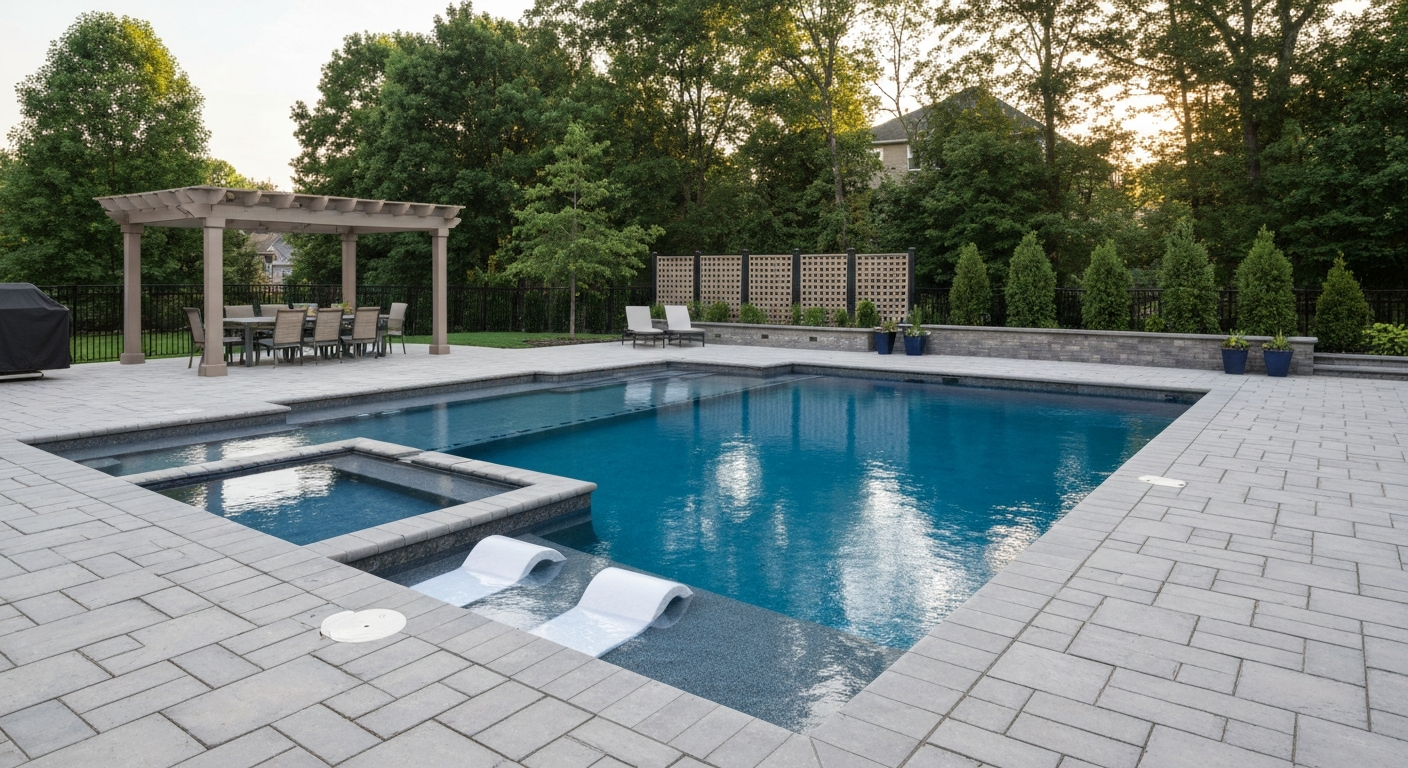
The biggest shift in backyard design right now is the move toward cohesive outdoor living rooms rather than isolated pool areas. Pools are being treated as anchors for a full entertaining zone, with the patio surface, seating walls, pergolas, and landscaping all planned together from the start. Plunge pools (typically 10x12 to 12x15 feet) are surging in popularity because they fit smaller lots, cost significantly less than a full-size pool, and can be installed faster. On the larger end, negative-edge (infinity) designs and sun shelves with built-in loungers remain a top request at pool and patio showrooms.
Material trends reflect a preference for natural-look finishes. Large-format porcelain pavers (24x24 or 24x48 inches) now dominate high-end patio decks because they resist fading, hold up to pool chemicals, and require almost no sealing. Brushed or honed concrete continues to be the workhorse choice at mid-range budgets. On the pool interior, pebble and exposed quartz aggregate finishes have largely replaced plain plaster at the mid-to-upper tier; they last 15 to 25 years versus 7 to 12 for basic white plaster.
Retail outlets and showrooms that specialize in pools and patios have evolved considerably. Many now offer full-package design-build services alongside product sales, so you can walk in, see material samples, get a rough estimate, and meet a contractor in the same visit. If you're exploring today's pool and patio retailers and outlets in your area, keep an eye out for those that stock both hardscape materials and pool equipment under one roof. For product selection and integrated design-build services, check today's pool and patio outlet for local showrooms that stock hardscape materials and pool equipment under one roof. You can also visit Law Pools & Patio for in-person samples and integrated design-build options. For local selections and sample displays, check today's patio outlet for curated product lines and design-build services. For local options and showroom comparisons, check today's pool & patio retailers for combined hardscape and pool equipment offerings. That kind of integration saves you from having to coordinate two separate vendors for materials and installation.
Project planning: goals, scope, budget, and timeline
Start by writing down what you actually want the space to do. Is this primarily for lap swimming, family recreation, entertaining adults, or all three? That answer dictates pool shape, depth, and the proportion of patio to water. A lap pool needs 40 to 75 linear feet. A family recreation pool typically lands at 12x24 to 16x32 feet. An entertainment-focused pool can be smaller and shallower if a generous patio surrounds it.
Once you know the use case, set a real budget with a 15 to 20 percent contingency built in. Using RSMeans location-adjusted unit costs and the 2025 Cost vs. Value benchmarks from Remodeling Magazine, a realistic starting point for a mid-range in-ground pool (vinyl liner, 16x32 ft) plus a 600-square-foot concrete patio is around $55,000 to $75,000 depending on your region. Gunite or shotcrete pools at the same size start closer to $70,000 to $95,000. These are installed costs, not materials-only prices.
Timeline planning is just as important. Permit approval alone can take 2 to 8 weeks in most jurisdictions. Pool excavation and shell construction (for gunite) takes another 4 to 8 weeks. Patio work runs 1 to 3 weeks. Factor in equipment lead times, which in 2025 and 2026 remain extended for some automation and heat pump systems. Realistically, a full pool and patio project from permit application to final inspection takes 3 to 6 months in most markets.
Permits and legal requirements you can't skip
Permits are not optional. Most jurisdictions that have adopted the International Swimming Pool and Spa Code (ISPSC) from the ICC require a building permit for any in-ground pool, plus separate electrical and plumbing permits. IAPMO’s Uniform Swimming Pool, Spa and Hot Tub Code (USPSHTC) is an ANSI‑designated model code covering water quality, suction entrapment protections and construction provisions used by some jurisdictions and useful for designers and spec authors when the ISPSC isn’t adopted locally Uniform Swimming Pool, Spa and Hot Tub Code (IAPMO). The Virginia Graeme Baker Pool and Spa Safety Act (VGBA) is federal law and requires compliant anti-entrapment drain covers on all residential pools, regardless of when they were built. If your pool predates the 2008 VGBA, a retrofit is not optional, it's a legal requirement. NEC Article 680 under NFPA 70 governs all pool electrical work: bonding, GFCI protection, and equipotential bonding grids must be installed by or inspected by a licensed electrician. No exceptions. For contractor verification, California homeowners can check the CSLB C-53 Swimming Pool classification, and Florida homeowners can verify credentials through the DBPR Certified Pool/Spa contractor database. Other states have equivalent licensing boards.
Sizing and layout: measuring and planning usable space
Start with a site survey before you design anything. Measure your lot boundaries, note all setbacks (most municipalities require 5 to 10 feet from property lines for in-ground pools), and locate utilities using a 811 call-before-you-dig request. Mark any existing drainage patterns, downspout termination points, and low spots. These will affect where water goes during heavy rain, which matters a lot once you've covered a large portion of your yard with impervious patio surface.
A common rule of thumb for patio-to-pool ratio is 2:1 or 3:1, meaning for every square foot of pool surface you want at least 2 to 3 square feet of patio deck. For a 400-square-foot pool (roughly 16x25 ft), that means 800 to 1,200 square feet of deck. That may sound like a lot, but it fills up fast once you account for chaise lounges, a dining set, and a path to the house. Cramped decks around pools are one of the most common complaints I hear from homeowners after the fact.
Leave at least 4 feet of clear deck width on all pool sides where people will walk. On the primary entertaining side, 10 to 12 feet of unobstructed deck is ideal. Equipment pads (pump, filter, heater) need 3 to 4 feet of clearance on access sides and should be positioned for short, direct plumbing runs, typically 6 to 10 feet from the pool wall.
Sample layouts for common yards and pool types
Below are four layout templates that cover the most common homeowner scenarios. These aren't rigid blueprints, but they give you a starting frame to work from when you sketch your own plan.
- Small rectangular lot (50x100 ft usable yard): A 12x24 ft rectangle pool positioned toward one end, with a 10-foot setback buffer on three sides, leaves room for a 600 sq ft L-shaped patio on the house-facing end. Equipment pad fits along one side fence. Works well for family recreation.
- Medium suburban backyard (70x120 ft): A 16x32 ft pool centered left-of-center allows a 1,000 sq ft patio on the right side for dining and seating, plus a 15-foot planting buffer along the back fence. A small pergola or shade structure anchors the patio corner.
- Narrow lot (40x120 ft): A plunge pool (10x15 ft) positioned at the far end with a continuous 500 sq ft patio runner from house to pool keeps the yard feeling open. Raised planters along both long fences add privacy.
- Large corner lot or estate yard (over 100x150 ft): Full resort-style layout with a 20x40 ft pool, beach entry or sun shelf at one end, 1,500+ sq ft of patio split into zones (dining, lounging, outdoor kitchen), and a separate spa. Negative-edge design works well here if the lot has natural grade change.
If you've inherited a yard with an old pool you're thinking about removing and replacing with a full patio space, the planning process is similar but includes pool demolition costs ($5,000 to $15,000 depending on method) and a longer site prep phase for compaction and fill. If you're converting an old pool, review this concise checklist for costs, grading, drainage, and permits specific to creating a patio where pool used to be. That conversion scenario has its own specific considerations around grading and drainage that are worth reviewing separately.
Materials comparison: costs, durability, and trade-offs
Choosing the right materials is where a lot of homeowners get overwhelmed. Here's a straightforward comparison of the most common patio and pool deck materials, with honest notes on performance and cost. All cost ranges are installed, using RSMeans and regional contractor benchmarks as of mid-2026.
| Material | Installed Cost (per sq ft) | Durability | Maintenance | Best For | Watch Out For |
|---|---|---|---|---|---|
| Broom-finish concrete | $6–$12 | 25–40 years | Low (seal every 2–3 yrs) | Budget builds, large areas | Cracks over time; limited aesthetics |
| Stamped/colored concrete | $12–$22 | 20–35 years | Medium (reseal regularly) | Mid-range, custom looks | Slippery when wet; color fades |
| Pavers (concrete) | $15–$25 | 30–50 years | Low (reset individual units) | Flexible design, easy repair | Weeds in joints; needs proper base |
| Natural stone (travertine, bluestone) | $20–$40 | 40+ years | Medium (seal periodically) | Premium aesthetics, cool underfoot | Higher cost; some stone slippery wet |
| Large-format porcelain pavers | $25–$50 | 40+ years | Very low (no sealing needed) | High-end, low-maintenance builds | Requires movement joints per TCNA EJ171; professional install recommended |
| Wood deck (pressure-treated) | $15–$28 | 15–25 years | High (stain/seal annually) | Warm aesthetic, above-ground pools | Splinters; degrades near water if unmaintained |
| Composite decking | $30–$55 | 25–35 years | Low | Clean look, less maintenance than wood | Higher upfront cost; heat retention in sun |
| Vinyl liner pool shell | ($3–$6/sq ft liner replacement) | Liner 7–12 yrs | Medium | Budget in-ground pools | Liner tears; limited shape options |
| Fiberglass pool shell | ($45K–$85K installed pool) | 50+ years (gel coat) | Low | Fast install, smooth finish | Shape/size limited by mold options |
| Gunite/shotcrete pool shell | ($60K–$120K+ installed pool) | 50+ years (with maintenance) | Medium (resurface every 10–25 yrs) | Custom shapes, any size | Longest build time; requires skilled nozzlemen (ASA/ACI 506 standards) |
A note on gunite and shotcrete: the American Shotcrete Association and ACI Committee 506 set the quality benchmark for pool shells at a minimum 4,000 psi in-place compressive strength. When interviewing pool contractors, ask specifically about their shotcrete crew's certification and whether they use a certified nozzleman. This is one of the most meaningful quality questions you can ask, and a reputable contractor will have a direct answer.
For porcelain pavers specifically, the TCNA Handbook method EJ171 requires exterior movement joints at roughly 8 to 12 foot spacing. This is not decorative, it's a structural requirement to prevent cracking and tile pop-up. Any installer who doesn't mention movement joints when bidding a porcelain paver deck is a red flag.
Site prep, drainage, and grading done right
Poor drainage is the single most common reason quality pool and patio projects fail early. Water that pools on or near your patio erodes base material, heaves pavers, undermines pool shell backfill, and creates safety hazards. Before any hardscape goes down, the grading around your project needs to direct water away from the house and pool at a minimum 1 to 2 percent slope (roughly 1/8 inch per foot).
Pool decks specifically should drain away from the pool at a 1 to 1.5 percent slope. That means for every 10 feet of deck, the outer edge sits about 1.5 inches lower than the pool coping. This keeps deck runoff, including fertilizer, sunscreen, and debris, from draining back into your pool water.
For larger patios, especially those over 800 to 1,000 square feet, channel drains or area drains tied to a proper outlet (daylight at a lower grade, a dry well, or a municipal stormwater connection where allowed) are worth the added cost. Permeable paver systems are another strong option. The EPA's stormwater Best Management Practices guidance confirms that permeable pavement systems with a properly designed infiltration layer and optional underdrain can significantly reduce runoff volume and rate. EPA's Soak Up the Rain: Permeable Pavement (U.S. EPA) provides technical guidance on permeable pavement systems, including design of infiltration layers and optional underdrains. In many municipalities, a permeable paver design can actually reduce your permit fee or stormwater utility charge because you're managing runoff on-site.
Grading and soil prep steps
- Have a site survey done or stake the corners yourself and string-line grade to verify existing slopes before demo or excavation.
- Clear the area of all organic material (sod, roots, topsoil) down to stable subgrade, typically 6 to 8 inches for a paver patio base, deeper for pool excavation.
- Compact subgrade with a plate compactor to 95 percent Standard Proctor density (your contractor will know this spec).
- Install a 4 to 6 inch compacted gravel base (3/4 inch crushed stone) for patio areas; this is your drainage layer.
- Set final grade slopes before laying any bedding sand or concrete.
- Install edge restraints before paver placement to prevent lateral creep.
- Route downspouts and any roof runoff away from the patio zone before backfilling around pool shell.
If your site has clay-heavy soil, poor natural drainage, or sits in a low-lying area, factor in a French drain system or a more robust underdrain. These add $2,000 to $6,000 to a project but prevent much costlier repairs down the road.
DIY vs. professional installation: making the honest call
Here's the honest breakdown: some parts of a pool and patio project are genuinely DIY-able, and some are not. Attempting licensed-trade work without a license doesn't just risk the project, it can void warranties, fail inspections, and create real safety hazards. The table below maps tasks to realistic DIY versus professional guidance.
| Task | DIY Feasible? | Why / Caveats |
|---|---|---|
| Site clearing and layout staking | Yes | Basic tools; verify setbacks and utility marks first |
| Gravel base prep and compaction (patio) | Yes, with rental equipment | Rent a plate compactor; follow compaction specs |
| Concrete paver installation (simple patterns) | Yes | Moderate skill; watch base prep and slope carefully |
| Stamped or poured concrete | No for most | Requires timing, tools, and finishing skill; hire out |
| Large-format porcelain paver installation | Advanced DIY only | Movement joints and substrate flatness are critical |
| Natural stone cutting and installation | Advanced DIY only | Wet saw required; mortar bed work is skilled |
| Pool excavation | No | Requires licensed excavation contractor; utility risk |
| Vinyl liner pool kit assembly (above-ground) | Yes (kit pools) | Follow manufacturer specs; plumbing connections need care |
| Fiberglass pool installation | No | Crane placement, backfill sequence, and plumbing are critical |
| Gunite/shotcrete pool shell | No | Requires certified nozzlemen; structural work |
| Pool plumbing (PVC, bonding) | Partial | Rough plumbing layout is DIY-possible; final connections inspected |
| Pool electrical (bonding, GFCI, pump wiring) | No | NEC Article 680 requires licensed electrician; GFCI and equipotential bonding are non-negotiable |
| Equipment installation (pump, filter) | Yes (mechanical only) | Follow Pentair or Hayward installation manuals; wiring by electrician |
| Permitting and inspections | Homeowner can pull permits | Check local rules; some jurisdictions require licensed contractor |
| Pool chemical startup and balancing | Yes | Learn water chemistry basics; CPO certification resources available through PHTA |
When hiring professionals, vet them carefully. The Pool and Hot Tub Alliance (PHTA) maintains a member directory and offers certifications including the Certified Building Professional (CBP) and Certified Service Professional (CSP) designations. Ask for proof of state licensing (use your state's contractor lookup tool, like California's CSLB or Florida's DBPR), proof of general liability and workers' comp insurance, and a minimum of three recent local references. Get at least three bids and compare them line by line, not just total price.
Decision checklist before choosing DIY
- Do you have the physical tools or budget to rent them (plate compactor, wet saw, level, laser level)?
- Have you successfully completed a similar hardscape project before?
- Can you commit the time (a 600 sq ft paver patio often takes 3 to 5 full weekends for an experienced DIYer)?
- Does your jurisdiction allow homeowner-pulled permits for this work?
- Are you comfortable reading installation manuals (Hayward, Pentair, or tile manufacturer specs) and following them precisely?
- Do you understand that electrical and structural pool work must go to licensed professionals regardless of your skill level?
The most cost-effective approach for most homeowners is a hybrid: hire a licensed pool contractor for shell, electrical, and plumbing, then take over the patio hardscape, landscaping, and equipment setup yourself once mechanical rough-ins are done. This can realistically save $5,000 to $15,000 on a mid-size project without touching the work that genuinely requires a license.
Ongoing maintenance and safety basics
Once your pool and patio are in, the work doesn't stop. Pool water chemistry should be tested two to three times per week during swim season: target pH 7.4 to 7.6, free chlorine 1 to 3 ppm, total alkalinity 80 to 120 ppm, and calcium hardness 200 to 400 ppm. Variable-speed pumps (models like those from Pentair or Hayward's VS series) dramatically cut energy costs compared to single-speed pumps, often paying back the $800 to $1,200 price premium within two to three seasons.
For the patio surface, concrete pavers need joint sand refreshed every 1 to 2 years and a polymeric sand reset every 5 to 7 years. Unsealed natural stone should be sealed every 1 to 3 years depending on stone type and traffic. Porcelain pavers need no sealing but should have movement joints inspected annually for cracking or separation.
Safety around the pool area requires attention to four areas. First, barrier compliance: most states require a minimum 48-inch pool fence with a self-latching, self-closing gate, and the ISPSC provides the model standard. Second, drain safety: VGBA-compliant anti-entrapment drain covers are required on all residential pools. Check yours annually for cracks, proper fit, and the compliance label. Third, electrical safety: GFCI protection on all outlets within 20 feet of the pool, as required by NEC Article 680. Fourth, slip resistance: deck surfaces near water should have a coefficient of friction of at least 0.6 (wet). Many pavers and textured concrete finishes meet this; highly polished stone often does not.
Building quality pools and patios is a significant investment, but a well-planned project holds up for decades, adds real value to your home, and becomes the space your household uses more than any other. Take the planning seriously, match your materials to your actual budget and maintenance tolerance, and don't cut corners on the work that requires a license. The result is worth the effort.
FAQ
What primary industry cost databases and market reports should I use for realistic budgeting and ROI estimates for pools and patios?
Use RSMeans (Gordian) for location‑adjusted unit and assembly costs; Remodeling Magazine / Cost vs. Value (Zonda Media) for region‑by‑region project cost vs. resale value benchmarks; and HomeAdvisor/Angi 'True Cost' guides to triangulate crowdsourced regional price ranges. Cite year and region for each data point.
Which model codes and regulatory texts are authoritative for pool design, construction, safety and permitting?
Cite the International Swimming Pool and Spa Code (ISPSC) from the ICC as the primary model code for residential and public pool safety and construction. Also reference the International Building Code (IBC) and related I‑Codes where structural/deck/barrier rules apply. When ISPSC isn’t adopted locally, reference IAPMO’s Uniform Swimming Pool, Spa and Hot Tub Code (USPSHTC). Always recommend readers check local code adoption and amendments with their jurisdiction.
What federal or national safety laws and electrical standards must be included when discussing drain safety and wiring?
Include the Virginia Graeme Baker Pool & Spa Safety Act (VGBA) and CPSC guidance for suction‑outlet/drain entrapment protections. For electrical safety, cite the National Electrical Code (NEC / NFPA 70), particularly Article 680 (bonding, GFCI, equipotential grids). Emphasize that electrical and gas work often require licensed trades and permitted inspections.
Which trade associations and certification programs help homeowners identify reputable vendors and qualified installers?
Reference the Pool & Hot Tub Alliance (PHTA) 'Find a Professional' directory and mention certifications like CPO (Certified Pool Operator) and PHTA member credentials. Recommend checking state contractor licensing boards (examples: California CSLB C‑53, Florida DBPR Certified Pool/Spa) to verify license class, bond, insurance and complaint history.
What manufacturer and technical resources should be cited for equipment sizing, installation and warranty details?
Use manufacturer technical data sheets and installation manuals from major suppliers such as Pentair and Hayward for pumps, filters, heaters and automation. These documents are authoritative for equipment sizing, wiring/bonding requirements, maintenance intervals and warranty conditions.
Which materials and construction standards are authoritative for pool shells, shotcrete/gunite, tile and paver installations?
Cite the American Shotcrete Association (ASA) and ACI Committee 506 guidance for shotcrete/gunite practice and minimum in‑place strength. For tile and porcelain pavers, reference the TCNA Handbook and method EJ171 for exterior movement joint requirements and installation best practices.