The best patio alternatives right now are ground-level decks, paver or gravel courts, composite platforms, porcelain slab layouts, artificial turf zones, and resin-bound surfaces. Each one can do everything a traditional poured-concrete patio does, and several do it better depending on your yard, budget, and how you actually plan to use the space. If you want to compare options by durability and upkeep, review the common patio surface alternatives covered in this guide.
Patio Alternative Guide: Pavers, Decks, Gravel, Turf Options

Miles Sutton
5 May 2026
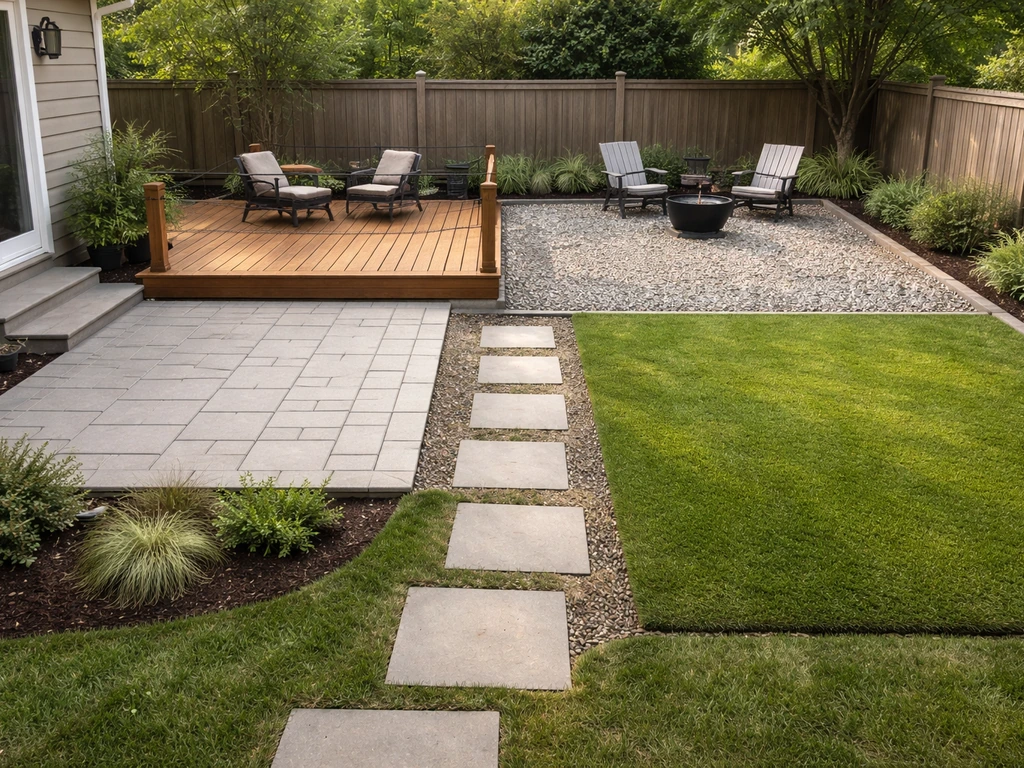
The right pick comes down to four things: your drainage situation, your climate, how much maintenance you're willing to do, and how much you want to spend upfront versus long-term. If you're stuck choosing between a patio and an alfresco setup, start by comparing your drainage and maintenance tolerance for the specific materials you're considering.
Why people look for a patio alternative in the first place
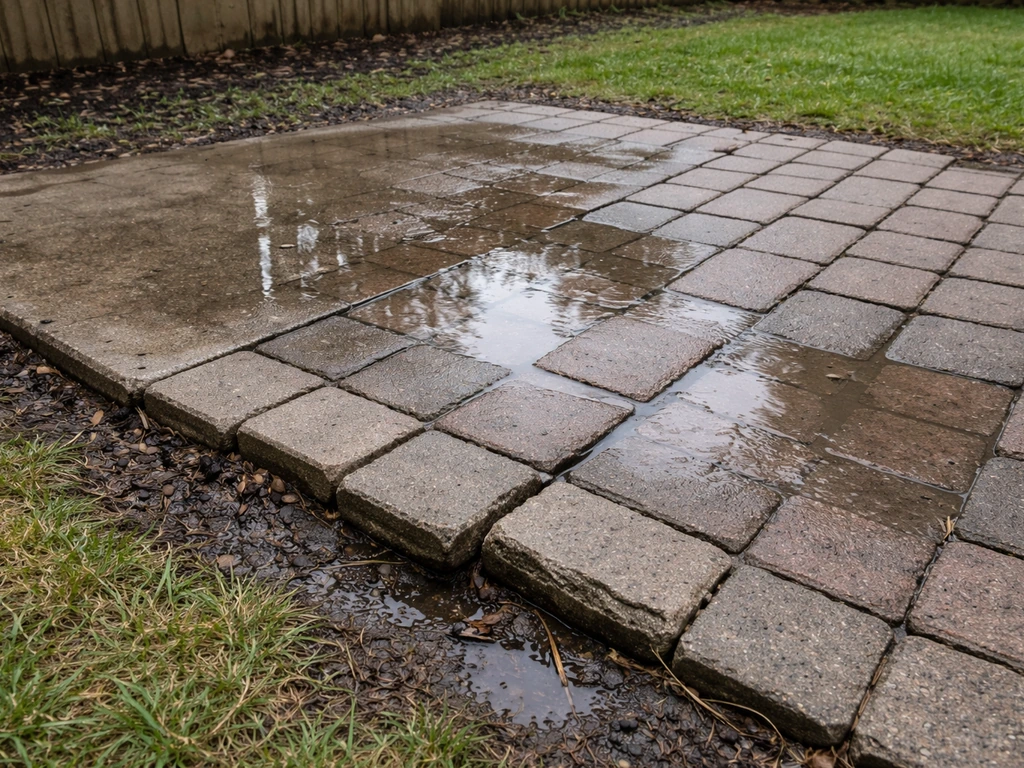
Most people start searching for an alternative after hitting one of a handful of frustrating walls. The most common is a drainage problem: standing water on a concrete or paver patio is a classic sign that the original surface was poorly graded, and over time that leads to erosion, mildew, and cracked or sunken sections. Repair costs for patio problems commonly run from about $730 to $2,500, and if the base has shifted badly, you're looking at full replacement anyway. At that point, switching to something better suited to your yard makes more sense than patching the same problem repeatedly.
Other triggers include a yard that's too sloped for a flat slab (a deck handles grade changes far more easily), a rental or smaller budget situation where $5–$15 per square foot for poured concrete still feels steep, a desire for a softer or more natural look, or a practical need that a rigid concrete pad just doesn't serve well, like a play area for kids or pets. Sometimes it's purely aesthetic: a plain gray slab doesn't match the direction you want the yard to go.
What actually counts as a patio alternative
A patio alternative is any outdoor surface or zone that gives you a defined, functional place to sit, eat, cook, or gather outside. It doesn't have to be rigid, raised, or permanent to count. Here are the options that genuinely work as substitutes:
- Ground-level wood or composite deck: raised on joists, great for uneven or sloped yards, installs over poor soil without major excavation
- Paver court (concrete, natural stone, or porcelain): individual units on a compacted base, easier to repair than a slab, huge variety of looks
- Poured concrete: the traditional option, lowest upfront cost at roughly $5–$15/ft² installed, but limited flexibility
- Gravel or decomposed granite court: loose-fill, extremely cheap and permeable, works well in dry climates or as a casual lounge zone
- Resin-bound paving: permeable, durable (design life around 25 years), smooth finish that looks high-end and drains naturally through the surface
- Porcelain slab layout: 2cm-thick outdoor porcelain on a sand or gravel bed, low maintenance, elegant, and very slip-resistant when rated correctly
- Artificial turf zone: soft underfoot, good for kids and pets, requires a proper compacted base and drainage but no watering or mowing
- Outdoor platform or pergola base: a defined zone under a shade structure, which can use any surface material underneath
- Hardscape walkway expanded into a living space: widened paths with seating nodes function as de-facto patios without the footprint of a full slab
If you're thinking about surface materials specifically (the actual stuff underfoot rather than the overall concept), there's a deeper breakdown worth reading that covers patio alternative materials in detail. And if you're in the UK, the rules around drainage falls and SuDS compliance shift the shortlist somewhat, which is a separate topic worth exploring for patio alternatives in a UK context. If you are looking specifically for patio alternatives in the UK, you will also want to think about how each option fits local drainage and SuDS expectations patio alternatives in a UK context.
How to pick the right alternative for your specific yard
Don't just pick what looks good in photos. The option that works for your neighbor's flat, well-drained garden might be a disaster in your sloped, clay-heavy yard. Work through these four filters before you commit.
Filter 1: Drainage
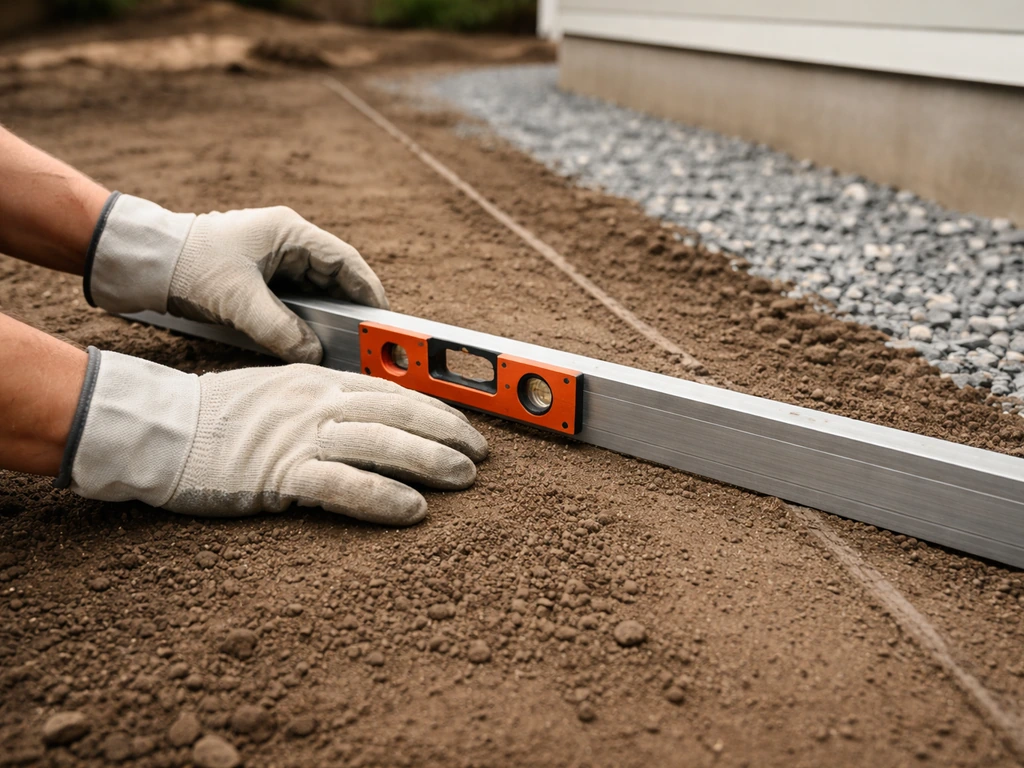
This is the one most people skip and later regret. If your yard holds water or you're near a building foundation, your surface needs to shed water away from the structure. Any solid surface within about 2 meters of your house should sit at least 150mm below the damp proof course and slope away at a minimum 1:80 fall (roughly 1 inch drop per 6.5 feet). A practical target is 1:60. Gravel and resin-bound surfaces drain through their structure, which removes some of this pressure, but you still need to grade the base. Composite decks handle drainage through board gaps (manufacturers like Trex recommend a 3/16-inch side-to-side gap between boards) and the open subframe underneath.
Filter 2: Yard slope and soil
If your ground drops more than 6–8 inches over your planned space, a ground-level deck becomes far easier than trying to cut and fill for a flat slab. Decks sit on posts and joists that handle grade changes without major earthwork. If your soil is soft, silty, or prone to shifting, pavers on a properly compacted base are more repairable than a slab that will crack as the ground moves. Gravel and turf are the most forgiving for imperfect ground.
Filter 3: Climate
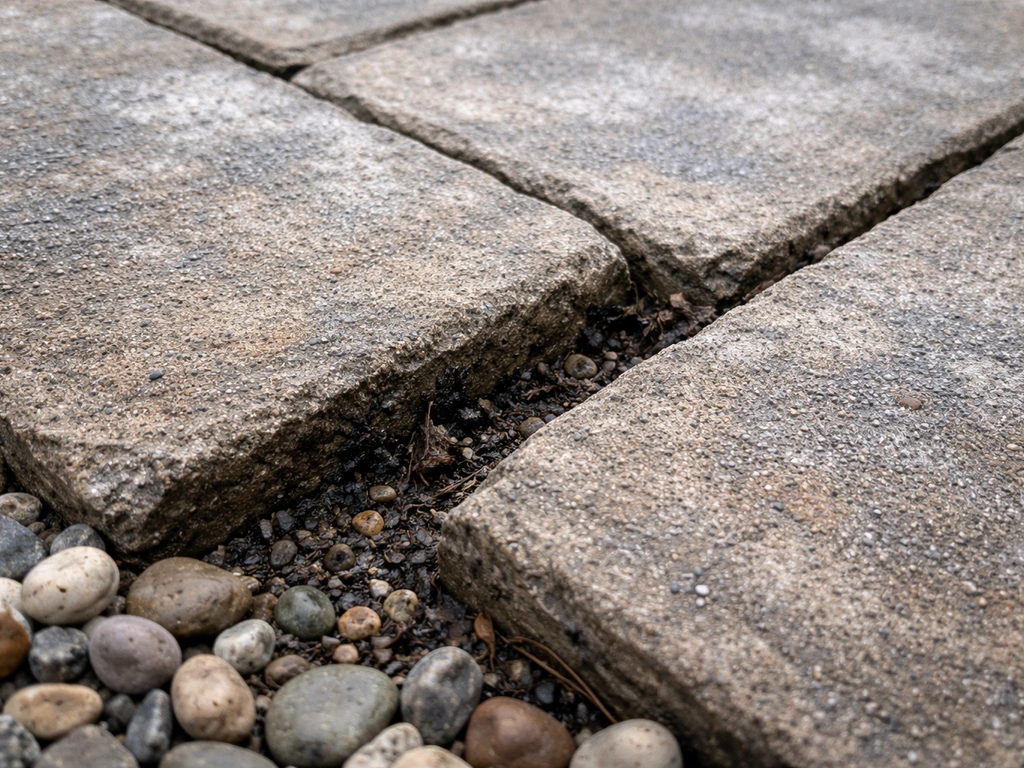
Freeze-thaw cycles are brutal on any surface with water trapped underneath. Moisture collects under poorly drained patio surfaces, and when it freezes it expands, cracking pavers and heaving slabs. In cold climates, a permeable surface (gravel, resin-bound, turf with a proper base) or a well-drained deck often outperforms a solid slab long-term. In hot, dry climates, gravel and decomposed granite are especially practical: cheap, permeable, and they don't absorb and radiate heat the way a dark slab does.
Filter 4: How you'll actually use it
A dining area with a heavy table and chairs needs a stable, level surface: pavers, a deck, or concrete. A lounge zone where you want bare feet and soft surfaces leans toward composite decking, artificial turf, or even a simple gravel court with outdoor rugs. A grill station needs a non-combustible surface nearby and good airflow. Kids and pets do best on turf, rubberized surfaces, or smooth composite decking with good slip resistance. If you entertain a lot, think about how the zone connects to the house and whether you can define it clearly enough to feel like a room.
Design ideas that make alternatives feel like a real patio
One of the biggest mistakes people make with patio alternatives is stopping at the surface and wondering why the space still feels unfinished. What makes a patio feel like a room is edges, layers, and purpose. Here's how to apply that to any alternative surface.
Define the boundary
A gravel court without an edge looks like an accident. Use steel edging, timber sleepers, concrete curbing, or raised stone borders to contain loose-fill surfaces and give the space a clear footprint. For turf or soft surfaces, a low border planting or a single row of pavers around the perimeter anchors the zone visually. The boundary is what tells people (and your own brain) that this is a place, not just an area.
Create zones for different uses
If you have the space, don't put everything in one undifferentiated rectangle. A dining zone, a lounging zone, and a grill station can each sit on slightly different surfaces or at slightly different levels. A raised composite deck for dining next to a gravel lounge court next to a turf patch for kids is a more functional layout than a single flat slab trying to do all three things at once. Even in a smaller yard, a simple change in material (pavers transitioning to decking boards, for example) creates a sense of distinct spaces.
Think about flow from the house
The path from your back door to the outdoor living zone should feel natural, not like an obstacle course. Keep the transition flush or use a small step that's easy to navigate in bare feet with a plate in your hand. If the main surface is a deck, align the decking boards perpendicular to the house to draw the eye outward. For a gravel or paver court, a simple stepping stone path connecting it back to the door makes the whole yard feel deliberate.
Scale the space to your furniture
A 6-person dining set needs at least a 12x14-foot zone with room to pull chairs back. A lounge with a sofa and two chairs needs roughly 10x12 feet. Build your alternative to actually fit the furniture you plan to put there, not just the minimum footprint that looks okay when empty.
Materials, costs, and maintenance side by side
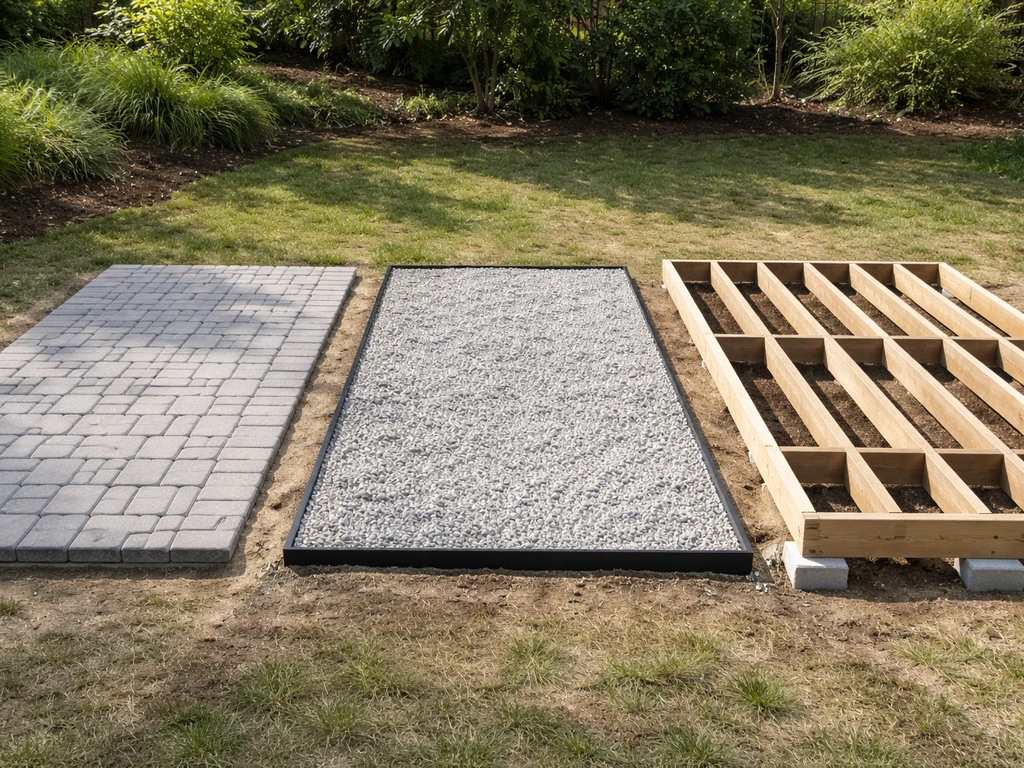
Here's a direct comparison of the main options so you can see the trade-offs at a glance. All cost figures are installed estimates for the US market based on 2026 data.
| Option | Installed Cost (per sq ft) | DIY Difficulty | Maintenance Level | Best For |
|---|---|---|---|---|
| Poured concrete | $5–$15 | Hard (pros recommended) | Low (seal every 2–3 yrs) | Budget slabs, simple rectangular spaces |
| Concrete or natural stone pavers | $10–$17 | Moderate | Medium (weeds, resanding joints) | Flexible design, repairable, any climate |
| Porcelain slabs | $15–$30+ | Moderate–Hard | Very low (sweep, occasional wash) | Sleek looks, low maintenance, frost-resistant |
| Wood deck (ground-level) | $25–$50 | Moderate–Hard | Medium–High (stain, seal annually) | Sloped yards, elevated feel, natural look |
| Composite deck | $40–$80 | Moderate (clips, spacing) | Low (occasional wash) | Low maintenance, longevity, modern look |
| Gravel / decomposed granite | $3–$8 | Easy | Low–Medium (top up, rake) | Budget, dry climates, casual zones |
| Resin-bound paving | $15–$25 | Hard (pros recommended) | Very low (sweep, jet wash) | Permeable drainage, clean finish, longevity |
| Artificial turf | $10–$20 | Moderate | Low (brush, rinse) | Kids, pets, soft underfoot zones |
A quick word on maintenance reality: pavers look low-effort until weeds get into the joints, which typically happens in accumulated detritus rather than the sand itself (weeds rarely push through a proper 200mm-plus base structure). Applying a general-purpose weedkiller two or three times a year handles it easily.
Composite decking is genuinely low maintenance but requires consistent joist spacing per manufacturer specs (often 16 inches on-center for perpendicular runs, closer for diagonal) to avoid sag and bounce over time, and that's a detail that DIYers sometimes cut corners on. Composite decking requires manufacturer-consistent joist spacing, commonly up to 16 in.
on-center for standard applications, with some diagonal layouts needing tighter rules such as 12 in. OC. Porcelain is the lowest-effort surface once it's down: regular sweeping and low-pressure washing (keep it under 1,600 psi) is about all it needs.
If budget is a real constraint right now, gravel or decomposed granite gives you a functional outdoor living space for the least money upfront, and you can always replace it later. There's a separate resource on patio alternatives on a budget that goes deeper into low-cost approaches if that's your priority. There's also a deeper guide on patio alternatives on a budget if you want more low-cost options.
Site prep before you build anything
Skipping or rushing site prep is the number one reason outdoor surfaces fail early. Whatever alternative you choose, the work that happens before the surface goes down determines whether it lasts 5 years or 25.
- Mark out the full footprint and check for underground utilities before digging. Call 811 (US) or your local equivalent before any excavation.
- Remove all vegetation, roots, and organic material from the area. Organic matter compresses and decomposes under load, which causes settling.
- Excavate to the required depth for your chosen system: about 4 inches of compacted base rock for turf, 4–6 inches for pavers (sub-base plus bedding), more for a concrete slab. For a composite deck, you're installing footings rather than excavating the whole area.
- Grade the exposed subsoil away from any buildings at your target fall: aim for 1:60 as a practical target, with 1:80 as the bare minimum. Check this with a long spirit level and tape measure before adding base layers.
- Compact the subgrade using a plate compactor. A hand tamper is fine for small areas but a rental plate compactor does a far better job for anything over about 50 square feet.
- Install a geotextile weed barrier over the compacted subgrade for gravel, turf, and loose-fill surfaces. For pavers, the barrier goes under the sub-base.
- Add and compact your base layer (crushed aggregate, road base, or sharp sand depending on the surface), checking your falls at each layer rather than trying to correct at the end.
- For structures like decks, pour footings at the correct depth for your frost line and let them cure fully before framing begins.
If you're replacing an existing patio that had drainage problems, don't just lay the new surface on top of the old one. The old base is likely compromised. Remove it, check the subgrade, re-grade if needed, and start fresh. Patching drainage issues at the surface level without fixing the grade underneath always fails.
Safety, drainage, and keeping your surface in good shape long-term
Drainage fundamentals
Every solid or semi-solid surface needs a consistent fall to move water off and away. For porcelain pavers, a slope of about 1cm per 80cm (1:80) directed toward a drain or planted area is the practical minimum. For permeable surfaces like gravel and resin-bound, the surface itself handles water, but the base still needs to be graded to prevent pooling at the bottom of the structure. If your yard naturally collects water in the area you're building, address that with a French drain or channel drain before laying any surface.
Slip safety, especially for tile and porcelain
If you're using porcelain slabs or ceramic tile outdoors, slip resistance matters more than aesthetics. Look for a wet Dynamic Coefficient of Friction (DCOF) above 0.42 per ANSI A137.1 as a minimum. For outdoor surfaces that will get rained on or be used barefoot near water, go higher and look for a textured or matt finish rated specifically for exterior wet conditions. A glossy porcelain that looks beautiful in a showroom can be dangerously slippery on a shaded, damp patio. Always wear gloves and appropriate PPE when cutting or handling large-format porcelain slabs; cut edges are extremely sharp.
Long-term care by surface type
Pavers need their jointing sand topped up as it settles, and joints that develop voids after the initial settling period (roughly 3 months under normal conditions) should be investigated for base movement rather than just refilled. Pressure washing pavers too aggressively strips jointing material and shortens the surface's useful life, so use a fan tip rather than a direct jet. Composite decking needs the gaps between boards kept clear of debris so water can drain freely through the subframe. Gravel courts need raking and occasional top-ups as material migrates or compacts. Artificial turf benefits from periodic brushing against the grain to keep fibers upright, plus rinsing to prevent odor buildup if pets use the area.
Your planning checklist before you start
Before you buy a single material or break any ground, work through this short checklist. It'll save you from the most common and most expensive mistakes.
- Check local permits: decks over a certain height (typically 30 inches) and permanent structures usually require a permit. Confirm before you build.
- Measure your actual usable space and decide how many zones you need (dining, lounge, grill, play).
- Assess drainage: does water currently pool here? Where does it need to go?
- Set your realistic budget including base prep, materials, and installation (or tools if DIY).
- Choose your surface based on climate, use, and maintenance tolerance using the table above.
- Mark underground utilities before any digging.
- Plan your fall direction and confirm the slope works for your yard layout.
- Decide honestly whether this is a DIY project or a pro job: concrete and resin-bound almost always warrant professional installation; pavers and gravel are very DIY-friendly; decks fall in the middle depending on complexity.
FAQ
What’s the fastest patio alternative to install if I need usable outdoor space quickly?
Gravel, decomposed granite, and artificial turf zones are usually the quickest to get to “usable,” especially if you already have a relatively flat area and can keep the drainage slope consistent. Composite decking can be fast too, but it depends heavily on subframe layout and deck-board spacing, which must follow the manufacturer spec to prevent bounce.
If my yard floods during storms, can I still use pavers or should I choose a deck or permeable option?
If the area reliably pools, start with options that either drain through the surface (resin-bound, gravel) or allow airflow and controlled runoff (properly built deck with an open subframe). For pavers, you can still succeed, but only if the base is designed for infiltration or directed discharge, and you often need an added drainage line if water collects at the bottom of the base.
How do I prevent weeds and ants on a patio alternative like gravel or pavers?
Weed pressure usually comes from incomplete or shallow base prep and detritus. Use a proper base depth and a weed-suppressing layer where appropriate, then plan for periodic joint sand top-ups for pavers (after settling) and light raking for gravel so loose material does not create “pockets” where seeds lodge.
Do patio alternatives need expansion joints or movement space the way concrete does?
Many do, but not in the same way as poured concrete. Paver fields need appropriate spacing and edge restraint to allow minor movement without shifting. Decking requires attention to thermal movement and keeping clearance around posts, structures, and penetrations. For porcelain, grout lines and substrate flexibility matter, so avoid treating it as a “no movement” surface.
What’s the safest patio alternative choice if there will be barefoot use and kids running around?
Prioritize traction and a forgiving surface. Composite decking with correct slip resistance, turf on a properly constructed base, and smooth, well-finished resin-bound or properly set pavers tend to be safer than polished or glossy finishes. Also consider transitions between zones, make them flush where possible, and ensure there are no raised edges near play paths.
Can I install a patio alternative directly over old concrete or pavers?
Usually not if your goal is to fix drainage problems. If the old surface already traps water or shows base movement, you need to remove the compromised base, re-grade, and build new. Installing on top is fine only when the existing base is sound, stable, and already sloped correctly, otherwise you risk repeating the same failure sooner.
How much slope is “enough” for patio alternatives that claim they drain themselves?
Even permeable surfaces still need base grading. Gravel and resin-bound can handle water through the material, but pooling can still happen at the bottom of the structure if the base isn’t sloped and compacted. A practical minimum for many solid surfaces is about a 1:80 fall, while permeable systems still need enough grade to move water away from structures.
What’s the best patio alternative for a sloped yard without major excavation?
A ground-level deck is typically the easiest when grade changes are more than about 6 to 8 inches across the planned footprint. If you want minimal earthwork and can accept some leveling with base layers, pavers on a well-compacted base and gravel courts are also forgiving, but you still must design the base to remain stable on that slope.
How do I design edges so my patio alternative looks finished and doesn’t spread?
Edges are functional, not decorative. Use steel edging, timber sleepers, raised stone borders, or concrete curbing to contain gravel and define paver footprints. For turf, a low planting border or a single-row paver perimeter helps anchor the look and keeps the zone from visually “melting” into lawn areas.
What mistakes cause porcelain slabs or tile outdoors to fail early?
The biggest issues are incorrect substrate preparation and slip risk. Make sure the outdoor tile is rated for exterior wet use and has adequate wet traction, then ensure proper substrate flatness and slope so water does not sit in grout lines or low spots.
How do I choose between turf and gravel if I have pets?
Turf can work well, but it needs periodic brushing to keep fibers upright and rinsing to reduce odor buildup. Gravel is lower-maintenance in that sense, but it can be uncomfortable for dogs to lie on and may track into the house unless you design containment at transitions. Many people do best by separating “pet play” and “entertaining” zones into different surface types.
How should I maintain pavers without damaging the joints?
Top up jointing sand when needed, but don’t rush refilling at the first sign of gaps. If voids appear after initial settling (commonly around the first few months), investigate base movement rather than just adding sand. When cleaning, use a fan tip and avoid high-pressure direct blasting that strips jointing material.
If I’m trying to control long-term costs, what’s the “most worth it” thing to spend on?
Site prep and correct drainage design usually deliver the highest return across patio alternatives. Cutting corners on base depth, compaction, slope, and edge restraint is the fastest way to create recurring repairs. If you only have one place to upgrade, invest in grading, base layers, and a drainage plan for the specific problem you have.