
Most homeowners spend between $1,500 and $12,000 on a new patio, with the typical installed project landing somewhere around $3,000 to $6,000 for a mid-size slab or paver surface. The wide range exists because material choice, patio size, and whether you hire a contractor or do it yourself each pull that number in very different directions. This guide gives you real line-item budgets for five example projects, a full material cost breakdown by square foot, and the practical details you need to plan a patio at any budget level.
Patio Cost Examples: Real Budgets, Materials, DIY Tips & Costs

Miles Sutton
16 Jul 2026
Who this guide is for and what it covers
If you are in the early planning stage and trying to figure out whether your patio idea is a $2,000 project or a $20,000 project, you are in the right place. This guide is aimed at homeowners who want concrete numbers rather than vague ranges, DIYers scoping their first paver install, and anyone getting ready to call contractors and wanting to know whether the quote they receive is in the right ballpark. I have worked through enough of these projects to know that the biggest budgeting mistakes happen before the first shovel goes in, usually because people anchor on a material cost per square foot without accounting for excavation, base materials, edging, and labor. We cover all of that here.
The article walks through a quick cost snapshot, a material-by-material cost table, a size-based total cost table, a full breakdown of every line item you will actually see on a contractor quote, and then five illustrated example projects with complete budgets. You will also find notes on regional price variation, permit considerations, DIY versus contractor tradeoffs, and a few practical tips for trimming costs without cutting corners.
Quick cost snapshot: what patios cost at a glance
The national installed cost range for patios runs from about $6 per square foot on the low end (gravel, basic decomposed granite) to $50 or more per square foot for premium natural stone with mortar joints. Plain poured concrete typically lands in the $6 to $17 per square foot range. Pavers sit in the $8 to $40 range depending on material and pattern complexity. Flagstone and natural stone routinely push past $20 and can exceed $50 per square foot installed. Those numbers include materials AND labor; if you are doing a DIY install, subtract roughly $5 to $15 per square foot depending on the material.
The table below gives you a fast reference. Use it to quickly filter materials by your budget before diving deeper into the sections that follow. If you are leaning toward a specific size project, the common patio sizes table a few sections down will translate the per-square-foot numbers into total project dollars, which is where the picture really clarifies.
| Material | Installed Cost (per sq ft) | Notes |
|---|---|---|
| Gravel / Decomposed Granite | $6 – $12 | Lowest cost; includes edging, compaction, and weed barrier |
| Plain Poured Concrete | $6 – $17 | Widely available; higher end includes broom finish or simple tinting |
| Stamped / Colored Concrete | $12 – $30 | Pattern and color complexity drive price; labor-intensive |
| Clay Brick Pavers | $10 – $35 | Mid-range; durability and classic look justify the premium over plain concrete |
| Interlocking Concrete Pavers | $8 – $40 | Wide range; simple grid pattern at low end, premium manufacturer at high end |
| Flagstone (dry-set) | $20 – $35 | Random irregular shapes; labor-intensive cutting and fitting |
| Natural Stone / Flagstone (mortared) | $25 – $50+ | Most expensive common option; requires skilled masonry labor |
| Composite Decking (ground-level) | $25 – $60 | Includes substructure; brand, warranty tier, and detailing affect price significantly |
How materials actually compare beyond just the price tag
Cost per square foot only tells part of the story. A material that costs less to install today might cost more to maintain over ten years, or it might crack and need to be relaid in a wet climate. The comparison below lays out the practical tradeoffs across the materials most homeowners actually choose. The lifespan figures assume a properly prepared base, which is the single most important factor in how long any patio surface lasts.
| Material | Durability | Appearance | Install Difficulty | Typical Lifespan | Maintenance Needs |
|---|---|---|---|---|---|
| Gravel / DG | Low-Moderate | Casual, natural | Easy (DIY-friendly) | 5–15 years (replenishment needed) | Annual raking, edging checks, weed control |
| Plain Concrete | High | Clean, utilitarian | Moderate (requires forms, finishing) | 25–40 years | Sealing every 2–3 years; crack repair as needed |
| Stamped Concrete | High | Premium; mimics stone or brick | Hard (professional recommended) | 25–40 years | Resealing every 2–3 years; color can fade |
| Clay Brick Pavers | Very High | Classic, warm tone | Moderate-Hard | 50+ years | Low; individual units replace easily; occasional re-sanding |
| Concrete Pavers | High | Versatile; many styles | Moderate | 30–50 years | Low; resealing optional; re-sanding joints periodically |
| Flagstone (dry-set) | High | Natural, irregular, high-end look | Hard (time-consuming) | 30–50 years | Low-Moderate; joints may need re-sanding or re-grouting |
| Natural Stone (mortared) | Very High | Premium, elegant | Very Hard (masonry skill required) | 50+ years | Low once installed; mortar joints may crack over time |
| Composite Decking | High | Modern; wood look without rot | Moderate-Hard (framing required) | 25–30 years | Low; periodic cleaning; no staining or sealing needed |
My honest recommendation for most homeowners: concrete pavers hit the best overall balance of cost, longevity, DIY-friendliness, and repairability. If a single paver cracks or a tree root heaves a section, you lift out the affected units, fix the base, and relay them. With poured concrete or stamped concrete, a crack is a much bigger repair conversation. That said, if budget is the primary driver, basic poured concrete is hard to beat for a clean, durable surface. If you want a truly unique look and you have the budget, mortared natural stone or flagstone is in a class by itself visually.
Common patio sizes and what they actually cost
Square footage is the most reliable way to budget a patio, so the table below translates the per-square-foot ranges into total installed cost estimates for common patio sizes. The ranges use the installed cost bands from the material table above, applied to three standard sizes plus a custom/large project category. Keep in mind these are professional installation totals. DIY savings typically run 30 to 50 percent off the labor component, which is often 30 to 50 percent of the installed price, so a DIY project can realistically come in 20 to 35 percent cheaper than the professional install figures shown here.
| Patio Size | Square Footage | Gravel / Basic Concrete | Concrete Pavers | Brick / Flagstone | Natural Stone (mortared) |
|---|---|---|---|---|---|
| Small (10 x 10) | 100 sq ft | $600 – $1,700 | $800 – $4,000 | $1,000 – $3,500 | $2,000 – $5,000+ |
| Medium (12 x 16) | 192 sq ft | $1,150 – $3,264 | $1,536 – $7,680 | $1,920 – $6,720 | $3,840 – $9,600+ |
| Large (20 x 20) | 400 sq ft | $2,400 – $6,800 | $3,200 – $16,000 | $4,000 – $14,000 | $8,000 – $20,000+ |
| Custom / Extra Large (20 x 30+) | 600+ sq ft | $3,600+ | $4,800+ | $6,000+ | $12,000+ |
A few things to note about these numbers: they assume a relatively level site with straightforward access. Sloped yards, tight side yards, or sites requiring retaining walls will push costs higher. The 12x16 medium size is one of the most common residential patio footprints and typically seats four to six people comfortably with a table and chairs. The 20x20 large patio starts to accommodate an outdoor kitchen or fire feature alongside seating. If you are planning something in the custom or larger category, break the budget into zones (seating area, cooking area, walkway) and price each separately.
Every line item on a patio quote, explained
One of the most common points of confusion I see is when homeowners get a contractor quote and do not recognize what half the line items are. Here is what each one covers and roughly what it should cost, so you can evaluate a quote intelligently rather than just looking at the total.
Excavation and site preparation
This covers digging out the patio area to the required depth (typically 6 to 10 inches for a paver patio to accommodate base + bedding layer), hauling away the excavated soil, and any grading needed to establish proper drainage slope. Simple hand excavation or small machine work for a 10x10 patio might run $200 to $400. A 20x20 patio with machine access will typically cost $400 to $800 for excavation and haul-away. Full demo and removal of an existing concrete slab adds $2 to $6 per square foot on top of that.
Aggregate base (crushed stone or road base)
The compacted gravel base is the structural foundation of any paver or stone patio. Most paver jobs need 4 to 6 inches of compacted road base. Crushed stone and road base currently run roughly $12 to $38 per ton delivered, and you should plan on about 3 to 10 cubic yards for most residential patios depending on depth and size. Contractor quotes typically show this as a material cost line item. Budget approximately $0.75 to $2.00 per square foot for the base material itself.
Bedding sand
A 1-inch screeded layer of coarse sand sits between the compacted base and the pavers on most dry-set installations. This is a relatively small line item, typically $0.50 to $1.50 per square foot in material cost, but it is critical for levelness and drainage. Do not skip it or substitute play sand, which compacts poorly.
Surface materials
This is the biggest material line item: the actual pavers, stone, brick, concrete pour, or gravel. Refer to the per-square-foot table above for ranges. For a concrete pour, this line item covers the concrete mix, reinforcing mesh or rebar, and any coloring agent. For pavers and stone, it covers the units themselves. On contractor quotes, material markup of 10 to 20 percent above wholesale cost is standard and reasonable.
Edge restraints
Plastic or metal edge restraints hold the perimeter pavers in place and prevent the entire surface from spreading outward over time. Budget $2 to $4 per linear foot. A 10x10 patio has roughly 40 linear feet of perimeter, so $80 to $160. A circular patio or one with curved edges requires more flexible restraints and may run slightly higher. This is not a line item to delete from a quote to save money as paver surfaces without proper edging will migrate and the joints will open up within a few seasons.
Polymeric joint sand
Polymeric sand fills the joints between pavers and hardens when wet, resisting ant intrusion and weed growth. Plan on one 50-lb bag per 50 to 75 square feet of patio surface. Most bags retail for $25 to $40 depending on brand. For a 200-square-foot patio, budget 3 to 4 bags.
Labor
Labor is typically the largest single line item on a professional quote. For standard paver or concrete work, labor runs roughly $5 to $10 per square foot for straightforward projects. Intricate patterns, hand-cut materials like flagstone, or stamped concrete with multiple colors can push labor to $15 to $25 per square foot. Regional wage variation is significant here: BLS data shows median masonry trade wages vary substantially by state, with high-cost markets like the Pacific Northwest, California, and the Northeast carrying meaningfully higher labor rates than the national median of around $56,600 annually for masons. If you are in Portland, Seattle, or the Bay Area, expect labor rates 20 to 40 percent above the national average figures cited in most online calculators.
Finishing, sealing, and cleanup
Most professional quotes include a final compaction pass with a plate compactor, joint sand activation (wetting the polymeric sand), surface cleanup, and haul-away of waste. Sealing is sometimes included and sometimes quoted as an add-on. Concrete sealers typically cost $0.50 to $2.00 per square foot applied, paver sealers similar. This is optional on new installations but recommended within 6 to 12 months of completion on concrete surfaces and every 2 to 3 years thereafter.
Permits
Many jurisdictions do not require permits for at-grade patios under a certain size, but covered patios, patios attached to the house, patios with electrical or gas connections, and projects in regulated areas (flood zones, HOA communities) often do. Permit costs vary widely: $50 to $500 for a simple residential permit is a typical range, but some jurisdictions charge more. Always check with your local building department before starting. A covered patio with a pergola or solid roof almost universally requires a permit and in many areas a structural review. Do not skip this step. Unpermitted covered structures can complicate home sales and insurance claims.
Five example projects with full cost breakdowns
The following five project examples represent realistic scenarios at different budget levels. Each one includes a complete line-item budget so you can see exactly where the money goes. Costs are based on national mid-range rates and will vary by region. If you are in a higher-cost market, increase labor line items by 20 to 40 percent. If you are doing the work yourself, remove the labor line entirely and add a rental cost for a plate compactor ($60 to $120 per day) and any specialty tools.
Project 1: Small concrete paver patio (10 x 10, 100 sq ft)
This is a back-door landing patio, perfect for a bistro table and two chairs. It is also the most common first DIY patio project because the scale is manageable and the material quantities are not overwhelming. The surface is a standard 4x8 inch concrete paver in a running bond pattern, set on a 4-inch compacted road base with a 1-inch bedding sand layer.
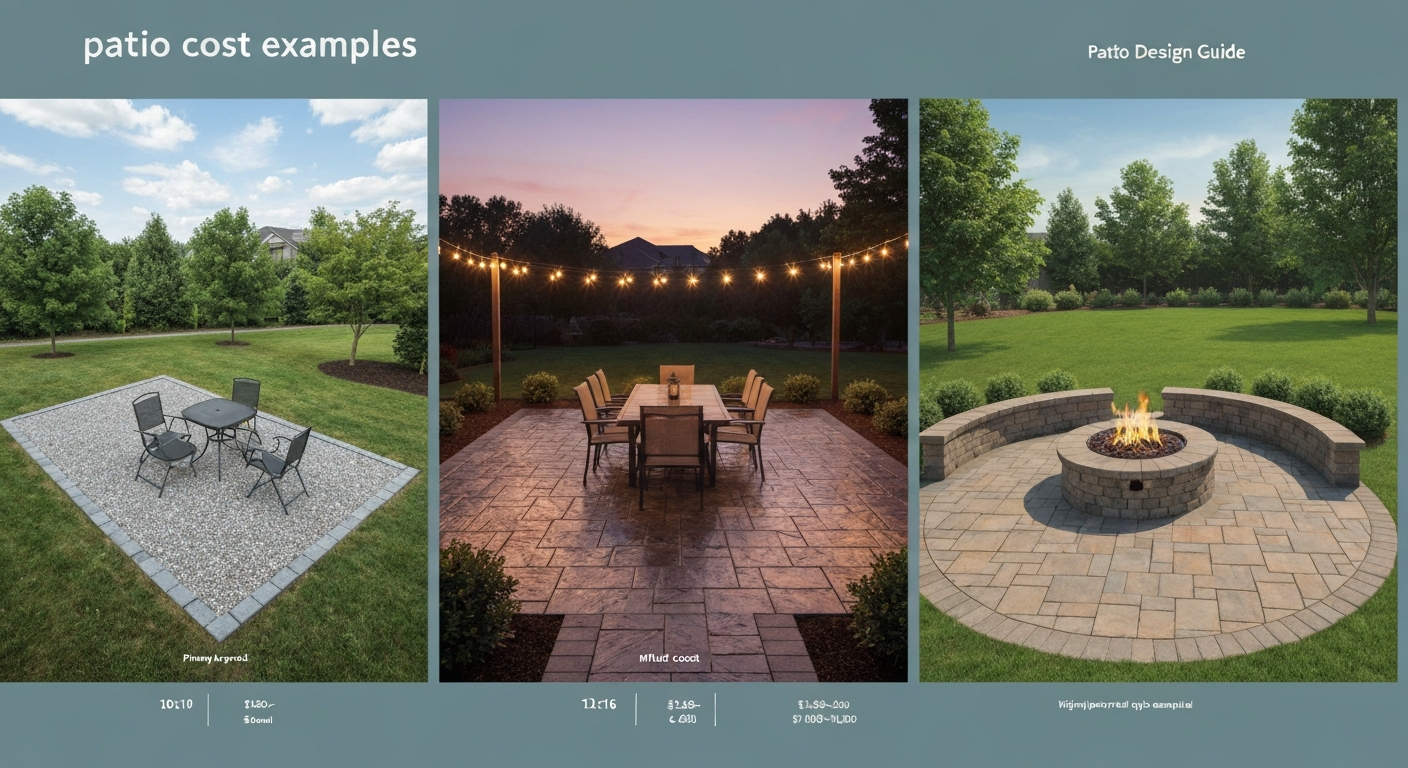
Illustration placeholder: overhead diagram of 10x10 paver patio with running bond pattern and labeled edge restraint perimeter.
| Line Item | Quantity / Notes | Estimated Cost |
|---|---|---|
| Excavation (6 in. depth, hand dig + haul) | 100 sq ft | $200 – $350 |
| Road base / crushed stone (4 in. compacted) | ~2 cu yd delivered | $80 – $120 |
| Bedding sand (1 in. layer) | ~0.3 cu yd | $30 – $50 |
| Concrete pavers (standard 4x8 in.) | ~115 units (5% waste) | $150 – $280 |
| Edge restraints + spikes | ~40 linear ft | $80 – $160 |
| Polymeric joint sand | 2 bags (50 lb each) | $50 – $80 |
| Plate compactor rental (if DIY) | 1 day | $60 – $120 |
| Labor (if professional) | 100 sq ft at $7–$10/sq ft | $700 – $1,000 |
| TOTAL (DIY estimate) | $650 – $1,160 | |
| TOTAL (professional install) | $1,390 – $2,140 |
Project 2: Medium entertaining patio with stamped concrete (12 x 16, 192 sq ft)
This is a full outdoor dining patio sized for a 6-person table with room to walk around it. Stamped concrete was chosen for a clean, upscale look at a lower material cost than natural stone. The pattern is a running ashlar slate stamp with a medium brown integral color and charcoal antique release. This is not a DIY-friendly project: the concrete has to be stamped before it sets, and timing mistakes are visible and permanent.
Illustration placeholder: photo-style rendering of 12x16 stamped concrete patio with outdoor dining furniture and string lights overhead.
| Line Item | Quantity / Notes | Estimated Cost |
|---|---|---|
| Excavation and grading (4–6 in. depth) | 192 sq ft with slope grading | $380 – $600 |
| Sub-base prep and compaction | Included in excavation line above | $0 (included) |
| Concrete pour (4 in. slab with mesh) | ~1.8 cu yd at $150–$180/cu yd delivered | $270 – $324 |
| Integral color (per batch) | Color admixture per yard | $100 – $160 |
| Stamping (texture mats + antique release) | 192 sq ft | $480 – $768 |
| Control joints (cutting) | Perimeter + field cuts | $100 – $150 |
| Concrete sealer (applied) | 192 sq ft at $1–$2/sq ft | $192 – $384 |
| Labor (concrete contractor) | 192 sq ft at $10–$16/sq ft all-in | $1,920 – $3,072 |
| Permit (typical simple patio) | Flat fee (check local rates) | $75 – $150 |
| TOTAL (professional install) | $3,517 – $5,608 |
Project 3: Large patio with built-in fire pit and seating wall (20 x 20, 400 sq ft)
At 400 square feet, this patio is designed as a full outdoor living room. The surface is a tumbled concrete paver in a 3-piece random pattern, and the project includes a built-in circular gas fire pit with a 4-foot diameter surround and a low seating wall along two sides of the patio. Built-ins like these are where patio costs escalate quickly, but they also add the most value and usability. The seating wall is constructed from the same paver material as the surface for a cohesive look.
Illustration placeholder: aerial-perspective rendering of 20x20 paver patio with circular fire pit centered in the space and seating wall along two edges.
| Line Item | Quantity / Notes | Estimated Cost |
|---|---|---|
| Excavation (6–8 in. depth, machine) | 400 sq ft with machine access | $600 – $1,000 |
| Road base (6 in. compacted) | ~8 cu yd delivered | $280 – $420 |
| Bedding sand | ~1.2 cu yd | $90 – $150 |
| Tumbled concrete pavers (3-piece random) | ~460 sq ft with 15% waste | $1,380 – $2,300 |
| Edge restraints + spikes | ~80 linear ft perimeter | $160 – $320 |
| Polymeric joint sand | 6–8 bags | $150 – $320 |
| Seating wall (2 sides, 40 linear ft) | Block + cap + mortar + labor | $2,400 – $4,800 |
| Built-in gas fire pit surround | 4-ft diameter block ring + gas connection stub | $1,800 – $3,200 |
| Gas line rough-in (plumber) | Exterior stub from house | $400 – $800 |
| Labor (paver install) | 400 sq ft at $8–$12/sq ft | $3,200 – $4,800 |
| Permit (fire feature + gas) | Typically required | $100 – $300 |
| TOTAL (professional install) | $10,560 – $18,410 |
Project 4: Circular patio with natural stone (12-foot diameter, approx. 113 sq ft)
Circular patios are a popular feature for fire pit areas and garden focal points. The curved perimeter requires more edge restraint planning, and any paver or stone that does not come in a purpose-made circle kit needs to be cut on a radial pattern, which adds labor time. This example uses a kit-style circular paver design from a major manufacturer, which includes purpose-cut units sized for a 12-foot finished circle. If you prefer random flagstone in a circular arrangement, add another $5 to $8 per square foot for the extra cutting and fitting time.
Circular patios are a strong design choice for standalone fire pit areas or as accent nodes connected to a larger rectangular main patio. They photograph beautifully and tend to feel intentional in garden settings. For more design inspiration at this scale, the small patio examples and circular patio design sections of this site cover the layout and proportioning in detail.
Illustration placeholder: overhead view of 12-foot diameter circular paver patio with fire pit at center, showing radial paver pattern and curved edge restraint.
| Line Item | Quantity / Notes | Estimated Cost |
|---|---|---|
| Excavation (6 in. depth, circular area) | ~113 sq ft | $180 – $300 |
| Road base (4–6 in. compacted) | ~2.5 cu yd | $90 – $150 |
| Bedding sand | ~0.4 cu yd | $35 – $55 |
| Circular paver kit (manufacturer kit, 12 ft dia.) | Includes purpose-cut radial units | $450 – $900 |
| Curved edge restraints (flexible steel) | ~38 linear ft at premium rate | $100 – $175 |
| Polymeric joint sand | 2 bags | $50 – $80 |
| Labor (circle pattern, extra cutting) | 113 sq ft at $10–$16/sq ft | $1,130 – $1,808 |
| TOTAL (professional install) | $2,035 – $3,468 |
Project 5: Covered patio with pergola, lighting, and fans (16 x 20, 320 sq ft)
This is the full outdoor room: a concrete paver surface under a wood pergola with a translucent polycarbonate roof panel, two ceiling fans, recessed LED lighting on a dimmer, and a built-in outdoor speaker rough-in. This type of project almost always requires a permit, and in many jurisdictions the pergola structure triggers a footing inspection. Budget time for that process: plan 2 to 6 weeks for permit approval in most suburban markets. The patio surface is a large-format 16x16 inch concrete paver in a 4-over-1 stacked pattern. The pergola is cedar with stainless hardware.
Illustration placeholder: perspective rendering of covered 16x20 patio with cedar pergola, polycarbonate roof panels, ceiling fan, and string of pendant lights, overlooking a backyard lawn.
| Line Item | Quantity / Notes | Estimated Cost |
|---|---|---|
| Excavation and grading | 320 sq ft with slope grading | $500 – $800 |
| Road base (6 in. compacted) | ~6.5 cu yd | $225 – $350 |
| Bedding sand | ~1 cu yd | $75 – $120 |
| Large-format concrete pavers (16x16 in.) | ~368 sq ft with 15% waste | $1,100 – $2,200 |
| Edge restraints + spikes | ~72 linear ft | $145 – $290 |
| Polymeric joint sand | 5 bags | $125 – $200 |
| Cedar pergola (16x20, pre-engineered kit) | Posts, beams, rafters, hardware | $3,500 – $6,000 |
| Polycarbonate roof panels | 320 sq ft coverage | $800 – $1,600 |
| Concrete footings for posts (6 posts) | Dig, form, pour | $600 – $1,200 |
| Ceiling fans (2, outdoor-rated) | Fixtures + installation | $400 – $900 |
| LED recessed lighting (4 fixtures + dimmer) | Fixtures + wiring + panel connection | $600 – $1,200 |
| Labor: patio install | 320 sq ft at $8–$12/sq ft | $2,560 – $3,840 |
| Labor: pergola and electrical (contractor) | Carpentry + licensed electrician | $2,000 – $4,000 |
| Permit (structural + electrical) | Most jurisdictions require | $200 – $500 |
| TOTAL (professional install) | $12,830 – $23,200 |
DIY vs. hiring a contractor: an honest comparison
The biggest variable in patio cost is labor, and labor is what you save when you do it yourself. For a basic paver patio, DIY is genuinely feasible for most homeowners with a weekend, a few tools, and a willingness to do some heavy lifting. For stamped concrete, natural stone with mortar, or anything involving electrical or gas, you need a professional. Here is how to think about where the line is.
| Project Type | DIY Feasibility | Key DIY Challenge | When to Hire |
|---|---|---|---|
| Gravel / DG patio | High | Edging and drainage slope | If site is sloped or drainage is complex |
| Basic concrete paver patio | High | Base compaction, keeping level | For large areas or tight tolerances |
| Brick paver patio | Moderate | Pattern cutting at edges | Complex patterns, large areas |
| Stamped concrete | Low | Timing and color consistency | Always hire; mistakes are irreversible |
| Flagstone (dry-set) | Moderate | Heavy material handling, fitting | Mortared applications always hire |
| Natural stone (mortared) | Very Low | Mortar mix, joint finishing | Always hire licensed mason |
| Covered patio / pergola | Moderate (structure only) | Post footings, squaring | Electrical and gas always hire |
| Fire pit (gas) | Very Low | Gas line, permit, inspection | Always hire licensed plumber |
If you are going the DIY route on a paver patio, the two investments that will make or break the outcome are renting a plate compactor (do not skip this) and spending extra time getting the base level before you lay a single paver. Everything that goes wrong with DIY paver patios traces back to a base that was not compacted adequately or was not graded correctly for drainage. Plan for a 1 to 2 percent slope away from the house: that is about 1/8 inch per foot.
Hiring a contractor: a checklist before you sign
- Get at least three written quotes that itemize labor and materials separately. Bundled lump-sum quotes make it impossible to compare apples to apples.
- Confirm the contractor is licensed and insured in your state. Ask for proof of general liability and workers compensation coverage.
- Ask specifically about the base depth they plan to install. A 4-inch compacted base is minimum for most regions; in freeze-thaw climates, 6 inches is better practice.
- Ask what edge restraint system they use and where they source polymeric joint sand. Cheap alternatives on these items cause premature failure.
- Check reviews specifically for patio work, not general landscaping. Laying pavers is a specialty skill.
- Confirm the quote includes haul-away of excavated material and construction waste.
- Ask about the warranty: most reputable contractors offer 1 to 2 years on labor for hardscape.
- Clarify who pulls the permit (contractor or homeowner) and who pays the permit fee.
- Get a timeline in writing. Most simple patio projects should take 1 to 3 days of active work once materials are on site.
- Do not pay more than 30 to 40 percent upfront. A final payment should be withheld until punch-list items are resolved.
Permits and site prep: what to check before breaking ground
- Call 811 (in the US) before any excavation to have underground utilities marked. This is free and legally required.
- Check your local municipality's permit requirements. Ground-level patios under 200 square feet are often exempt, but rules vary widely.
- Review your HOA rules if applicable. Some associations require approval of hardscape materials, colors, and coverage percentages.
- Check setback requirements: most jurisdictions require patios to be set back a minimum distance from property lines (typically 5 to 10 feet, but check locally).
- Identify your drainage direction. Water must always flow away from the house foundation. Mark the low point of your site before designing the patio grade.
- Confirm your site access for equipment. A skid steer or compact excavator needs at least 36 to 48 inches of gate width. Limited access = more hand labor = higher cost.
- For covered patios, confirm footing requirements. Most codes require frost-depth footings for pergola posts, which can add $300 to $800 to the project.
- If adding electrical or gas, coordinate permits with licensed trades before the patio surface is installed, not after.
Regional price variation and a Portland example
The national averages in this guide are useful benchmarks, but local market conditions move the numbers meaningfully. Labor is the biggest regional variable. In higher-cost markets like the Portland, Oregon metro area, Seattle, San Francisco, and New York, labor rates for hardscape contractors commonly run 25 to 45 percent above the national averages shown here. Material prices also vary based on regional material availability: natural stone quarried locally will cost less than stone shipped across the country.
For Portland specifically, a standard paver patio that might cost $8 to $10 per square foot in labor nationally will often cost $11 to $15 per square foot in labor in the Portland market, reflecting both higher wage rates and strong demand from the region's active outdoor living culture. Portland's wet winters also mean contractors often recommend a deeper base layer (6 inches rather than 4), which adds to material cost. A medium 12x16 paver patio in Portland that might cost $3,800 to $5,500 nationally could easily run $5,000 to $7,500 with Portland-area labor rates factored in. For a more detailed breakdown of what patio projects actually cost in the Pacific Northwest, the Portland patio guide in this section of the site goes deeper on local material sourcing, regional contractors, and seasonal timing considerations.
Cost-saving tips that actually work
- Do your own excavation if access allows and you have a weekend. Renting a mini excavator ($350 to $500 per day) and doing the dig yourself can save $300 to $800 on a medium patio.
- Choose a simple square or rectangular patio layout. Curved edges and circular designs add 15 to 30 percent to labor costs because of additional cutting and edge restraint work.
- Buy pavers at the end of the season (October in northern climates). Hardscape supply yards often discount remaining stock before winter.
- Select a standard paver color and size from a local supplier's stocking inventory. Special-order or imported materials add both cost and lead time.
- Use a basic grid or running bond pattern. Herringbone and complex patterns require more cuts and more labor time.
- Bundle projects: if you are adding a walkway or a garden border at the same time, the mobilization cost (excavator day, material delivery) is shared across a larger area.
- For gravel or DG patios, the entire project is genuinely DIY-accessible with minimal tool rental. If your design allows for a casual gravel surface, the savings are significant.
- Get multiple bids in winter or early spring, when contractor schedules are lighter. Spring and summer demand often pushes prices up and extends timelines.
Long-term costs: maintenance and what to budget annually
Purchase price is only part of the cost equation. Concrete patios should be sealed every 2 to 3 years at roughly $0.50 to $2.00 per square foot applied. Paver patios need polymeric sand refreshed in joints every 5 to 10 years and may benefit from a sealer application every 2 to 4 years. Natural stone requires the least maintenance once installed but may need mortar joint repair every 10 to 20 years as the substrate shifts seasonally. Gravel patios need annual raking, spot replenishment of gravel (roughly $50 to $150 per year depending on area), and periodic edging adjustment.
In freeze-thaw climates, any paver or stone surface that was installed with an undersized base may begin to heave and settle within 5 to 10 years. The repair cost for resetting heaved sections varies: a small area of 20 to 30 square feet can typically be releveled by a contractor for $300 to $600. Investing in a proper 6-inch compacted base at installation avoids most of this.
ROI and resale value: is a patio worth it?
A well-designed patio typically returns 50 to 70 percent of its installed cost in added home resale value, according to widely cited remodeling industry surveys. That is not a 100 percent return, but it is competitive with many interior renovation projects and comes with years of enjoyment as a bonus. The highest ROI tends to come from patios that are appropriately sized for the home, use materials consistent with the neighborhood, and are well-maintained. An oversized premium natural stone patio on a modest home in a neighborhood where most homes have basic concrete patios will likely return less than a properly scaled paver patio would.
From a practical standpoint, a patio that increases the functional square footage of a home during warm months, provides a defined outdoor entertaining space, and photographs well for listing purposes is a net positive for resale. Covered patios and patios with built-in features tend to appeal strongly to buyers who prioritize outdoor living, a demographic that has grown significantly in recent years. If you are building primarily for resale, keep the design clean and the material choice conventional. If you are building for yourself, build what you actually want: that is what makes the investment worthwhile regardless of the percentage return.
How to use these numbers to build your own budget
Start with your target size and your material choice. Pull the per-square-foot installed range from the cost table and multiply by your square footage to get a baseline. Then add a 10 to 15 percent contingency for unknowns (buried debris, extra base material needed, drainage issues). If you are getting contractor quotes, use the line-item breakdown section to verify that the major cost categories are present in the quote. Any quote that is missing excavation, edge restraints, or a base material line item is either missing those components (a red flag) or bundling everything into a single labor number with no transparency.
For a deeper look at design options that fit specific budgets, the patio design examples section of this site walks through finished projects at various price points with layout sketches and material notes. And if you want to go deeper on the full pricing picture across all patio types and sizes, the patio price guide is the companion reference to this article.
FAQ
What is a concise title and meta description I can use for this patio costs guide?
Title: Patio Cost Examples & Sample Budgets — Materials, Sizes, Circular & Covered Patios Meta description: Realistic patio cost examples and line‑item budgets for gravel, concrete, pavers, brick, and natural stone. Includes 5+ sample projects, regional pricing (Portland example), DIY vs contractor comparisons, permit checklist, timeline estimates, cost‑saving tips and contractor‑hiring checklists.
What are realistic national installed cost ranges per square foot by patio surface?
Typical national installed ranges: gravel/DG: ~$6–$12/sq ft; plain poured concrete: ~$6–$17/sq ft (avg ~$11/sq ft); stamped/colored concrete: ~$12–$30/sq ft; concrete pavers/interlocking: ~$8–$40/sq ft (common $12–$25); clay brick pavers: ~$10–$35/sq ft; natural stone/flagstone: ~$20–$50+/sq ft; wood deck/ground decking: ~$15–$60+/sq ft depending on material (pressure‑treated vs composite). Actual price varies by region, complexity, and base requirements.
How do labor and materials typically split in a patio quote?
A common contractor split: 30–50% of installed cost for visible finish and skilled labor, 30–50% for aggregate base and buried materials, with the remainder for pavers/stone and consumables (sand, polymeric sand, edge restraints). Labor often ranges $5–$15+/sq ft depending on complexity; intricate flagstone or hand‑cut patterns push labor toward $15–$25+/sq ft.
Can you show example line‑item budgets for five sample projects (small, medium, large, circular, covered)?
1) Small gravel patio — 100 sq ft: demolition $200; geotextile $50; crushed rock base (2