
Most homeowners spend between $2,000 and $12,000 on a new patio, with the typical mid-size project (200–400 sq ft) landing around $3,500–$7,000 installed. At the low end, a basic gravel or simple concrete slab can come in under $1,500. At the high end, natural stone or stamped concrete with drainage and lighting can push past $20,000. Where your project lands depends almost entirely on four things: size, material, labor rates in your area, and what's hiding under your yard.
Patio Price Guide: Costs, Materials & Budget Examples

Miles Sutton
16 Jul 2026
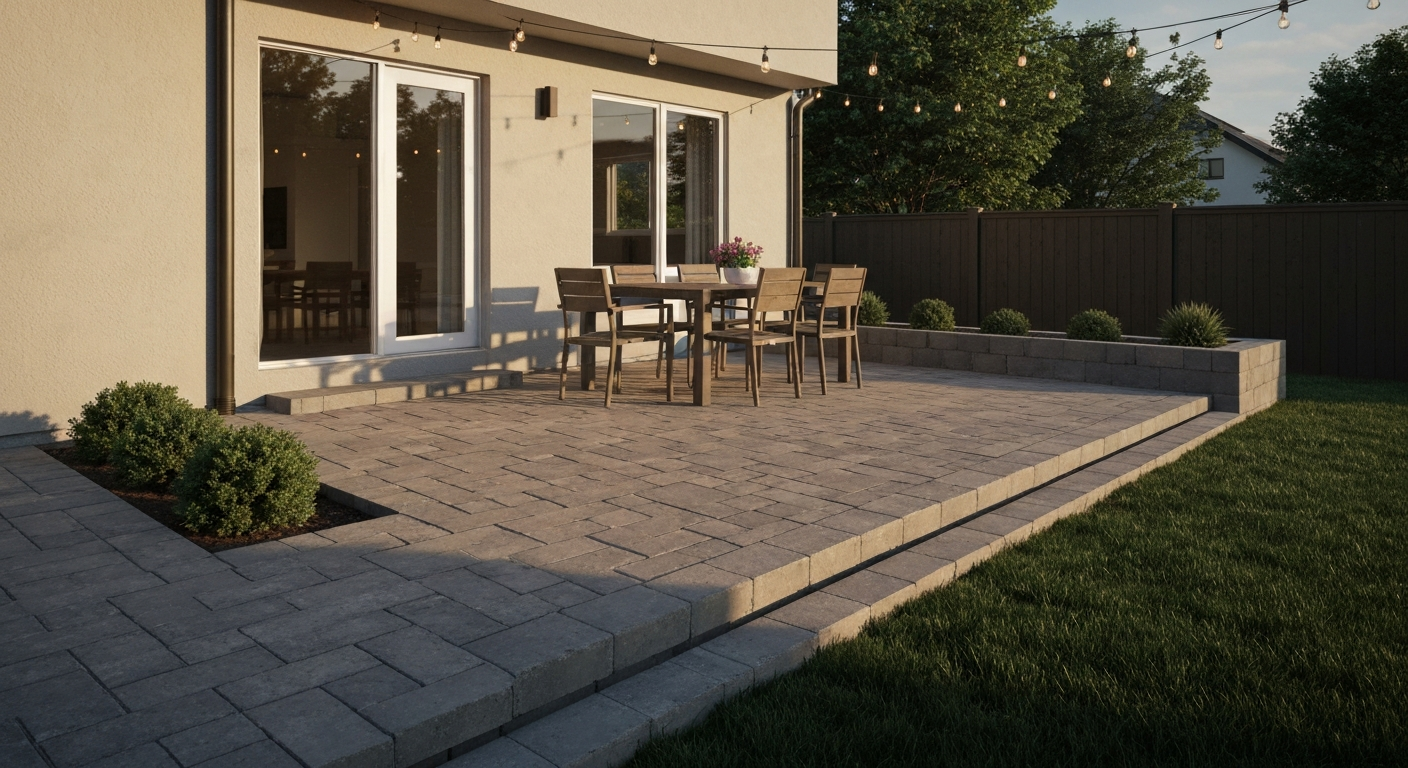
What this patio price guide covers
This guide is built for homeowners who want real numbers, not vague ballpark figures. Whether you're planning a simple 120 sq ft concrete pad off the back door, a circular paver centerpiece, or a full outdoor living room, you'll find per-square-foot cost ranges by material, itemized line-item budgets, a materials comparison chart, and sample project budgets you can adapt to your own layout. I've also included a DIY vs. professional breakdown, a permitting overview with Portland-specific details, lifecycle cost comparisons, and a contractor hiring checklist so you know what to ask before signing anything.
Quick cost summary: patio price ranges at a glance
The table below shows typical installed cost ranges nationally for 2026. These include materials and standard labor but assume reasonably flat ground with no major drainage work or demolition. Add 10–20% if your site has significant slope, poor drainage, or existing hardscape to remove.
| Material | Cost per sq ft (installed) | Typical 200 sq ft project | Typical 400 sq ft project |
|---|---|---|---|
| Gravel / crushed stone | $1–$4 | $200–$800 | $400–$1,600 |
| Basic poured concrete | $3–$8 | $600–$1,600 | $1,200–$3,200 |
| Stamped / decorative concrete | $10–$25 | $2,000–$5,000 | $4,000–$10,000 |
| Concrete pavers | $8–$18 | $1,600–$3,600 | $3,200–$7,200 |
| Brick pavers | $10–$20 | $2,000–$4,000 | $4,000–$8,000 |
| Flagstone | $15–$30 | $3,000–$6,000 | $6,000–$12,000 |
| Porcelain / ceramic tile | $15–$35 | $3,000–$7,000 | $6,000–$14,000 |
| Natural stone (premium) | $20–$50+ | $4,000–$10,000+ | $8,000–$20,000+ |
| Wood decking (composite) | $15–$35 | $3,000–$7,000 | $6,000–$14,000 |
HomeAdvisor's 2026 data shows an average paver patio total of roughly $3,800 for a project around 280 sq ft, which aligns well with the concrete paver range above. That's a useful gut-check number when you're first scoping a mid-size project.
What actually drives patio cost
There's no single cost lever. Most budgets get derailed because homeowners plan for the material cost but not the full installed cost. Here are the real drivers you need to understand before you commit to a design.
Size and shape
Square footage is the biggest multiplier in any estimate. But shape matters too: a rectangular patio is cheaper to build than a circular or freeform one because cuts and waste are minimized. Circular patios require more cutting, especially with standard rectangular pavers, which adds both labor time and material waste (typically 10–15% extra). If you're considering a circular design, it's worth reviewing specific layout examples to understand how the geometry affects both material quantity and installation time. For layout ideas and real-world cost comparisons, see circular patios: five great examples.
Material choice
Material is the second-biggest variable. Basic concrete at $3–$8 per sq ft installed is a fraction of premium flagstone at $20–$50 per sq ft. But material cost doesn't tell the whole story. Some cheaper materials (like gravel) require more ongoing maintenance. Some expensive materials (like quality porcelain tile) last decades with almost no upkeep. Factor in lifecycle cost, not just day-one cost.
Labor and crew rates
Labor typically accounts for 40–60% of a professional patio installation. BLS May 2024 occupational data puts the median annual wage for masonry workers (brickmasons, stonemasons) at $56,600 nationally, which translates to roughly $28–$35 per hour before burden. BLS OEWS (May 2024) lists median and percentile hourly rates for cement masons and concrete finishers blank" rel="noopener noreferrer">BLS OEWS (May 2024) lists median and percentile hourly rates for cement masons and concrete finishers.. Fully burdened contractor labor rates (including overhead, insurance, and profit) commonly run $50–$90 per hour, depending on your region. In higher cost-of-living cities like Portland or Seattle, effective labor rates are often 15–25% above the national median.
Site conditions and prep
What's under your yard is often what blows up a budget. Rocky soil, tree roots, poor drainage, significant slope, or an existing concrete slab that needs demolition all add cost before a single paver gets laid. RSMeans 2024/2025 data shows subgrade preparation at about $1.51 per square yard as a baseline unit cost, but that figure assumes standard earth with no complications. Hauling demolition debris can add $9.85 per ton or more depending on disposal fees and distance.
Drainage and base
A compacted crushed-stone base is non-negotiable for long-term paver performance. RSMeans lists crushed stone base at around $31 per ton as a material benchmark. On top of that, if your yard has drainage issues, expect to budget for perforated pipe ($0.50–$10 per linear foot for materials, depending on product grade) or a French drain system. Installed French drains run $25–$75 per linear foot nationally. Catch basins add $55–$520 each depending on size and product. Skipping drainage to save money is the number-one cause of patio failures I see.
Permits and inspections
Not every patio requires a permit, but many do, especially if you're altering drainage, building near property lines, or adding structures. Permit fees vary widely by municipality. Portland's master fee schedule references residential concrete flatwork (patio, sidewalk, driveway) at $0.50 per sq ft as a fee basis, with additional development service surcharges applied depending on valuation. Always check with your local building department before assuming a permit isn't needed, the fine for unpermitted work is nearly always more expensive than the permit itself.
Price ranges by patio type and material
The numbers below separate material-only costs from installed (material plus labor) costs. This matters a lot if you're considering DIY for part or all of the work.
| Material | Material only (per sq ft) | Labor only (per sq ft) | Installed total (per sq ft) |
|---|---|---|---|
| Gravel / crushed stone | $0.50–$2 | $0.50–$2 | $1–$4 |
| Basic poured concrete | $1–$3 | $2–$5 | $3–$8 |
| Stamped concrete | $3–$8 | $7–$17 | $10–$25 |
| Concrete pavers | $2–$6 | $6–$12 | $8–$18 |
| Brick pavers | $3–$8 | $7–$12 | $10–$20 |
| Flagstone (irregular) | $5–$15 | $10–$15 | $15–$30 |
| Porcelain tile | $4–$12 | $11–$23 | $15–$35 |
| Natural stone (premium) | $8–$25+ | $12–$25+ | $20–$50+ |
| Composite decking (wood-look) | $5–$15 | $10–$20 | $15–$35 |
One thing worth noting: stamped concrete is often the most cost-effective way to get a high-end look. At $10–$25 per sq ft installed, it undercuts natural stone significantly while mimicking slate, flagstone, or brick convincingly. The tradeoff is repairability, a cracked stamped slab is much harder to patch invisibly than a cracked individual paver.
Line-item cost breakdown: what you're actually paying for
When you get a professional quote, it should be itemized. Here's what a typical 300 sq ft concrete paver patio quote should include, with approximate cost ranges for each line item.
| Line item | Unit | Estimated range | Notes |
|---|---|---|---|
| Site layout and marking | Lump sum | $100–$300 | Included in many contractor quotes |
| Excavation (6"–8" depth) | Per sq ft | $1–$3/sq ft | Deeper if drainage grade needed |
| Subgrade preparation / compaction | Per sq yd | $1.50–$4/sq yd | RSMeans baseline ~$1.51/sq yd |
| Crushed stone base (4" depth) | Per ton | $31–$60/ton installed | ~0.5 tons per 10 sq ft at 4" |
| Landscape fabric / geotextile | Per sq ft | $0.10–$0.30/sq ft | Optional but recommended |
| Bedding sand (1") | Per sq ft | $0.30–$0.80/sq ft | Fine-grade concrete sand |
| Paver materials (concrete) | Per sq ft | $2–$6/sq ft | Retail/pallet pricing |
| Paver installation / labor | Per sq ft | $6–$12/sq ft | Includes cutting and fitting |
| Polymeric sand (joints) | Per 50-lb bag | $20–$80/bag | 1 bag covers ~50–75 sq ft |
| Edge restraints / edging | Per linear ft | $1.50–$5/lf | Plastic, aluminum, or steel |
| Drainage pipe (perforated 4") | Per linear ft | $5–$10/lf installed | If drainage is needed |
| Catch basin (if needed) | Each | $55–$520 each | Size and product dependent |
| Debris hauling / disposal | Per ton | $9.85–$30/ton | RSMeans $9.85/ton as baseline |
| Permit fee (Portland example) | Per sq ft | ~$0.50/sq ft + surcharges | Verify current BDS fee schedule |
| Contractor overhead and profit | % of project | 15–25% of subtotal | Standard range |
For a 300 sq ft project using concrete pavers, a realistic professional total using these line items works out to roughly $4,500–$7,500, depending on drainage complexity and local labor rates. That aligns with HomeAdvisor's reported national average of about $3,800 for a 280 sq ft paver patio, the difference reflects regional variation and whether drainage work is included.
Materials comparison: pavers, concrete, flagstone, and more
Choosing a material isn't just about price. Durability, appearance, DIY-friendliness, and long-term maintenance all play into the real cost of ownership. Here's how the main options stack up.
| Material | Installed cost (sq ft) | DIY difficulty | Durability | Maintenance level | Best for |
|---|---|---|---|---|---|
| Poured concrete (basic) | $3–$8 | Moderate | Good (15–30 yrs) | Low (seal every 2–3 yrs) | Budget-focused, simple shapes |
| Stamped concrete | $10–$25 | Hard (pro recommended) | Good (15–25 yrs) | Medium (resealing, crack repair) | High-end look, mid-range budget |
| Concrete pavers | $8–$18 | Moderate–Hard | Very good (25–50 yrs) | Low–Medium | Versatile, repairable, DIY-able |
| Brick pavers | $10–$20 | Moderate–Hard | Very good (50+ yrs) | Low | Classic look, durable |
| Flagstone (irregular) | $15–$30 | Hard | Excellent (50+ yrs) | Low–Medium (weed control) | Natural, organic aesthetic |
| Gravel / crushed stone | $1–$4 | Easy | Fair (needs topping up) | Medium (raking, replenishing) | Budget, informal, permeable |
| Porcelain / ceramic tile | $15–$35 | Hard (substrate critical) | Excellent (if installed right) | Very low | Modern/contemporary look |
| Natural stone (premium) | $20–$50+ | Hard | Excellent (50+ yrs) | Low | Premium, high-value projects |
| Composite / wood decking | $15–$35 | Moderate | Good (25–30 yrs) | Low (composite) | Raised areas, organic warmth |
My personal take: for most homeowners weighing cost against longevity, concrete pavers hit the sweet spot. They're repairable (you can pull and replace individual units), they look great, and they hold up well in freeze-thaw climates. Stamped concrete is close behind for pure bang per dollar on aesthetics, but factor in that a crack in a stamped slab is harder to hide than a single replaced paver.
Representative cost examples: small, circular, and mid-size patios
Small patio cost examples (under 150 sq ft)
Small patios are often underestimated in cost because many of the fixed expenses (mobilization, equipment, base materials, edging perimeter) don't shrink proportionally with size. See our patio cost examples for real project breakdowns and sample budgets you can adapt to your own site. A 100 sq ft concrete paver patio can cost $1,200–$2,500 installed, which works out to $12–$25 per sq ft, higher per-unit than a 400 sq ft version of the same design. Small patios are well-suited for DIY precisely because the material quantities are manageable and the labor savings are proportionally significant. A 100 sq ft paver patio with basic concrete pavers at $4/sq ft material runs about $400 in pavers alone, the rest of the budget is base materials, sand, edging, and your time. blank" rel="noopener noreferrer">Concrete Stone & Tile (CST) Paver Product & Technical Guide (pallet/sqft tables) provides manufacturer 'pieces per pallet' and 'sq ft per pallet' figures for common modular pavers so you can verify exact pieces‑per‑sq‑ft for accurate takeoffs.
| Project type | Size | Material | DIY total (materials) | Pro installed total |
|---|---|---|---|---|
| Small back-door pad | 100 sq ft | Concrete pavers | $600–$900 | $1,200–$2,500 |
| Small garden patio | 120 sq ft | Flagstone | $900–$1,500 | $2,200–$4,000 |
| Compact gravel patio | 150 sq ft | Gravel / crushed stone | $200–$450 | $600–$1,200 |
| Small concrete slab | 120 sq ft | Poured concrete | $300–$500 | $700–$1,500 |
Circular patio cost examples
Circular patios are among the most visually striking designs but carry a real cost premium. A 12-foot diameter circle covers about 113 sq ft, but the cutting waste on standard rectangular pavers typically adds 10–15% to material quantity. Labor is also higher: circular layouts require more careful planning, more cuts, and more time to execute correctly. Budget roughly 15–25% more per square foot for a circular layout compared to a rectangular one using the same material. A 12-foot diameter paver circle professionally installed typically runs $1,800–$3,500 depending on material and complexity.
| Diameter | Approx. area | Material | Estimated installed cost |
|---|---|---|---|
| 10 ft | ~79 sq ft | Concrete pavers | $1,200–$2,200 |
| 12 ft | ~113 sq ft | Concrete pavers | $1,800–$3,500 |
| 14 ft | ~154 sq ft | Brick pavers | $2,500–$5,000 |
| 16 ft | ~201 sq ft | Flagstone | $4,000–$7,500 |
| 20 ft | ~314 sq ft | Natural stone | $8,000–$16,000+ |
Typical mid-size project examples (200–400 sq ft)
The 200–400 sq ft range is where most homeowners land, and where the economy of scale starts to kick in. Per-square-foot costs drop compared to small patios, and the variety of material options opens up. Here are four realistic project examples with fully loaded estimated costs.
| Project | Size | Material | Site prep notes | Estimated total (installed) |
|---|---|---|---|---|
| Basic entertainer patio | 240 sq ft | Poured concrete | Flat lot, no drainage work | $1,800–$3,500 |
| Weekend BBQ paver patio | 280 sq ft | Concrete pavers | Minor grading, standard base | $3,500–$6,000 |
| Flagstone garden retreat | 320 sq ft | Irregular flagstone | Moderate slope, French drain added | $7,500–$13,000 |
| Stamped concrete outdoor room | 400 sq ft | Stamped concrete | Flat site, standard drainage | $5,500–$11,000 |
Sample budgets by patio type and material
The itemized budgets below are designed to be used as starting templates. Adjust quantities and unit prices to reflect your local market and actual site conditions. These assume professional installation with standard site prep on a reasonably flat lot.
Sample budget A: 240 sq ft basic concrete paver patio
| Line item | Quantity | Unit cost | Subtotal |
|---|---|---|---|
| Excavation (7" depth) | 240 sq ft | $1.80/sq ft | $432 |
| Subgrade compaction | 27 sq yd | $3.00/sq yd | $81 |
| Crushed stone base (4") | 3.7 tons | $45/ton installed | $167 |
| Landscape fabric | 240 sq ft | $0.20/sq ft | $48 |
| Bedding sand (1") | 240 sq ft | $0.50/sq ft | $120 |
| Concrete pavers (material) | 264 sq ft (+10% waste) | $4.00/sq ft | $1,056 |
| Paver installation labor | 240 sq ft | $9.00/sq ft | $2,160 |
| Polymeric sand (4 bags) | 4 bags | $35/bag | $140 |
| Edge restraints (64 lf) | 64 linear ft | $2.50/lf | $160 |
| Debris hauling | 1.5 tons | $20/ton | $30 |
| Contractor overhead / profit (20%) | — | 20% of $4,394 | $879 |
| TOTAL | — | — | ~$5,273 |
Sample budget B: 300 sq ft stamped concrete patio
| Line item | Quantity | Unit cost | Subtotal |
|---|---|---|---|
| Excavation (5" depth) | 300 sq ft | $1.50/sq ft | $450 |
| Subgrade compaction | 33 sq yd | $3.00/sq yd | $100 |
| Concrete pour (4" slab) | 3.7 cu yd | $260/cu yd | $962 |
| Stamping / color / release agent | 300 sq ft | $8.00/sq ft | $2,400 |
| Finishing and sealing labor | 300 sq ft | $3.00/sq ft | $900 |
| Edge forms (lump sum) | — | $200 | $200 |
| Debris hauling | 1 ton | $20/ton | $20 |
| Contractor overhead / profit (20%) | — | 20% of $5,032 | $1,006 |
| TOTAL | — | — | ~$6,038 |
Sample budget C: 200 sq ft flagstone patio with French drain
| Line item | Quantity | Unit cost | Subtotal |
|---|---|---|---|
| Excavation (8" depth) | 200 sq ft | $2.50/sq ft | $500 |
| French drain (20 lf) | 20 linear ft | $50/lf installed | $1,000 |
| Crushed stone base (4") | 2.5 tons | $50/ton installed | $125 |
| Bedding sand / stone dust | 200 sq ft | $0.70/sq ft | $140 |
| Flagstone material (irregular) | 220 sq ft (+10%) | $10.00/sq ft | $2,200 |
| Flagstone installation labor | 200 sq ft | $13.00/sq ft | $2,600 |
| Joint sand / polymeric fill | 3 bags | $40/bag | $120 |
| Edge restraints (60 lf) | 60 linear ft | $3.00/lf | $180 |
| Debris hauling | 2 tons | $20/ton | $40 |
| Contractor overhead / profit (20%) | — | 20% of $6,905 | $1,381 |
| TOTAL | — | — | ~$8,286 |
DIY vs. professional installation: where to draw the line
DIY patio installation can save 40–60% of the total project cost on labor alone. But it only makes financial sense if you have the time, tools, and physical capacity to do the job right. A poorly compacted base leads to heaving, settling, and drainage failure, and fixing it after the fact often costs more than hiring a pro would have from the start.
Gravel, basic concrete paver, and simple flagstone patios are the most DIY-accessible. Stamped concrete, porcelain tile, and any project requiring significant grading or drainage work are best left to professionals. Concrete finishing in particular has a very narrow window between pour and final finish, it's not forgiving of inexperience.
| Project type | DIY feasibility | Labor savings potential | Biggest DIY risk |
|---|---|---|---|
| Gravel patio | High | $300–$800 | Poor drainage if not graded correctly |
| Basic concrete pavers | Moderate | $1,500–$4,000 | Uneven base causing settling |
| Concrete slab (basic) | Moderate–Low | $800–$2,500 | Poor finishing, cracking |
| Stamped concrete | Low (pro recommended) | $2,500–$6,000+ | Timing and pattern errors |
| Flagstone (dry-lay) | Moderate | $1,500–$4,000 | Unstable stones, tripping hazards |
| Porcelain tile | Low (pro recommended) | $2,000–$5,000+ | Substrate failure, cracked tiles |
| Brick pavers | Moderate | $1,500–$3,500 | Joint creep without proper edging |
Estimating your project in five steps
You don't need to be a contractor to build a solid cost estimate. Work through these steps before you contact a single quote and you'll ask better questions, spot low-ball bids, and avoid nasty surprises.
- Measure your space accurately. Sketch the shape and get total square footage. Add 10% for rectangular layouts and 15% for circular or irregular shapes to account for cuts and waste.
- Identify your site conditions. Is the ground flat or sloped? Do you have existing hardscape to demo? Does water pool after rain? Each yes adds to your budget.
- Pick your material tier. Use the materials comparison table above to narrow your choices to two or three realistic options based on your budget ceiling and desired look.
- Build a line-item estimate. Use the sample budgets above as templates. Price crushed stone, sand, pavers, edging, and polymeric sand at your local supplier. Get labor quotes for any work you're not doing yourself.
- Add a contingency. Add 10–15% to your subtotal for unknowns. Patios almost always reveal a surprise — a buried root ball, a drainage issue, or a short load of material. Budget for it upfront.
Permitting: what you need to know before you dig
Permit requirements for patios vary significantly by jurisdiction. In general, a ground-level patio that doesn't alter drainage or sit in a setback or easement may not require a permit in many cities. But anything that changes drainage flow, sits within 5–10 feet of a property line, exceeds a certain square footage, or has any attached structure almost always does. The safest move is a five-minute call to your local building department before you start.
Portland, Oregon: permitting specifics
Portland homeowners working with the Bureau of Development Services (BDS) should be aware that residential concrete flatwork, including patios, driveways, and sidewalks, is subject to permit fees calculated on a per-square-foot basis. Portland's current master fee schedule references a $0.50 per sq ft fee basis for this category, plus applicable development service surcharges based on project valuation. For a 300 sq ft patio, the baseline fee would start around $150, but total permit costs with surcharges can be higher. Always verify the current fee schedule directly with Portland BDS before budgeting, as fee tables are updated periodically. Portland also has stormwater management requirements that can affect how you handle patio runoff, particularly for impervious surfaces, permeable paver designs may be eligible for fee credits or rebates under Portland's Clean River Rewards program.
Lifecycle and maintenance costs
The cheapest patio to install isn't always the cheapest patio to own. Here's a practical look at what ongoing maintenance costs look like across major material types over a 10-year period, assuming a 300 sq ft patio.
| Material | Typical install cost (300 sq ft) | 10-year maintenance estimate | 10-year total ownership cost |
|---|---|---|---|
| Gravel | $600–$1,200 | $300–$600 (replenishment, raking) | $900–$1,800 |
| Basic concrete | $1,200–$2,800 | $200–$500 (crack fill, sealing) | $1,400–$3,300 |
| Stamped concrete | $3,500–$8,500 | $400–$1,200 (resealing, crack repair) | $3,900–$9,700 |
| Concrete pavers | $2,800–$6,000 | $300–$700 (re-sanding, occasional reset) | $3,100–$6,700 |
| Flagstone | $5,500–$10,000 | $400–$900 (weed control, re-seating) | $5,900–$10,900 |
| Porcelain tile | $5,000–$11,500 | $200–$500 (grout repair, cleaning) | $5,200–$12,000 |
| Composite decking | $5,000–$11,500 | $300–$600 (cleaning, board replacement) | $5,300–$12,100 |
Gravel and basic concrete look cheap upfront but the gap narrows over time. Concrete pavers hold their value well because individual repairs are straightforward and inexpensive. Stamped concrete requires professional resealing every 2–3 years to maintain appearance and protect the color layer, don't skip this or you'll face premature wear and color fade.
Regional cost adjustments
National averages are a useful starting point, but local labor and material costs can shift your total by 20–40% in either direction. High cost-of-living metro areas like the San Francisco Bay Area, New York City, Seattle, and Portland consistently run 15–30% above national median installed costs. Lower cost-of-living regions in the South and Midwest frequently run 10–20% below. RSMeans publishes City Cost Indexes (CCI) that allow you to multiply national unit costs by a local adjustment factor, this is the most reliable way to calibrate a national estimate for your zip code.
For Portland specifically: labor rates in the Portland metro area are above the national median for both masonry and concrete work, reflecting Oregon's prevailing wage laws and the region's strong construction market. Material costs are also slightly elevated due to transportation logistics in the Pacific Northwest. A project estimated at $5,000 nationally might run $5,750–$6,500 in the Portland metro. If you're researching Portland patio design and cost specifics in more depth, a dedicated Portland patio guide will give you more granular local contractor and supplier context.
Decision checkpoints before you commit
Before you hire anyone or buy a single pallet of pavers, work through these questions. They'll help you lock in the right design, size, material, and budget combination for your specific situation.
- What is the patio's primary function? (Dining, lounging, fire pit, play area, or a combination.) Function determines the minimum useful size.
- What's my firm budget ceiling, and what's my preferred number? Work backward from your ceiling to the material tier that fits.
- How flat is my site? Is there visible drainage pooling after rain? Budget for site prep and drainage before you budget for the surface.
- Do I want a DIY project, a professional install, or a hybrid? (DIY prep, pro finish, for example.)
- What's the shape I want? Rectangle and square are cheapest. Circular and freeform cost more in both material and labor.
- What aesthetic am I going for? Match your material choice to your home's exterior and landscape style — not just your budget.
- How long do I plan to stay in this home? Higher-end materials add more to resale appeal and justify a larger upfront investment if you're staying 10+ years.
- Do I need a permit? Make one call to your local building department before you start.
How to hire a patio contractor: the checklist
Getting three quotes is the minimum, but knowing what to ask and what to look for separates a good hire from a costly mistake. Use this checklist when you're vetting contractors.
- Verify licensing and insurance. Ask for proof of contractor's license (required in Oregon and most states) and general liability insurance of at least $1 million. Don't skip this.
- Ask for an itemized written quote. If a contractor won't break out materials, labor, base prep, and drainage separately, move on. Vague quotes lead to scope disputes.
- Check references for similar projects. Ask specifically for references on patios of similar size and material to yours. A driveway contractor isn't necessarily the right choice for flagstone.
- Confirm the base and drainage spec. Ask exactly what depth of base they're installing, what compaction equipment they use, and how they handle drainage. The answer tells you a lot.
- Clarify what's included in the quote. Does it include debris hauling? Permit fees? Polymeric sand finishing? Get it in writing.
- Ask about warranty. Reputable contractors offer at least a one-year workmanship warranty. Some offer two to three years on base and installation.
- Confirm the payment schedule. Never pay more than 10–30% upfront. Final payment should be tied to your walkthrough approval.
- Check online reviews and BBB standing. Look for consistent feedback on communication, timeliness, and how they handle problems — not just overall star ratings.
Matching your budget to design inspiration
One of the most useful things you can do before finalizing a budget is to look at real completed projects in your price range. Browsing patio design examples gives you a clearer sense of what $5,000 vs. $12,000 actually looks like on the ground, and often reveals simpler design moves (a clean rectangular concrete paver layout with a planted border, for instance) that deliver high visual impact at lower cost. Small patios in particular are worth studying: some of the most elegant outdoor spaces I've seen are under 150 sq ft and well under $4,000. See small patio examples for ideas that fit modest budgets and spaces. What makes them work is intentional material choice and precise execution, not size or budget.
If you're drawn to circular shapes, it's worth understanding both the cost implications and the design principles before you commit to that layout. Circular patios can work beautifully in garden settings and as focal-point gathering areas, but they're not the right call for every space or every budget. The additional cutting and labor cost is real and worth pricing out specifically with any contractor you're considering.
Final thoughts on getting your patio cost right
The homeowners who end up happiest with their patio projects are the ones who spent time on the estimate before they spent money on the install. They understood which line items were fixed (excavation, base preparation) and which were variable (material tier, size). They got itemized quotes, asked specific questions about drainage, and built in a contingency. Most of them also looked at real cost examples, not just national averages, to calibrate their expectations before the first contractor showed up.
Use this guide as your working document. Revisit the sample budgets as your project scope solidifies. If something in a contractor's quote doesn't match the line items here, ask why, the answer will either reassure you or save you from a bad hire. A well-built patio lasts 25–50 years. Getting the planning right is worth every hour you put into it.
FAQ
What primary authoritative data sources should I use to build a complete patio price guide?
Use a mix of national construction-cost references and local government resources: RSMeans (Gordian) for unit costs and productivity; BLS/OEWS for regional labor wages; industry aggregator data (HomeAdvisor, Concrete Network, Angi) for consumer-installed ranges and examples; manufacturer technical guides (pavers, concrete bag yields, polymeric sand) for material yields and coverage; municipal permit fee schedules (city building department) for permitting costs; and local supplier/contractor quotes to ground-truth retail and installed prices.
Which cost drivers must the guide explain in detail?
Explain: patio size/shape and geometry (sq ft and edge linear ft); material type (concrete, stamped, pavers, natural stone, porcelain); base and subbase depth/quality (gravel/compaction); drainage and grading work (French drains, catch basins); site prep (demo, tree roots, rock removal, hauling/dump fees); edging/retaining elements; finishes and coatings (sealers, staining, stamping); labor productivity and crew composition; permits/inspections; and regional labor/material price adjustments and mobilization.
What line‑item cost categories should appear in every sample budget?
Include: 1) Materials (paver units, concrete, base aggregate, sand, polymeric sand, edging, sealer), 2) Labor (installation, finishing, crew hours), 3) Site prep & demo (excavation, tree/root/rock removal), 4) Base/subgrade work (compaction, geotextile), 5) Drainage (perforated pipe, catch basins, French drain tie‑ins), 6) Edging & retaining (steel/stone/blocks), 7) Finishes (stain, sealers, jointing), 8) Disposal/hauling and permits, 9) Contingency (5–15%).
What national per‑unit price guidance should I report (2024–2026 aggregated ranges)?
Report ranges with source attribution and note regional variation: basic poured concrete installed $3–$12/ft²; decorative/stamped concrete $10–$30/ft²; concrete pavers/brick typical installed $4–$25/ft²; premium natural stone/porcelain often $15–$50+/ft² installed. Material‑only paver ranges: basic $2–$6/ft²; premium $5–$12+/ft². Drainage: French drain installed $25–$75/linear ft; perforated pipe/linear pricing varies widely ($0.50–$10/ft material; installed $5–$10+/ft reported). Cite Concrete Network, HomeAdvisor, RSMeans, Angi.
How should I present representative sample budgets and tables?
Provide compact sample tables for common project sizes and types, e.g.: - Small rectangular 120 ft² patio: material‑only & installed low/mid/high scenarios; - Typical mid‑size 300 ft² paver patio: breakouts for materials, base, labor, drainage; - Circular 200 ft² decorative concrete: add cost premium for formwork/finish. Each table should show unit quantities, unit costs, line totals, permit and contingency, and a final installed total with source notes.
What concrete technical metrics and yields must be included for accurate takeoffs?
Include concrete bag yields (80‑lb ≈0.60 cu ft; 45×80‑lb bags/yd³ approx), typical slab thickness options (3–4" residential patio; thicker if vehicular loads), cubic yards required = area×thickness/27, waste factor (5–10%), and RSMeans or local supplier price per cubic yard. Also include finishing productivity (crew hours per 100 ft²) references or RSMeans labor-hour rates.